If you’ve been evaluating contract management software, you’ve probably heard of Juro. It’s London-founded, built by a former Magic Circle lawyer and positioned as an AI-native platform for managing contracts end-to-end. Reviewers like its clean interface, fast onboarding, templates, collaboration features and support.
The question is whether it fits the way your business actually works with and manages contracts. Reviews still point to friction around complex negotiations, redline-over-redline workflows, Word formatting, reporting depth, AI extraction accuracy and integrations that depend heavily on the use case.
This article compares nine Juro alternatives for UK teams, focusing on CRM and workflow integration, post-sign visibility, AI maturity, reporting flexibility and cross-functional adoption across legal, sales, finance, HR and operations.
Why look for a Juro alternative
Juro reviews across G2 and Capterra are largely positive, especially around ease of use, onboarding, support, templates and collaboration. But the same reviews show where buyers should validate fit before committing.
- Complex negotiations: Juro supports in-platform redlining and collaboration, but reviewers mention limits around redline-over-redline workflows, Word formatting, table customisation and version control.
- Reporting and intelligence: Juro helps centralise contracts and track key data, but some reviewers miss deeper analytics, stronger reporting, better search and more reliable AI extraction.
- Pricing fit: Juro doesn’t publish standard pricing, so buyers need a custom quote. That’s common in CLM, but it makes side-by-side comparison harder.
- Integration depth: Juro integrates with tools like Salesforce, HubSpot, Slack and Google Drive. Some users praise the CRM connectivity, while others yearn for deeper connectors, better mapping and less technical setup for specific workflows.
The tools below were selected on four criteria: cross-functional usability, CRM and workflow integration depth, post-sign visibility, and AI maturity. The evaluation is grounded in published user reviews from G2, Capterra, and Gartner Peer Insights, plus current vendor documentation where relevant. Pricing claims are included only when supported by public or review-based evidence.
The best alternatives to Juro for UK teams in 2026
These tools vary in depth, complexity, and who they’re for. Some are purpose-built for legal professionals managing complex workflows. Others are designed for the entire business, with contract data flowing across sales, finance and HR without manual intervention. The list is optimised for teams that need contracts to do the actual work, before signing and well after.
| Tool | Main differentiator | CRM integration depth | Post-sign visibility | AI capabilities | Complexity | Capterra rating |
| Juro | AI-native CLM with strong ease of use and broad business-team positioning | Strong for core tools including Salesforce, HubSpot, Slack and Google Drive | Good, with repository, tracking and AI extraction | AI review, AI extraction, AI repository search and Operator | Low–Medium | 4.8 |
| Oneflow | Live digital contracts with two-way CRM sync and cross-functional workflows | Native two-way sync with Salesforce, HubSpot, Microsoft Dynamics and Pipedrive | Strong | AI review, AI extraction, summaries, drafting and insights | Medium | 4.6 |
| Ironclad | Enterprise CLM with no-code workflow automation and Jurist AI | Strong, especially Salesforce and Slack | Good | AI drafting, redlining, review, legal research and analytics | High | 4.4 |
| PandaDoc | Sales document automation with proposals, CPQ and Deal Rooms | Strong for sales tools including Salesforce, HubSpot and Pipedrive | Limited–Moderate | AI document creation and workflow automation | Low | 4.5 |
| Docusign CLM | Enterprise agreement management within the Docusign IAM suite | Strong across Salesforce, SAP Ariba, Coupa and partner integrations | Moderate | Iris AI extraction, analysis, summarisation and assisted review | High | 4.5 |
| Contractbook | Accessible contract management with templates, automation and AI extraction | Good, with HubSpot, Pipedrive, Salesforce, Zapier, Make and API access depending on plan | Moderate | AI import, AI data extraction and AI Contract Assistant | Low–Medium | 4.7 |
| LinkSquares | Contract intelligence, repository analytics and legal workflow management | Good, especially Salesforce | Strong | LinkAI extraction, summaries, AI-assisted review and reporting | Medium | 4.3 |
| Summize | Embedded CLM inside Outlook, Teams, Slack, Salesforce, HubSpot and Word | Good across Salesforce, HubSpot, Microsoft 365, Slack and Google Workspace | Good | SIA, Ask SIA and Review Pro for AI review, redlining and contract questions | Low–Medium | 4.6 |
| Leah | Agentic AI platform across legal, contracts, procurement and finance | Strong across Salesforce, Microsoft Dynamics, HubSpot, SAP, Oracle, Workday and Coupa | Strong | Agentic OS, playbook redlining, cognitive search and AI contract helpdesk | Very High | 4.5 |
| Gatekeeper | Combined CLM, vendor lifecycle management, third-party risk and spend tracking | Good across ERP, CRM, finance and business systems | Strong | LuminIQ agents for extraction, clause analysis, risk screening and obligations | Medium–High | 4.7 |
Oneflow
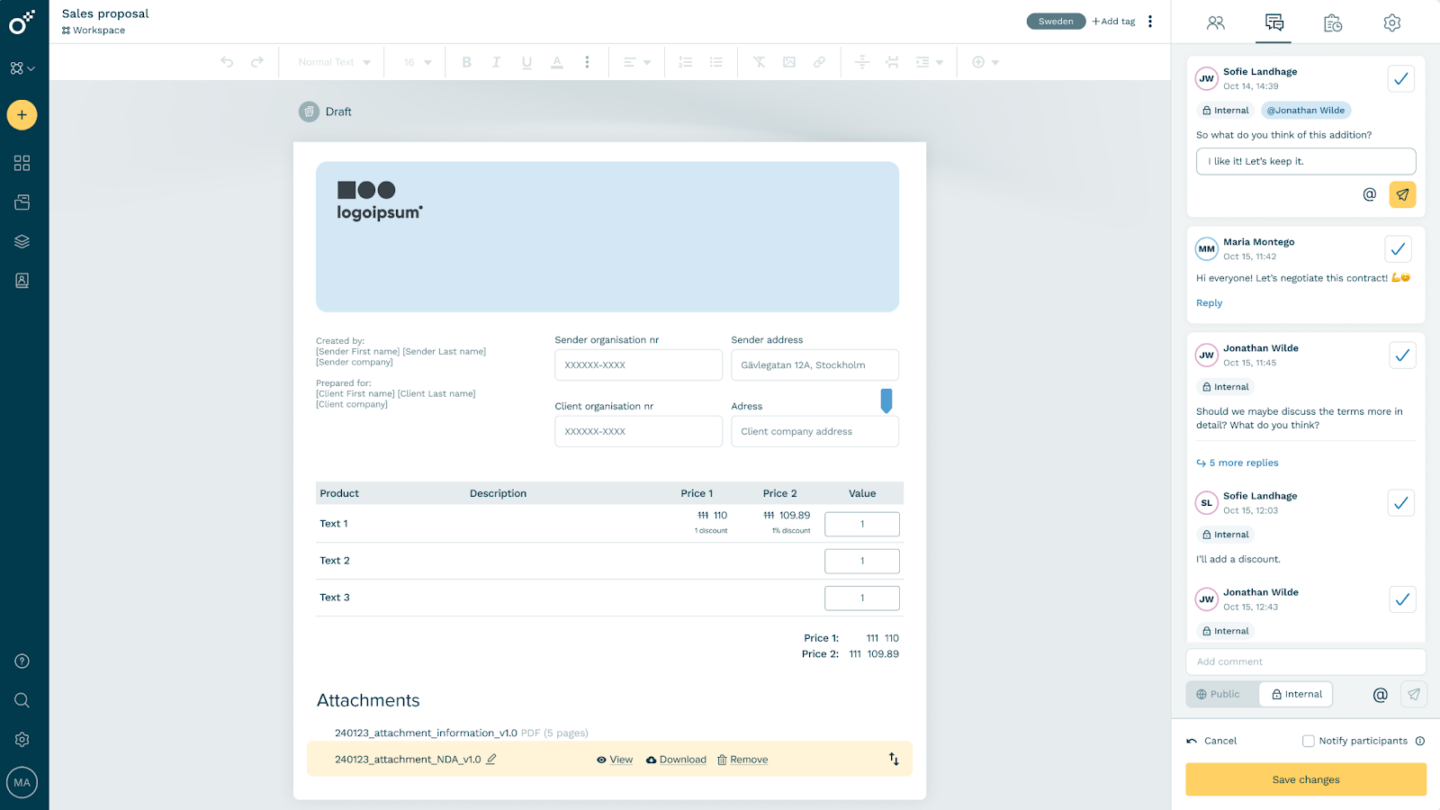
Oneflow treats digital contracts as live business data, not static documents that move through legal and disappear into a repository. It’s for companies where contracts need to stay connected to the teams and systems that depend on them: Sales, Finance, Procurement, HR, Legal and Ops. For a deeper overview of how these work, see this guide to what digital contracts are and how they work.
Its strongest use case is cross-functional contract management across three workflows: quote-to-cash for Sales, Finance and RevOps; source-to-pay for Procurement, Legal and Finance; and hire-to-retire for HR, Legal and Ops. That makes it especially relevant for scaling businesses that want one connected platform rather than separate tools for sales contracts, supplier agreements, employee paperwork and post-signature tracking.
For revenue teams, the CRM-native experience is the key differentiator. Oneflow supports two-way sync with Salesforce, HubSpot, Microsoft Dynamics and Pipedrive, so reps can generate and negotiate contracts from the systems they already use. Its live digital contracts also help teams avoid static PDF bottlenecks: reviewers praise the ability to edit documents after sending, collaborate in real time, customise pricing tables and avoid version confusion.
Post-signature, Oneflow keeps contracts useful through lifecycle management, reminders, audit trails, document links, contract insights and portfolio visibility. Its European footprint is another trust signal for UK buyers: Oneflow highlights GDPR and eIDAS compliance, ISO certifications, data retention controls, and secure access management for sensitive contract data, all aligning with best practice guidance on modern contract management in the UK.
User sentiment: Oneflow reviews are mostly positive, with users highlighting its intuitive interface, easy adoption, real-time collaboration, contract tracking, templates and CRM integrations. Reviewers often contrast the platform with static PDFs and email-based workflows, saying Oneflow makes contracts easier to create, update, send, track and manage across teams. G2 lists Oneflow at 4.4, while Capterra lists it at 4.6 stars.
Some drawbacks include advanced configuration, edge-case usability, bulk actions, comments and occasional support or integration limitations.
Pricing: Free 14-day trial. The Business plan starts at £45 per user per month, billed annually, for teams starting with 5 users, which means from £225/month or £2,700/year. Enterprise pricing is custom.
Key features
- Live, editable digital contracts with real-time collaboration
- Two-way CRM integrations with Salesforce, HubSpot, Microsoft Dynamics, and Pipedrive
- Contract workflows across quote-to-cash, source-to-pay and hire-to-retire
- Templates, approval workflows, signing order, inline comments and audit trails
- Lifecycle management, renewal reminders, document links and contract calendar
- AI contract management capabilities, including Write with AI, AI Extract, AI Summary, AI Review and AI Insights, depending on plan
- Portfolio-level contract visibility through dashboards, advanced filters and contract insights
- API access, webhooks and standard integrations for connecting contracts to wider business systems
- Legally compliant electronic signatures across the UK and EU
Best for: Mid-market and larger UK businesses that need contracts to work across Sales, Finance, Procurement, HR, Legal and Ops, especially teams that want CRM-connected contract workflows, live digital contracts, post-sign visibility and fewer manual handoffs between departments.
Book a demo and see what connected contract management looks like in practice.
Ironclad
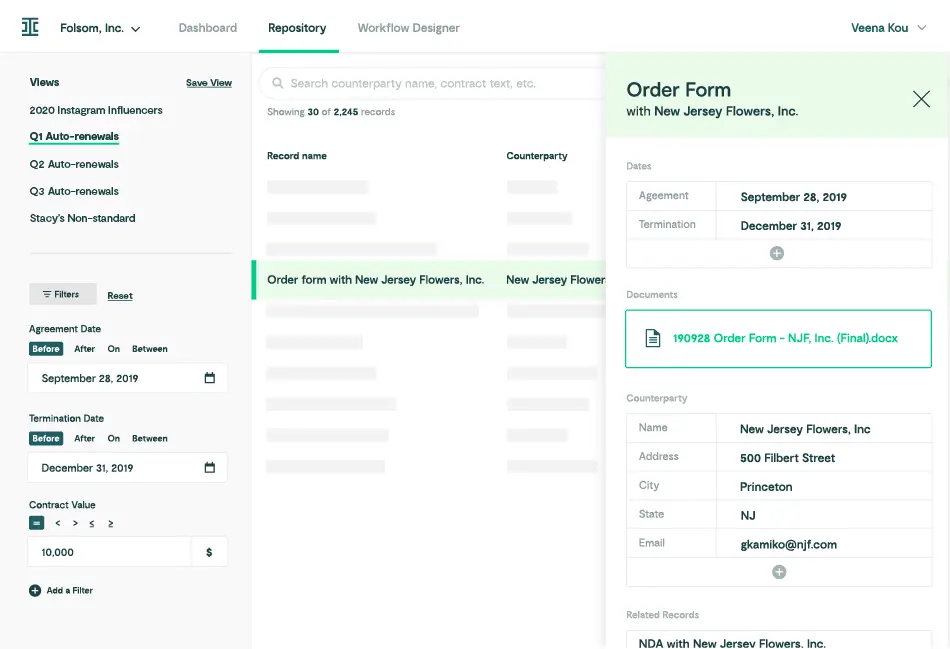
Ironclad is an enterprise CLM and a strong Juro alternative for large legal teams with complex approval chains and enough legal ops resources to configure a sophisticated platform properly.
It’s more enterprise-heavy than Juro, with a stronger emphasis on workflow automation, approvals and portfolio control.
Its no-code Workflow Designer allows legal teams to build conditional workflows, route contracts through layered approvals, and keep stakeholders updated without developer help. Jurist AI supports drafting, review, redlining and legal research, while the repository provides teams with search, reporting and visibility across large contract volumes.
User sentiment: Strong marks for workflow automation, approval tracking, Salesforce and Slack integrations, AI capabilities and customer support. Recurring complaints focus on search, learning curve, technical integration setup, workflow edits and occasional Word/PDF friction.
Pricing: Custom. No public GBP pricing. Vendr’s benchmark data puts Ironclad mid-market deployments for 100–500 users at around $50,000–$120,000/year, with implementation fees often estimated at $10,000–$40,000+. Exact UK pricing requires a quote.
Key features
- Jurist AI for drafting, review, redlining and legal research
- No-code Workflow Designer
- Salesforce, Slack, Coupa, Ramp and enterprise integrations
- Contract repository with metadata, search and reporting
- Approval tracking, negotiation history and audit trails
- Renewal dashboards and obligation visibility
PandaDoc
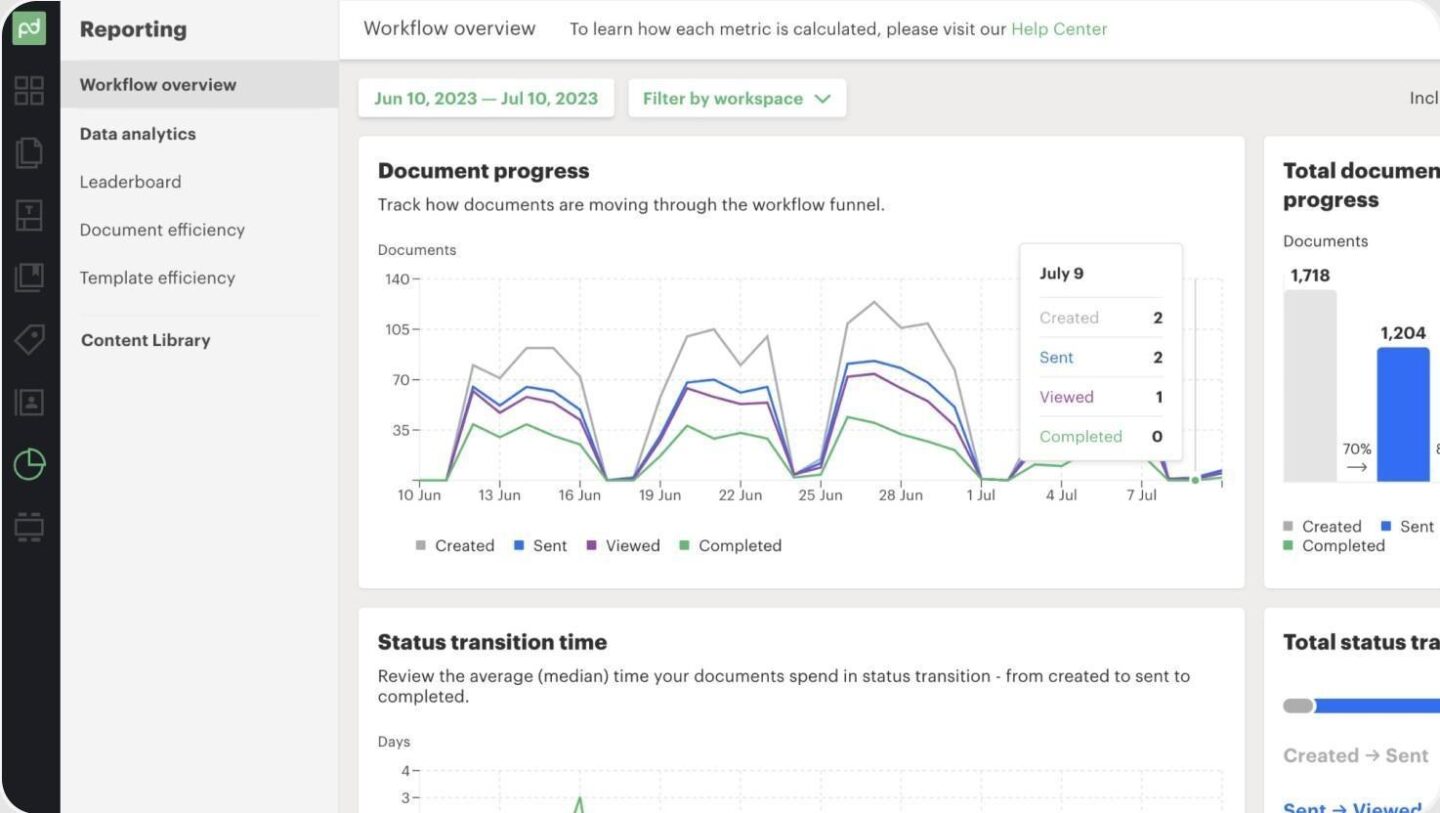
PandaDoc is a document automation platform for sales-led teams that need to move quickly from quote to signature. Compared with Juro, it’s lighter on legal-led CLM depth, but stronger as a proposal creation tool, handling sales documents and buyer-facing agreement workflows.
Teams can build branded proposals, agreements and quotes using templates, pricing tables, product catalogues and a drag-and-drop editor. PandaDoc also includes Deal Rooms, approvals, tracking, analytics, e-signatures and CRM integrations with Salesforce, HubSpot and Pipedrive.
The tradeoff is post-sign depth. PandaDoc includes storage, search, audit trails and reminders, but it’s not built around complex obligation tracking, renewal governance or portfolio-level contract intelligence.
See also: PandaDoc alternatives
User sentiment: Positive on ease of use, templates, e-signatures, fast document creation, document tracking and CRM-connected sales workflows. Common complaints mention missing features, editing limitations, table formatting, occasional performance issues with larger documents, signature quirks and pricing concerns as usage grows.
Pricing: Free plan available. Paid plans start at $19/user/month for Starter and $49/user/month for Business when billed annually. Enterprise pricing is custom. GBP pricing isn’t published. 14-day free trial, no credit card required.
Key features
- Drag-and-drop editor with templates and rich media
- Pricing tables, product catalogue and CPQ on higher tiers
- Deal Rooms for buyer collaboration
- Approval workflows, comments and tracking
- E-signatures, audit trails and recipient analytics
- CRM integrations with Salesforce, HubSpot and Pipedrive
Docusign CLM
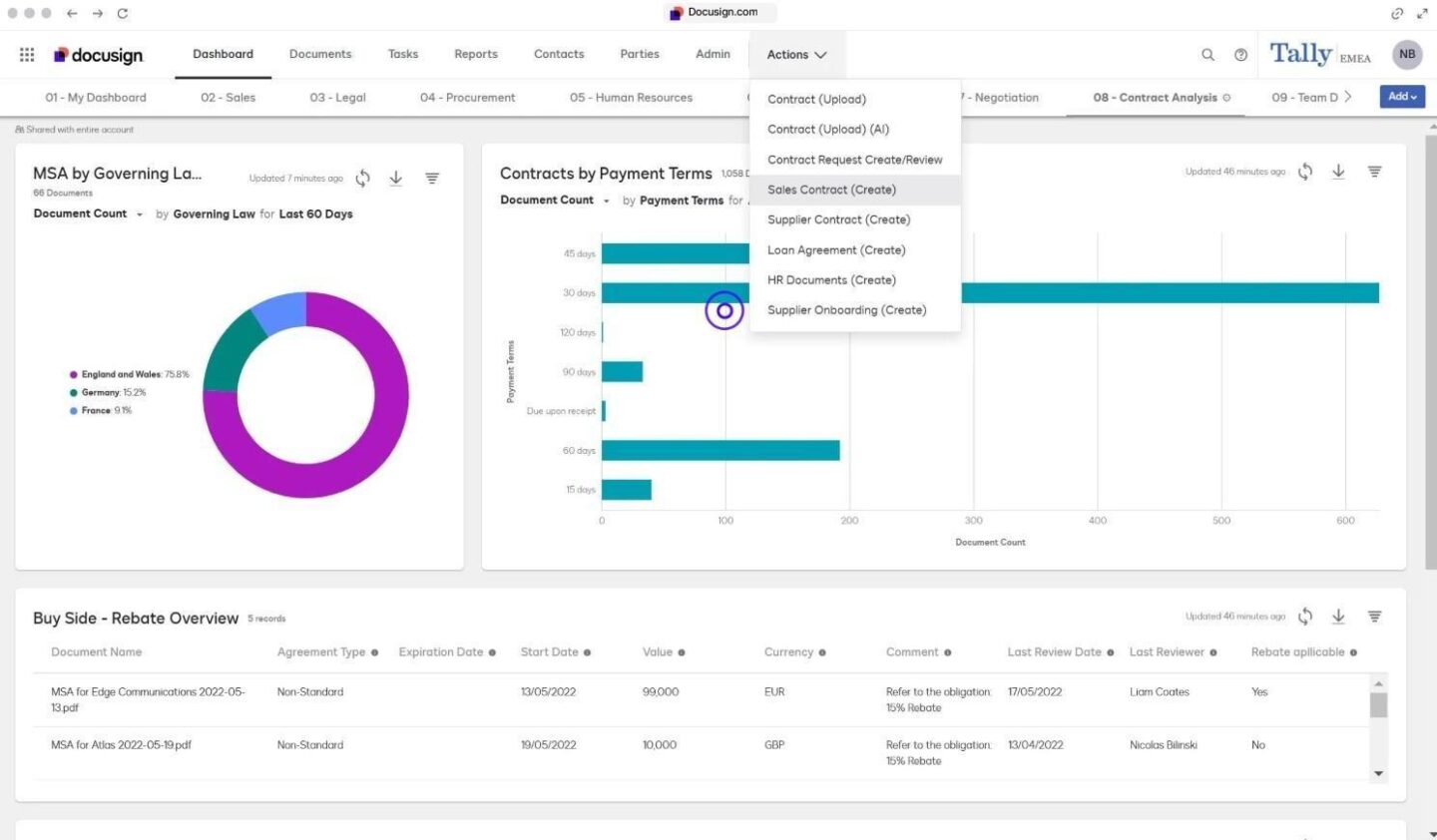
Docusign CLM is an enterprise contract management platform within the wider Docusign IAM suite. It offers broader agreement management than Juro, but it can feel heavier, more modular and less straightforward for teams that want contract data to move cleanly across the business.
The platform covers e-signature, contract generation, review, negotiation, workflow automation, storage and analytics. Iris AI supports term extraction, agreement analysis, summarisation and assisted review. Integrations include Salesforce, SAP Ariba and Coupa.
User sentiment: Positive on reliable e-signature, document storage, tracking, security and broad workflow coverage. Recurring concerns include implementation time, learning curve, pricing for smaller teams and complexity around advanced features.
Pricing: IAM Starter starts at £31/user/month, IAM Standard at £35/user/month and IAM Professional at £61/user/month, all billed annually. Enterprise CLM is custom quoted. Some add-ons, including QES, ID verification and multi-channel delivery, cost extra.
See also: Docusign alternatives for UK teams
Key features
- Iris AI for extraction, analysis, summarisation and assisted review
- Dynamic templates, clause library and conditional rules
- Drag-and-drop workflow designer
- Repository with keyword, concept and metadata search
- Salesforce, SAP Ariba, Coupa and partner integrations
- E-signature, identity verification and multi-channel signing
Contractbook
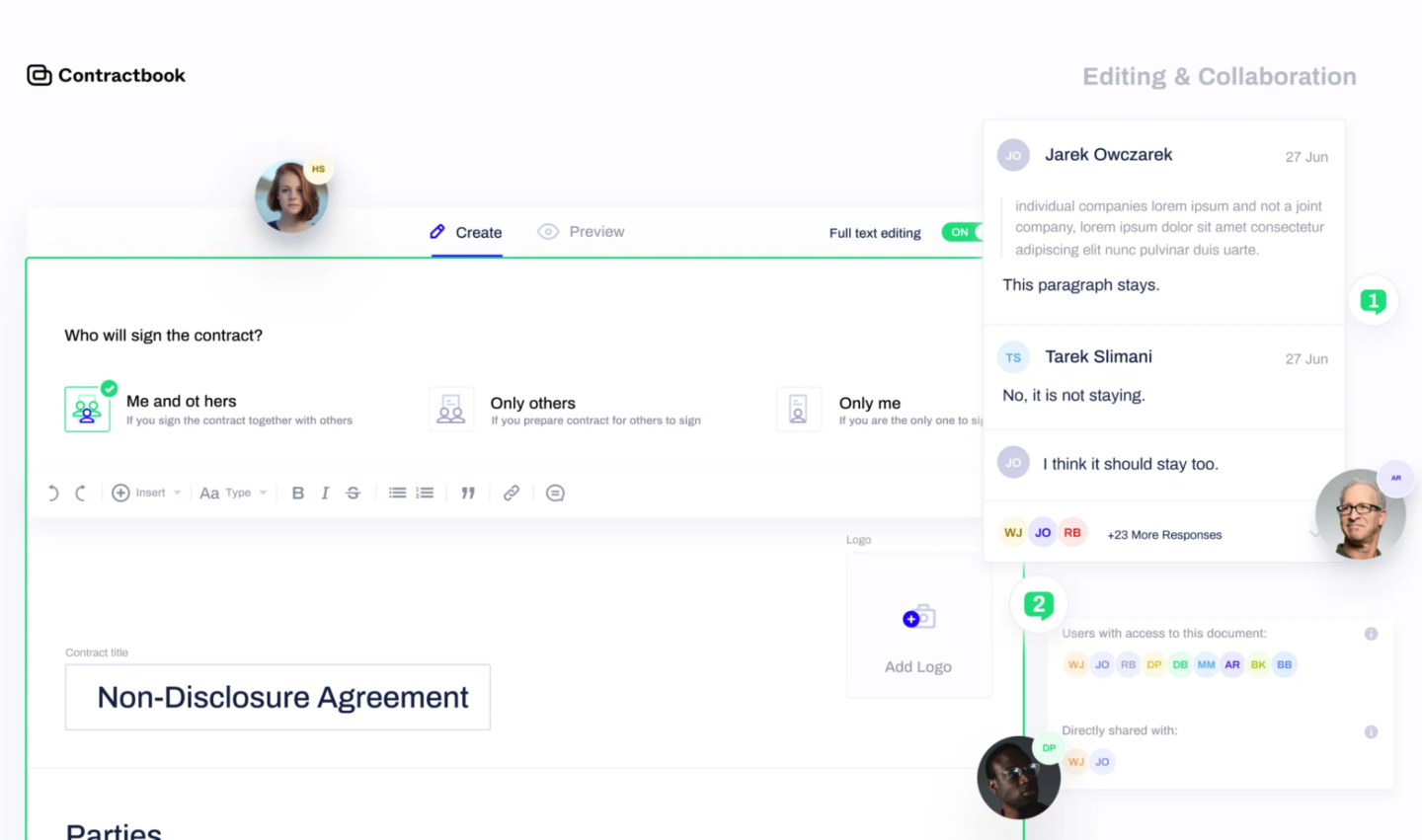
Contractbook is a Copenhagen-founded contract management platform for teams that want simple creation, signing, storage and automation without enterprise CLM weight. It feels more accessible than Juro for smaller and mid-sized teams, but less mature for complex reporting, deep portfolio intelligence or highly customised workflows.
The platform includes templates, e-signatures, collaboration, version history, reminders, AI extraction, centralised storage and no-code automation. It also supports CRM-driven workflows through HubSpot, Pipedrive, Salesforce, Zapier, Make and API access, depending on plan.
User sentiment: Positive on ease of use, quick setup, templates, support, automation, centralised storage and CRM-connected contract creation with a clean interface. Common concerns include setup effort for non-standard workflows, limited role control, formatting issues, occasional bugs and renewal or billing frustrations.
Pricing: Not publicly disclosed. Available on request. Free 14-day trial available.
Key features
- Smart templates, dynamic templates and conditional logic
- E-signatures, signing order and version history
- Repository with custom views, filters and full-text search
- AI Import, AI extraction and AI Contract Assistant
- No-code automations for approvals and reminders
- HubSpot, Pipedrive, Salesforce, Zapier, Make and API access depending on plan
LinkSquares
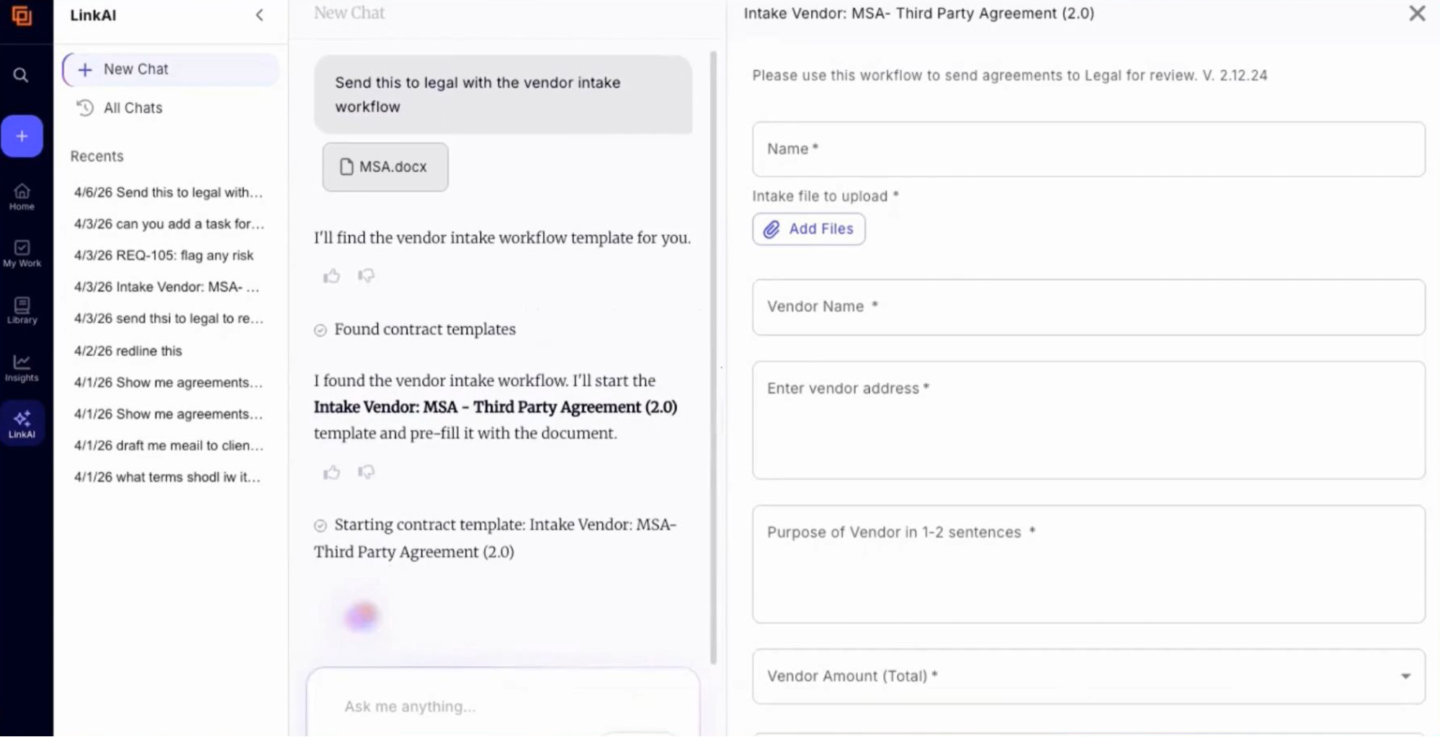
LinkSquares is an AI-powered CLM platform focused on contract intelligence, analytics and legal workflow management. It puts more emphasis than Juro on analysing large contract portfolios, surfacing risk and turning agreement data into reports and searchable insights.
The platform covers drafting, negotiation, approval workflows, repository management, analytics and AI-assisted review. LinkAI extracts metadata, dates, clauses and obligations, supports AI summaries, and powers search across large volumes of agreements.
User sentiment: Strong for ease of use, contract repository management, customer support, Salesforce integration, reporting and AI analytics. Concerns include AI accuracy on some contract data, limited dashboard customisation, search and filtering gaps, Salesforce write-back limitations and pricing.
Pricing: Custom. LinkSquares doesn’t publish pricing. Vendr’s 2026 analysis lists a median buyer price of $31,000/year, with observed deals ranging from $5,999 to $79,318. GBP pricing is unavailable.
Key features
- LinkAI for extraction, summaries and AI-assisted review
- Contract intelligence repository with structured data
- Dashboards for trends, risk, obligations and performance
- Pre-signature workflows, templates and playbooks
- Legal request management and workload visibility
- Salesforce, DocuSign, Google Drive and other integrations
Summize
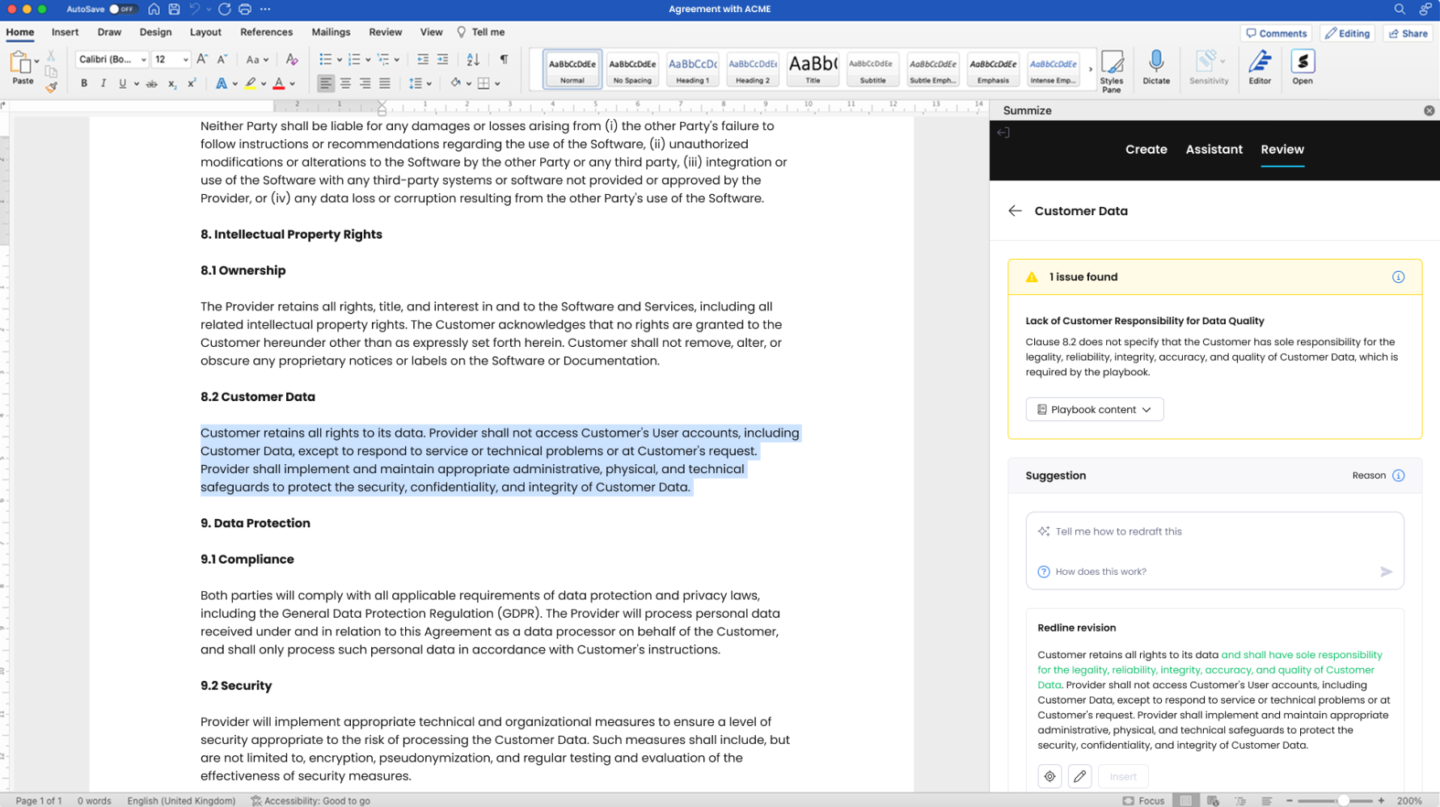
Summize is a Manchester-based CLM platform built around embedded contract workflows. Its main difference from Juro is where users work: Summize puts contract requests, reviews and approvals inside Outlook, Teams, Slack, Salesforce, HubSpot, Gmail and Word.
It covers intake, contract generation, review, collaboration, repository storage and analytics. Business users can request or create contracts from familiar tools, while legal keeps control through pre-approved templates, approval workflows and embedded legal knowledge. Review Pro works in Microsoft Word for AI-assisted review, redlining and clause analysis.
User sentiment: Strong for ease of use, adoption, Microsoft and Slack integrations, AI review, customer support and implementation support. Reviews note limited customisation in some areas, user-role visibility, mobile usability, occasional bugs or slow responses and some gaps in workflow visibility.
Pricing: Custom. Summize says pricing is tailored to the business and requires a quote. Capterra lists pricing from £99/user/month, but Summize doesn’t publish a full public pricing table.
Key features
- SIA and Ask SIA for contract questions, summaries and AI assistance
- Review Pro for AI review and redlining in Microsoft Word
- Requests from Outlook, Teams, Slack, Salesforce, HubSpot and Gmail
- Legal Front Door for intake and routing
- Repository with search, reminders, calendar sync and obligations
- Contract analytics for risks, renewals and portfolio insights
Leah (formerly ContractPodAi)
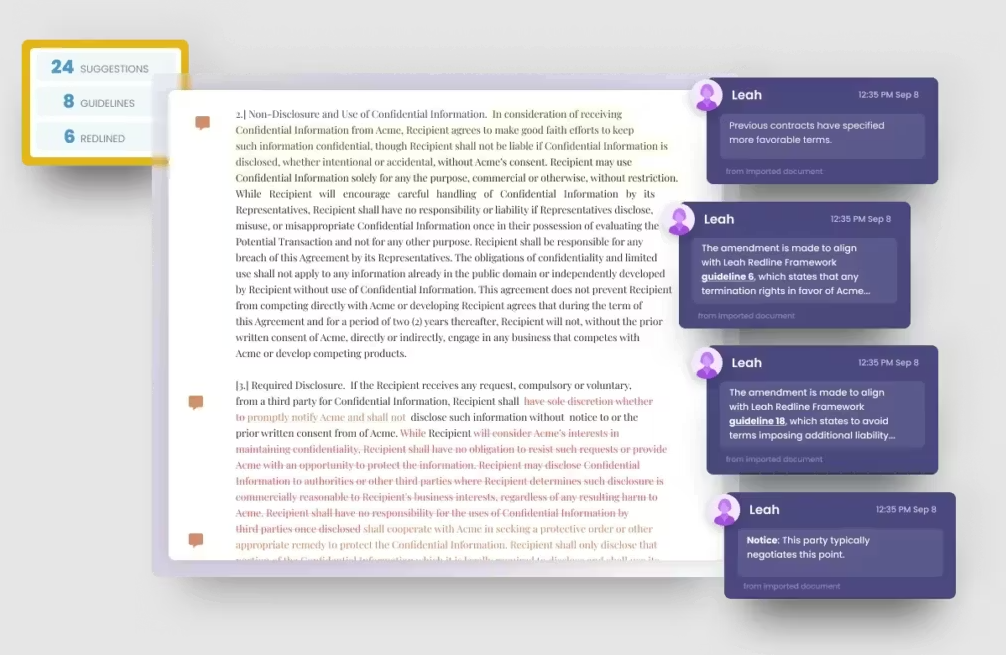
Leah, formerly ContractPodAi, is an enterprise AI platform for legal, contracting, procurement and finance teams. It’s broader than Juro: less a conventional CLM and more an agentic operating layer for complex commercial work.
Its Agentic OS connects legal, contracts, procurement and finance through specialised agents, workflows and apps. Agentic CLM covers intake, creation, review, negotiation, approval, signature, repository management, obligations and renewal alerts. Leah also supports playbook redlining, clause guidance, cognitive search and AI-backed contract helpdesk answers.
User sentiment: Positive on configurability, customer support, workflow automation, repository management, obligations tracking and AI-assisted contract work. Common concerns include implementation effort, complexity, search reliability in some older reviews and the need for strong internal ownership to get full value.
Pricing: Custom. Vendr lists ContractPod/Leah as contact-for-pricing, with an average contract value of $124,000 and a proposed price example of $372,000. Exact UK pricing requires a quote.
See also: ContractPodAI/Leah alternatives
Key features
- Agentic OS for legal, contracting, procurement and finance
- Agentic CLM for intake, drafting, review, approval and renewal
- Playbook redlining and clause-level AI guidance
- Smart Repository with cognitive search and obligations
- Contract helpdesk with source-backed answers
- Integrations with Salesforce, Microsoft Dynamics, HubSpot, SAP, Oracle, Workday, Coupa, Docusign, Adobe Sign, Teams and Slack
Gatekeeper
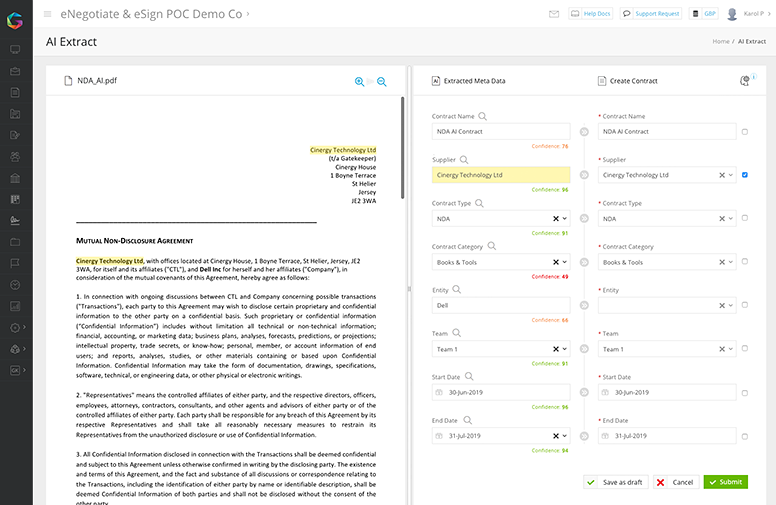
Gatekeeper is a contract and vendor lifecycle management platform for procurement, finance and legal teams. Unlike Juro, it combines CLM with vendor onboarding, third-party risk, compliance monitoring and spend management.
It covers contract intake, authoring, approvals, negotiation, e-signature, repository management, renewal tracking and obligations. It also includes vendor portals, employee intake portals, risk registers, balanced scorecards, and spend tracking. MarketIQ monitors financial, cyber and regulatory risk, while LuminIQ agents support extraction, clause analysis, obligations, risk screening and approval routing.
User sentiment: Reviewers highlight ease of use, vendor management, workflow automation, contract visibility, implementation support and customer service. Common concerns include limited customisation in some areas, reporting flexibility, pricing for additional modules, setup effort for complex workflows and occasional support or configuration frustrations.
Pricing: Custom. Gatekeeper publishes plan tiers and usage limits, but not fixed public pricing.
Key features
- Combined CLM and vendor lifecycle management
- LuminIQ agents for extraction, clause analysis, risk screening and obligations
- Employee Portal and Vendor Portal
- Repository with renewal alerts, obligations and audit trails
- MarketIQ for financial, cyber and regulatory monitoring
- Spend Module, Risk Register and Balanced Scorecards
The right Juro alternative depends on how your business uses contracts
The right Juro alternative depends on two questions: who needs to use contracts in your business, and what happens after signing?
If contracts are primarily owned by legal, with other teams joining at defined points, the options are broad. Ironclad, Summize and Leah serve legal-led workflows at different scales and budgets. Gatekeeper is worth considering when procurement needs vendor risk visibility. LinkSquares is strong when post-sign analytics on an existing portfolio are the priority.
But if contracts need to support the whole business every day, the list gets shorter. At that point, the question is not just whether a platform can manage contracts, but whether each team can use contract data in the systems where they already work. Sales needs contract data aligned with the CRM. Finance needs pricing, renewal and invoicing data without manual re-entry. Procurement needs supplier agreements to be visible after signing. HR needs employee contracts, amendments and offboarding documents managed in one process.
Juro is a credible CLM with strong reviews, AI-native positioning and broad integrations. But if your priority is making contracts operational across the business, Oneflow is the alternative to evaluate first.
Book a demo to see how Oneflow handles live, connected workflows across quote-to-cash, source-to-pay, and hire-to-retire.
FAQs
What is the best alternative to Juro for sales teams?
For sales teams, the key requirements are CRM-native contract creation, fast turnaround and contract data that stays aligned with the CRM. Oneflow is a strong fit because it supports live contracts and two-way sync with Salesforce, HubSpot, Microsoft Dynamics and Pipedrive.
PandaDoc and Contractbook may also be worth evaluating, depending on whether you need proposal creation, document automation or broader contract lifecycle management.
Does Juro integrate with Salesforce and HubSpot?
Yes. Juro integrates with Salesforce, HubSpot, Slack, Google Drive, Word and other tools. Users can generate contracts from Salesforce, live-sync with Salesforce objects and create or track contracts in HubSpot.
The point to validate is depth. Some reviewers praise Juro’s CRM connectivity, while others mention wanting deeper integrations, retroactive HubSpot deal mapping, more flexible enterprise-system integrations or less technical setup.
What are the limitations of the Juro contract management software?
Reviews are mostly positive, especially around ease of use, onboarding, support, templates and collaboration. The main limitations to validate are complex negotiation workflows, reporting depth, search and data extraction, Word formatting, integration fit and pricing fit.
One G2 reviewer notes that Juro doesn’t support redline-over-redline workflows, which can limit multi-round negotiations. Others mention formatting issues, limited table customisation, basic search/data extraction, limited AI extraction functionality and reporting features that could be improved.
How much does Juro cost? (GBP)
Juro doesn’t publish pricing. Vendr’s 2026 analysis puts the median Juro contract at $32,832/year, with observed deals from $11,964 to $132,339. That’s roughly £26,000/year, though exact UK pricing requires a custom quote.
For comparison, Oneflow publishes Business pricing at £45 per user/month, billed annually, for teams starting with 5 users—from £225/month or £2,700/year before add-ons. There’s also a 14-day free trial.
.png?id=40edbc9ee25345a211152388fdcf1fd2)

.png?id=073897979970647cd034d6db96c145de)