Finding a liability cap below your company’s approved threshold during contract review is useful. However, how do you know whether the same issue appears in other agreements? Identifying recurring problems across a large contract portfolio is much more difficult when every contract is reviewed separately.
AI contract analytics helps connect individual findings with the wider contract portfolio. It identifies relevant terms and potential deviations, then combines the results to show how often certain issues occur and which agreements are affected.
This guide explains how AI contract analytics works, where its results require caution and compares six contract lifecycle management (CLM) platforms and how they approach AI analytics.
What is AI contract analytics?
AI contract analytics uses artificial intelligence to identify, extract and assess information in contracts. It can review the terms of individual agreements as well as analyze information across a contract portfolio.
Basic contract reporting relies mainly on information stored in structured fields, such as signature dates, contract values and renewal dates. AI contract analytics can also examine the contract text itself. For example, it may identify a termination notice requirement that hasn’t been recorded in a dedicated field. Depending on the tool and configuration, that information can then be included in portfolio-level reports.
AI also supports the contract review process. Traditionally, lawyers and contract managers read agreements to identify clauses that deviate from the company’s requirements. AI-assisted review can help identify those deviations, highlight relevant passages and flag potentially missing clauses. However, reviewers still need to verify the findings and decide which require negotiation or further attention.
The findings from individual reviews can then support portfolio analysis. This gives the organization a clearer view of recurring issues, provided the agreements have been analyzed against the appropriate standards.
How AI contract analytics works
AI contract analytics relies on several technologies to process contract language and identify relevant information. Different platforms combine these technologies in different ways:
- Optical character recognition (OCR) and natural language processing (NLP): OCR converts scanned documents into machine-readable text, while NLP helps identify information such as dates, parties and clauses. NLP can also recognize related concepts expressed in different ways. For example, it can identify confidentiality obligations whether a contract refers to a supplier’s duty to maintain confidentiality or a vendor’s restrictions on disclosing information.
- Machine learning and large language models (LLMs): These technologies help classify provisions and analyze their meaning in context. For example, a limitation of liability may appear within a warranty section rather than under its own heading. AI can identify the relevant wording and, where the software supports it, compare the provision against the company’s review criteria.
- Generative AI: This technology can, for example, summarize contract terms and answer questions about their contents. Some platforms also support questions about contract portfolios, allowing users to investigate patterns across multiple agreements. However, AI-generated answers may overlook exceptions or misinterpret provisions, so important findings should always be checked against the original contracts.
Four stages of an AI contract analytics workflow
AI contract analytics typically involves preparing contract records, defining review standards, analyzing individual agreements and reporting on findings across the portfolio. The exact process varies by platform. Below, we explain these four stages using the Oneflow contract lifecycle management platform as an example.
1. Centralize contract records
Before analyzing contracts across an organization, you need access to the agreements you want to include. If contracts are scattered across email inboxes and shared drives, some may be overlooked, leaving gaps in the analysis. A centralized contract repository provides a single source for the agreements included in the analysis, making it easier to review the entire contract portfolio.
In Oneflow, contracts created and signed in the platform retain the data entered into their structured fields. For agreements signed elsewhere, users import PDF or TIFF files. AI Extract identifies information such as participants, contract duration and signature date, which users can verify and correct before marking the imported document as signed. Once the relevant lifecycle settings are configured, Oneflow can also send reminders before contractual notice periods expire.
2. Define review standards
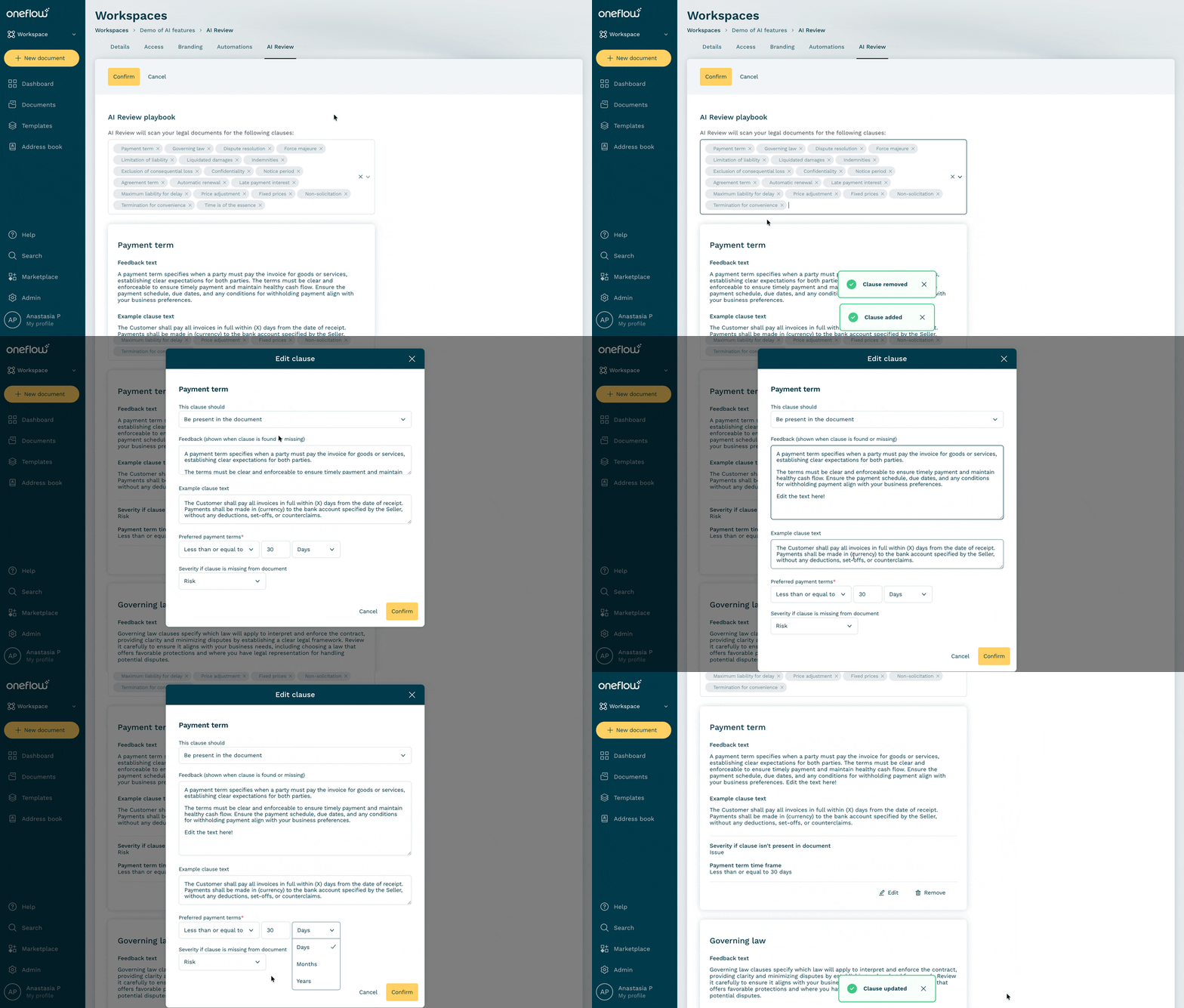
AI contract analytics produces more consistent results when you define what the system should look for. Contract playbook development involves legal work: documenting which clauses agreements must contain, what terms are acceptable and which deviations need further review. This also preserves institutional knowledge that might otherwise remain with a few experienced reviewers, while giving AI clear standards for evaluating contracts.
In Oneflow, administrators can configure a separate playbook for each workspace. Each playbook contains a set of clause concepts, such as liability limits or termination rights. Administrators can remove those that are not relevant to the workspace’s contracts. For each remaining concept, they define what reviewers should check, provide an example of acceptable clause wording and specify whether a departure from the standard should be flagged as an issue or a risk.
3. Identify and assess provisions
Once the review standards are defined, AI contract review can identify relevant clauses, compare them against the requirements and flag potential deviations. The exact review process and the way findings are presented depend on the platform.
In Oneflow, AI Review automatically checks documents against the configured playbook when they are sent, provided the feature is enabled for the workspace. Users can also initiate a review manually, including while a document is still a draft.
For each deviation, Oneflow highlights the relevant passage and displays the guidance and example clause configured in the playbook. It also lists any playbook concepts it could not identify in the document, allowing reviewers to check whether required clauses are missing. Each finding links to the relevant contract wording for verification.
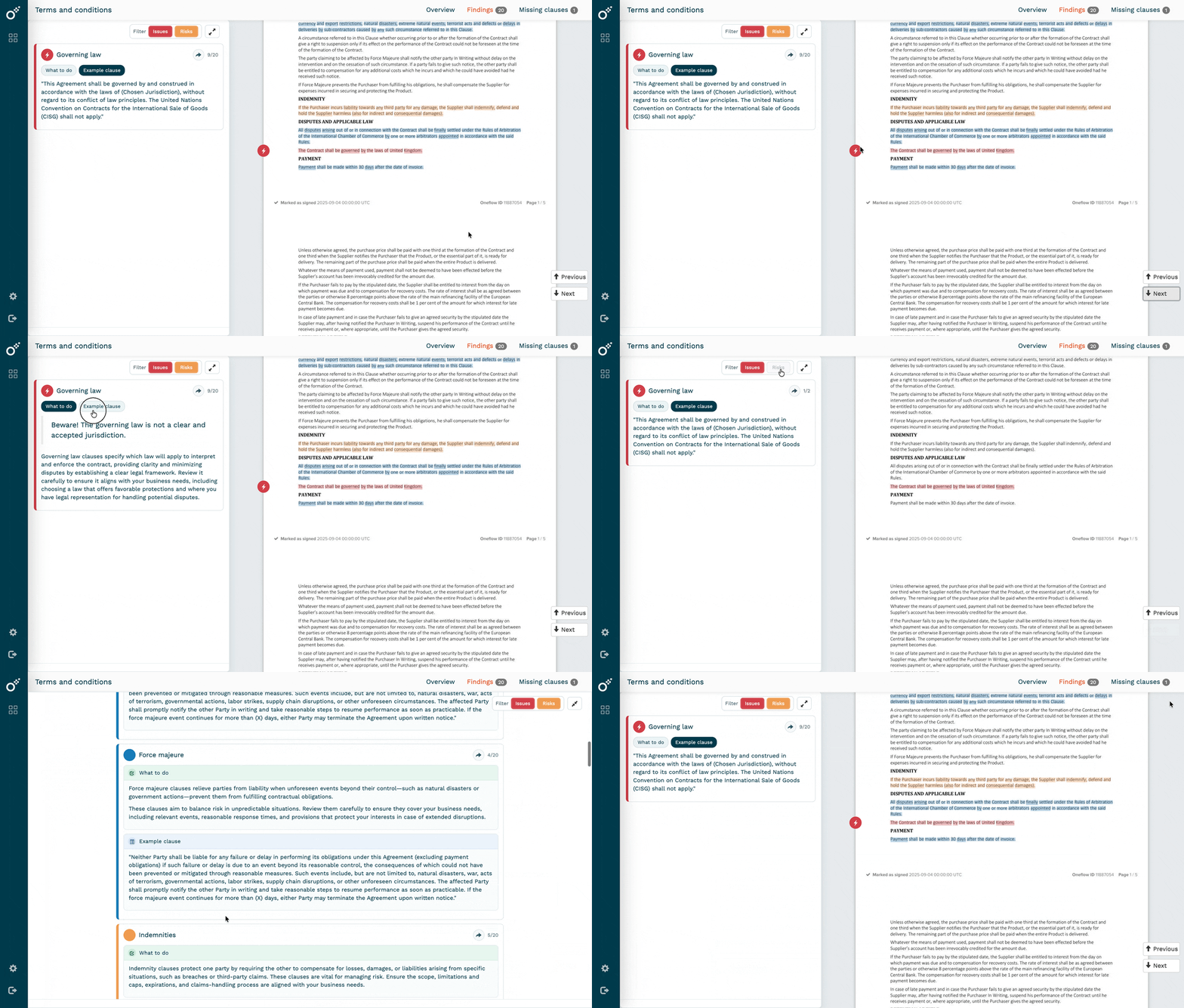
Different AI contract review tools classify findings differently. Some assign numerical risk scores, while Oneflow uses two categories: issues and risks. In the document list, a red label identifies contracts containing issues, while a yellow label marks contracts with risks but no issues.
4. Aggregate and report
The final stage combines findings from individual contract reviews to identify recurring issues in the contract portfolio. This helps legal teams understand which deviations occur most frequently and which agreements may require further attention.
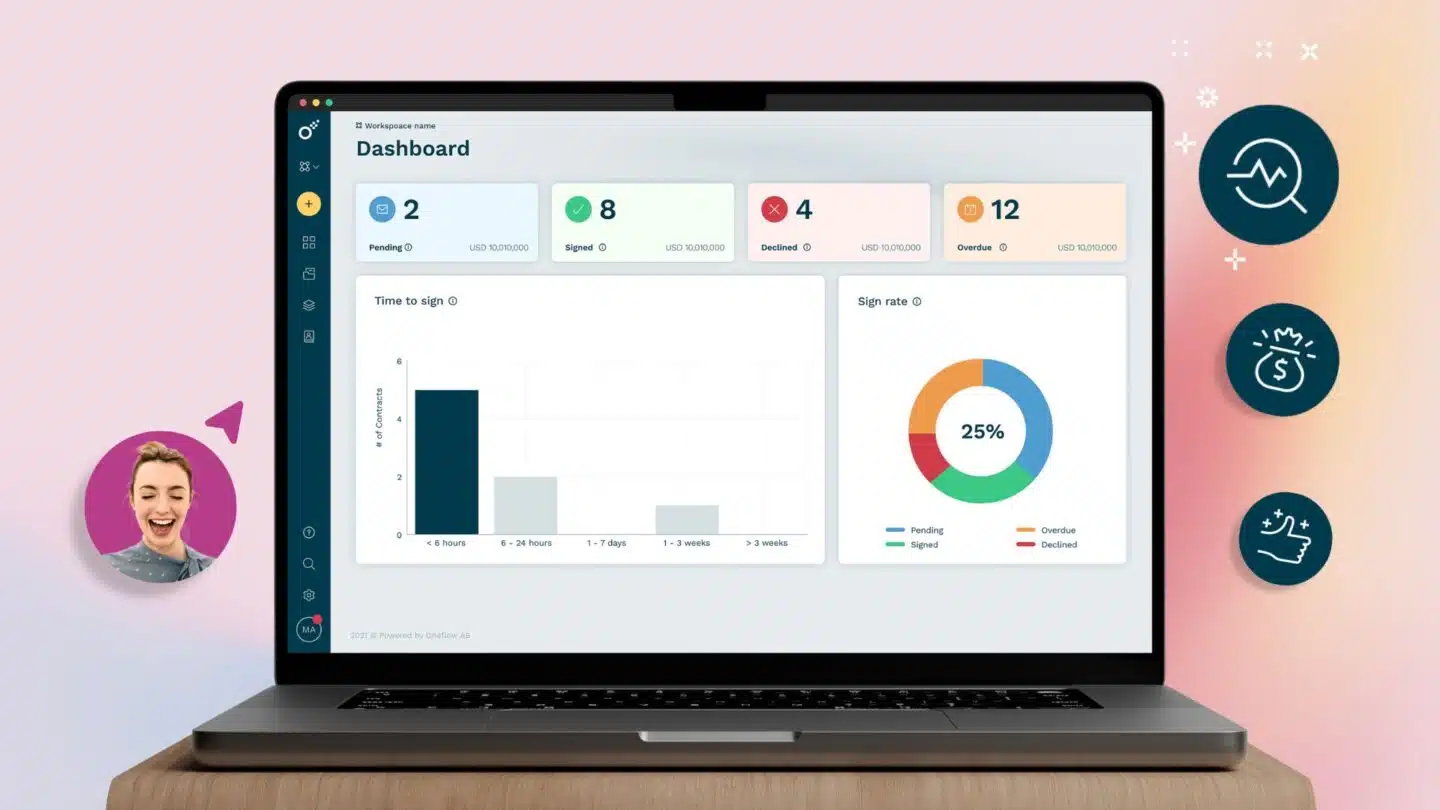
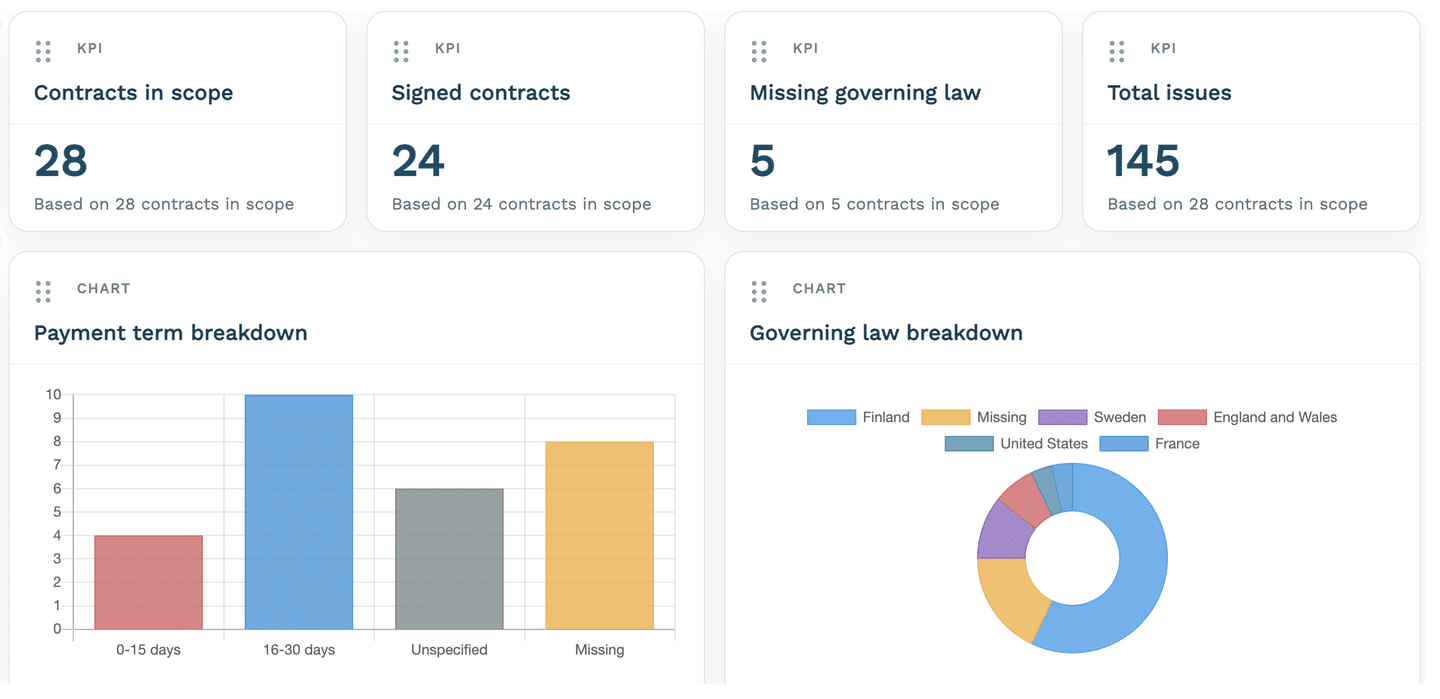
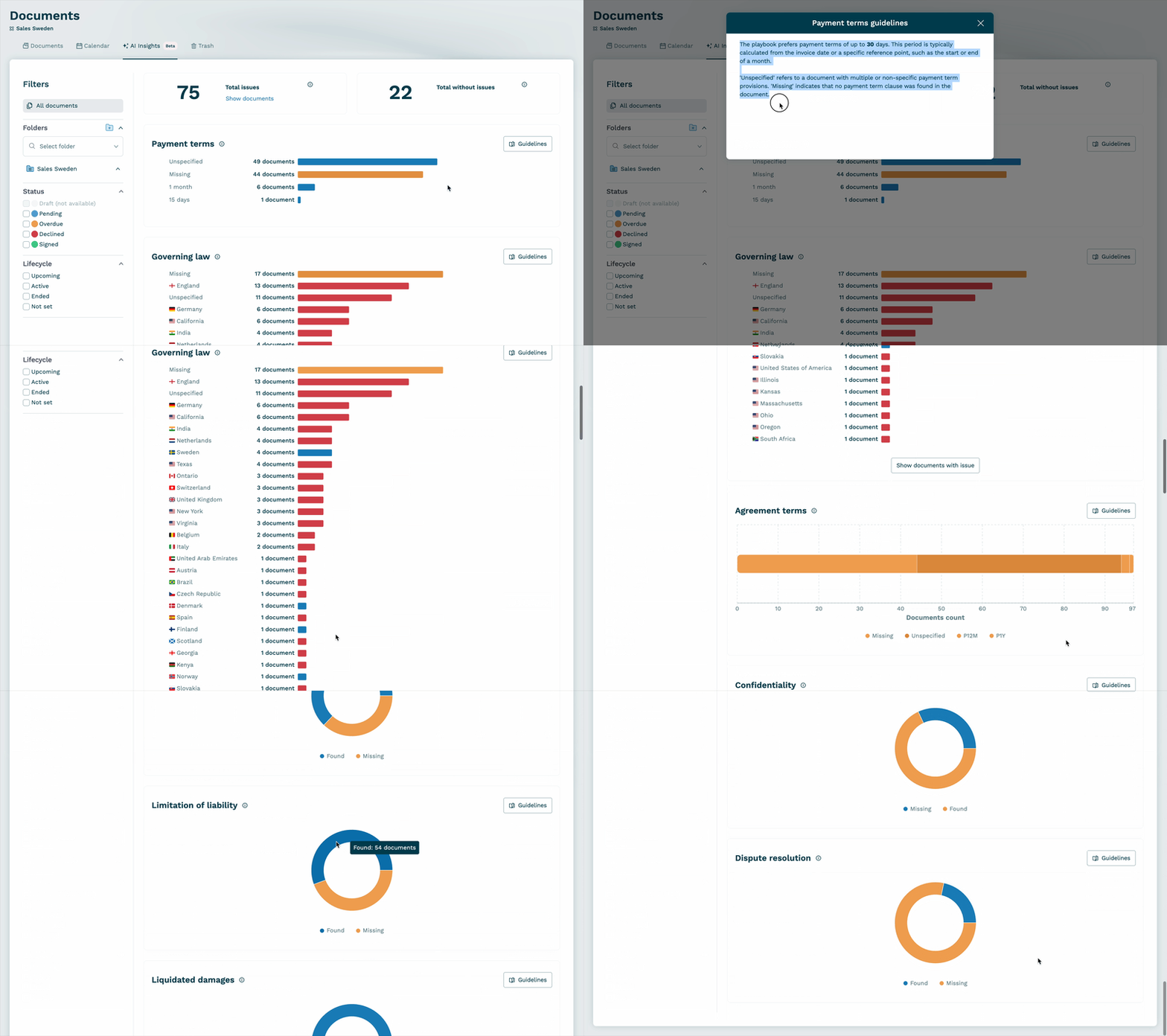
Oneflow’s AI Insights aggregate this information into a dashboard that includes a summary of documents with and without identified issues, followed by a separate chart for each concept in the workspace’s playbook. Users can select any chart to see the contracts associated with that finding. They can also filter the results by document status, lifecycle stage or folder, and export the analysis.
For organizations that need more detailed reporting, Oneflow offers Insights Premium, which allows teams to define custom review rules and data fields, create dashboards based on their reporting needs and generate action reports from contract reviews.
AI contract analytics limitations
AI contract analytics can identify risks across large contract portfolios, but its findings depend on the quality of the documents and the review criteria. Three limitations deserve particular attention.
Scanned and legacy contracts
Older agreements are often stored as scanned PDFs, which require optical character recognition (OCR) to convert their contents into readable text. Poor scan quality can cause dates or amounts to be extracted incorrectly. If those errors go unnoticed, they can affect portfolio reports or trigger reminders based on the wrong deadlines.
To improve accuracy in contract records and reporting, check extracted data against the original agreements before relying on them. For large imports, reviewing a representative sample can help assess overall extraction accuracy, but individual findings used for legal or financial decisions should still be verified by legal professionals.
Long contracts with amendments
A contract’s original terms may change through later amendments. For example, a master agreement might establish a liability cap that a subsequent amendment increases. If the AI analyzes only the original agreement, it could report a liability limit that no longer applies. Long documents with extensive cross-references can also be more difficult to analyze accurately.
Platforms handle related documents differently. For example, Sirion offers a conformed-contract feature that consolidates amendments into a single agreement; Oneflow allows users to link amendments and related contracts to the original record.
Incomplete playbooks
The quality of AI review also depends on how clearly your organization defines its contract requirements. For example, a playbook that only checks whether an agreement contains a liability clause may overlook a cap that falls below the company’s approved minimum.
Before using AI contract risk management tools, define which clauses are required, what terms are acceptable and which deviations need further review. Review the playbook regularly as your organization’s requirements change.
AI contract management tools compared
The limitations above illustrate why choosing AI contract analytics software involves more than comparing dashboards. You should also consider how reliably a platform processes contract information, whether you can verify its findings against the original agreements and how well its reporting supports your team’s needs.
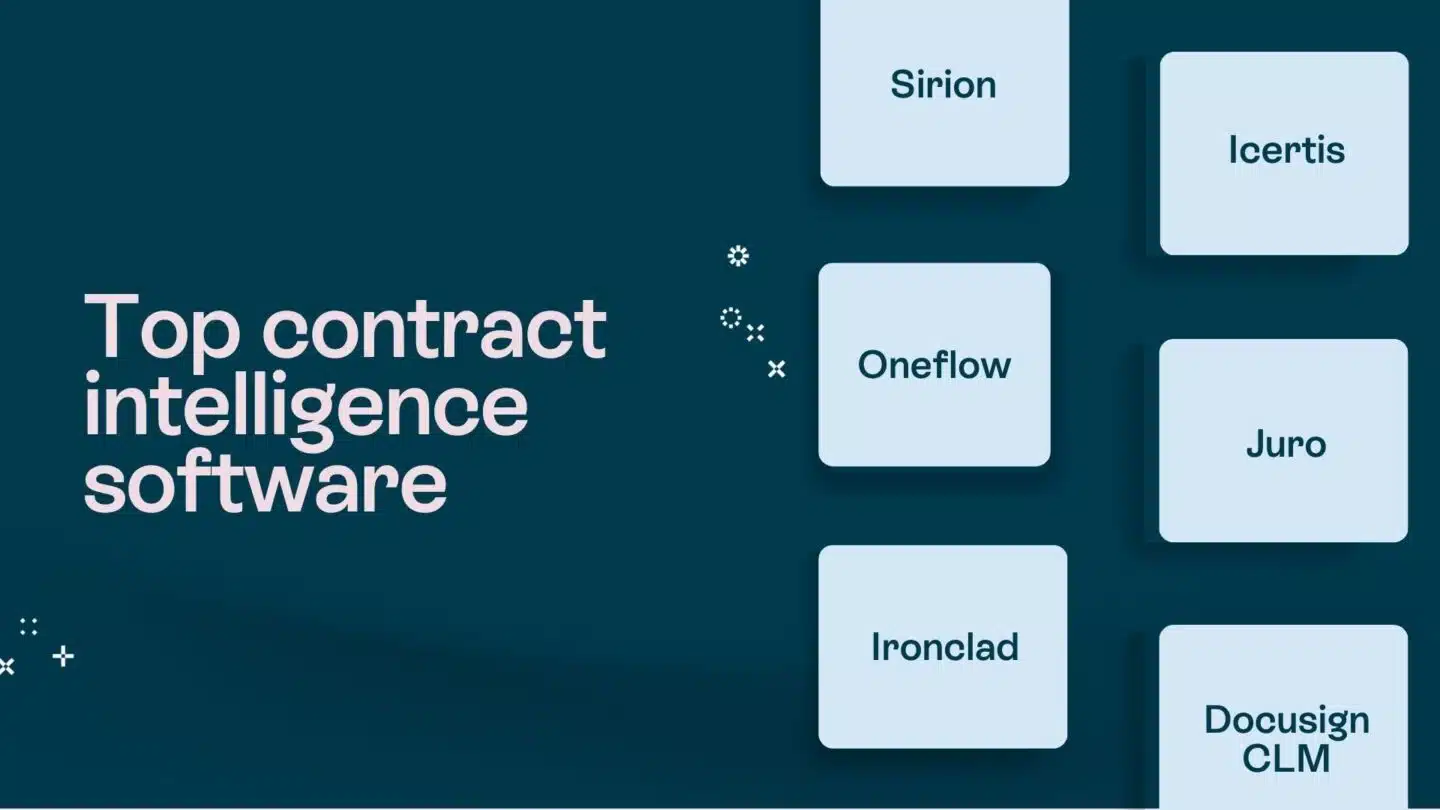
The six platforms below combine AI analytics with different contract management software capabilities. We compare their strengths, the types of analysis they support and the main trade-offs to be aware of.
| Platform | Best for | Analytics strengths |
|---|---|---|
| Oneflow | Mid-sized and large teams managing CRM-connected contracts | Playbook-based risk review, portfolio-level risk dashboards, custom analytics |
| Sirion | Enterprises monitoring supplier obligations and performance | AI obligation extraction, supplier performance analysis, invoice validation |
| Icertis | Global enterprises tracking obligations across legacy and new contracts | AI clause extraction, obligation analysis, portfolio risk insights |
| Agiloft | Organizations with complex, department-specific approval and reporting requirements | Playbook-based review, portfolio Q&A, AI-assisted data extraction |
| Docusign | Teams consolidating Docusign eSignature records and older agreements for AI analysis | AI term extraction, custom fields, cross-contract comparison worksheets |
| Ironclad | Enterprises analyzing high-volume contracting activity alongside contract terms | AI metadata extraction, playbook-based review, natural-language analytics |
Oneflow
Oneflow is a contract management system for mid-sized and large organizations. It supports contract creation, negotiation and contract execution through electronic signatures, as well as post-signature management. Its AI features assist with contract drafting, summaries, import and analysis.
Unlike workflows based on exchanging static PDFs, Oneflow lets teams create and negotiate editable contracts in one place. Its integrations with Salesforce, HubSpot, Microsoft Dynamics 365 and Pipedrive also allow contract data to be exchanged with CRM records. For example, sales teams can generate contracts using existing customer and deal information, reducing manual entry. Supported updates can also be sent back to the CRM, keeping the data up-to-date.
Key AI features:
- AI Review: Compares agreements against workspace-specific playbooks, identifies potentially problematic terms and flags missing clauses. Reviewers can inspect the relevant wording and guidance before deciding what action to take.
- AI Insights: Aggregates findings into dashboards, allowing teams to identify recurring risks, filter affected agreements, and easily access the underlying contracts.
- Insights Premium: Provides additional control over analysis through custom clause rules, data fields and dashboard views. Teams can also generate action reports to help address findings.
- AI Extract: Identifies and extracts key information such as contract duration, signature dates and participants, from imported agreements. Users can verify and correct the extracted data.
- AI Summary: Generates summaries of contract content. You can customize summaries to focus on specific terms, obligations or questions.
- Write with AI: Helps draft and revise contracts directly in Oneflow. It can also simplify existing wording, translate text and assist with document invitation messages.
Beyond AI analytics, Oneflow includes contract templates, internal approval workflows and collaboration features. Teams can track document changes through audit trails, manage access with workspace permissions and receive automated alerts for renewals or other deadlines. Contracts and their associated information remain accessible in a centralized repository with advanced search and filtering.
Trade-off: Some reviewers report limitations in document formatting and template customization, particularly when working with more complex documents. Oneflow’s AI is optimized primarily for English and Swedish, so organizations working with contracts in other languages may find it limited.
Book a Oneflow demo to see how your team can turn AI-powered contract insights into informed decisions, reducing manual workload.
Sirion
Sirion is an enterprise CLM platform for organizations managing complex supplier and services agreements across their supply chain. It connects contractual obligations with performance data from ERP and procurement software, helping teams monitor supplier commitments and compare invoices and spend with agreed contract terms.
Key AI features:
- Extracts obligations, service levels and milestones, with links to the relevant contract clauses.
- Tracks supplier performance against agreed service levels and calculates the financial impact of missed commitments.
- Validates invoices against contract terms, pricing, consumption and actual performance data.
- Consolidates amendments into a single contract reflecting the updated terms.
Trade-off: Some reviewers report that advanced features require considerable configuration and can be difficult for occasional users to navigate. Others mention slow loading times.
Icertis
Icertis is an enterprise contract intelligence platform for global organizations managing large contract portfolios across departments and regions. Its AI capabilities help teams analyze legacy and third-party agreements, identify contractual risks and monitor obligations. The platform also connects contract information with procurement, sales and finance workflows.
Key AI features:
- Extracts clauses and key information from legacy and third-party agreements, converting them into searchable, structured records.
- Uses Vera Analytics to identify risky provisions, analyze patterns across agreements and answer questions about contract terms.
- Uses Vera Obligations to extract and classify contractual commitments, helping teams monitor deadlines and compliance in the portfolio.
Trade-off: Some reviewers report that the interface is difficult to navigate. Configuring workflows and customizing forms can also be time-consuming and require specialist support.
See also: Icertis alternatives.
Agiloft
Agiloft is a CLM platform that lets organizations create their own contract fields, set approval rules, build workflows and design reports without writing code. Its Astra AI supports contract review and portfolio analysis, allowing teams to verify agreements against their legal standards and identify recurring risks across contracts.
Key AI features:
- Reviews individual contracts or entire portfolios against playbooks and risk thresholds, flagging deviations and suggesting redlines.
- Answers plain-language questions about contract terms, risks and obligations, and identifies patterns across agreements.
- Uses AI-assisted contract intake to extract key information from uploaded agreements and create structured CLM records.
Trade-off: Some users report that configuring and maintaining complex workflows requires considerable training or specialist support, despite the platform’s no-code design.
Docusign
Docusign is best known for electronic signatures, but its Intelligent Agreement Management solution also helps organizations analyze contracts after signing. Agreements signed through Docusign eSignature are automatically added to a searchable repository, where users can also upload contracts signed outside the platform. Docusign’s AI then helps teams extract key terms, identify upcoming renewals and compare information across agreements.
Key AI features:
- Docusign Iris extracts key information, including parties, renewal dates and financial terms, from signed agreements.
- Users can choose additional information to extract from contracts, such as liability limits or termination notice periods so that they can search and filter agreements based on those terms.
- AI-generated worksheets let users compare specific terms across multiple contracts, such as how much suppliers can increase prices or how quickly they must report a data breach.
Trade-off: AI extraction capabilities vary by contract language. Custom agreement-type extraction currently supports English-language contracts only, which limits automated analysis for multilingual portfolios.
See also: Docusign alternatives.
Ironclad
Ironclad is a CLM platform for legal teams managing contract requests, negotiations, approvals and signed agreements. Its AI capabilities help teams extract information from contracts, review clauses against company requirements and analyze contract data alongside workflow performance.
Key AI features:
- Smart Import and Extract Metadata identify counterparties, renewal dates and other details in uploaded or existing agreements. Teams can also train AI to extract specific terms, such as breach notification periods.
- Reviews agreements against company playbooks using Contract Review Agent, identifying potentially risky provisions and suggesting redlines for legal teams to evaluate.
- Allows users to ask Analytics Agent questions about stored contract data and workflow activity, generating charts and tables showing contract values, upcoming renewals or approval times.
Trade-off: Analytics Agent reports on information already recorded in contract fields rather than analyzing clause text directly. Some users report difficulty finding agreements through repository search, particularly when contract metadata is inconsistent.
See also: Ironclad alternatives.
Turn contract data into business decisions
Portfolio reports are useful when they lead to decisions. If several agreements contain unusual termination terms, for example, legal teams need to identify the affected contracts, verify their wording and decide which require attention.
Oneflow connects AI-assisted review and portfolio analytics with the wider contracting process. Teams can investigate flagged terms, manage approvals and plan follow-up using lifecycle reminders. Book a Oneflow demo to see how your team can identify portfolio-level risks and address them without reviewing every agreement manually.
FAQs
How accurate is AI contract intelligence in CLM software?
Accuracy depends on the software’s AI capabilities, how it’s configured and the quality of the contracts being analyzed. For example, extracting a clearly stated renewal date is simpler than interpreting a clause modified by several amendments, particularly if the platform cannot analyze related documents together. Findings affecting legal or financial decisions still require verification against the original agreements by reviewers with the appropriate expertise.
Can ChatGPT do contract analytics?
ChatGPT can summarize contracts, identify clauses and compare terms across uploaded agreements, but it shouldn’t replace dedicated contract analytics software. Specialist platforms provide structured repositories, consistent playbook-based reviews and portfolio reporting without requiring custom setup.
Security is another consideration. Personal ChatGPT content may be used for model training, depending on account settings, while Business and Enterprise data is excluded by default. For ongoing contract analysis, dedicated CLM software offers more appropriate workflows and controls for managing sensitive agreements.
Is it safe to use AI to analyze confidential contracts?
It can be, provided the platform protects sensitive information through encryption and access controls. Its AI governance policies should also clarify data ownership, where contracts are stored and whether customer data is used to train AI models.
Oneflow stores contract data in the EU and encrypts it in transit and at rest. It doesn’t use customer data to train AI models and deletes temporary AI processing data after use. Oneflow is also ISO 27001 certified, and administrators can restrict access to AI features or disable them entirely.
.png?id=40edbc9ee25345a211152388fdcf1fd2)

.png?id=073897979970647cd034d6db96c145de)