You probably know the drill—deals close, CRM gets updates, sales reps move on. But then? Maybe finance invoices the customer based on the original quote, not the negotiated price, or the renewal dates or termination clauses get missed and pass unnoticed. Sound familiar?
World Commerce & Contracting found that poor contracting practices erode value equivalent to almost 9% of annual revenue on average (even 15% or more in complex industries). For a $50 million business, this kind of lost revenue quietly kills margin while your sales targets look perfectly healthy on paper.
This guide covers what proper sales contract management involves, where the process breaks down, and what it can look like when teams get the contract management process right.
What is the sales contract management process?
Sales contract management is the end-to-end process of creating, negotiating, executing and monitoring every sales agreement from the first draft through invoicing and renewals. A sales contract defines the terms of a commercial relationship (pricing models, delivery terms, payment schedules, termination clauses), and once signed, it becomes a legally binding document that sets clear expectations for how both the buyer and seller should operate.
Sales contract management is slightly different from contract lifecycle management: CLM is broader and spans procurement, vendor agreements, HR contracts, etc. Sales contract management sits at the intersection of the sales cycle, CRM data and revenue operations. It’s where commercial intent turns into a legally binding agreement. And, as with any contract process, errors made here ripple downstream into invoicing, billing, cash flow forecasting, and customer relationships.
Managing sales contracts effectively means keeping your contract data in sync with your business data, avoiding discrepancies between systems, inaccurate forecasting and revenue leakage.
Why you need specific sales contract management
Legal cares about contracts because of compliance and risk management. Finance teams care because of payment terms and cash flow. Sales reps often care most about getting contracts signed quickly so they can move on. None of them are wrong, but treating contract management as someone else’s problem leads to revenue leakage in the long term.
Every sales agreement you sign is a financial commitment. Key concepts such as the price, the payment and delivery schedules and the renewal dates all need to reach billing accurately, otherwise you’re leaving money on the table. When you’re relying on manual processes, that journey from “signed PDF in an email thread” to “accurate invoice in finance’s system” is full of opportunities for things to go sideways.
And let’s not forget about the competitive reality. Deals that sit in internal approvals while the process drags on through inboxes are still at risk of getting rejected. Buyers don’t wait indefinitely. The longer it takes to finalize contracts, the more room your competitors have to create doubt.
The sales contract lifecycle management stages
Here’s how the contract lifecycle usually looks like, and where things tend to fall apart if you don’t have the tools to fix it:
- Contract creation: Sales reps working from outdated Word files, recreating contract language from scratch, or copy-pasting business deal terms manually into new contracts are asking for errors. Pre-approved templates connected to CRM data are an easy fix, with product details, pricing structures and customer information auto-populating the contract, the legal team only has to review the guardrails once. With the right tools, contract creation is no longer a bottleneck.
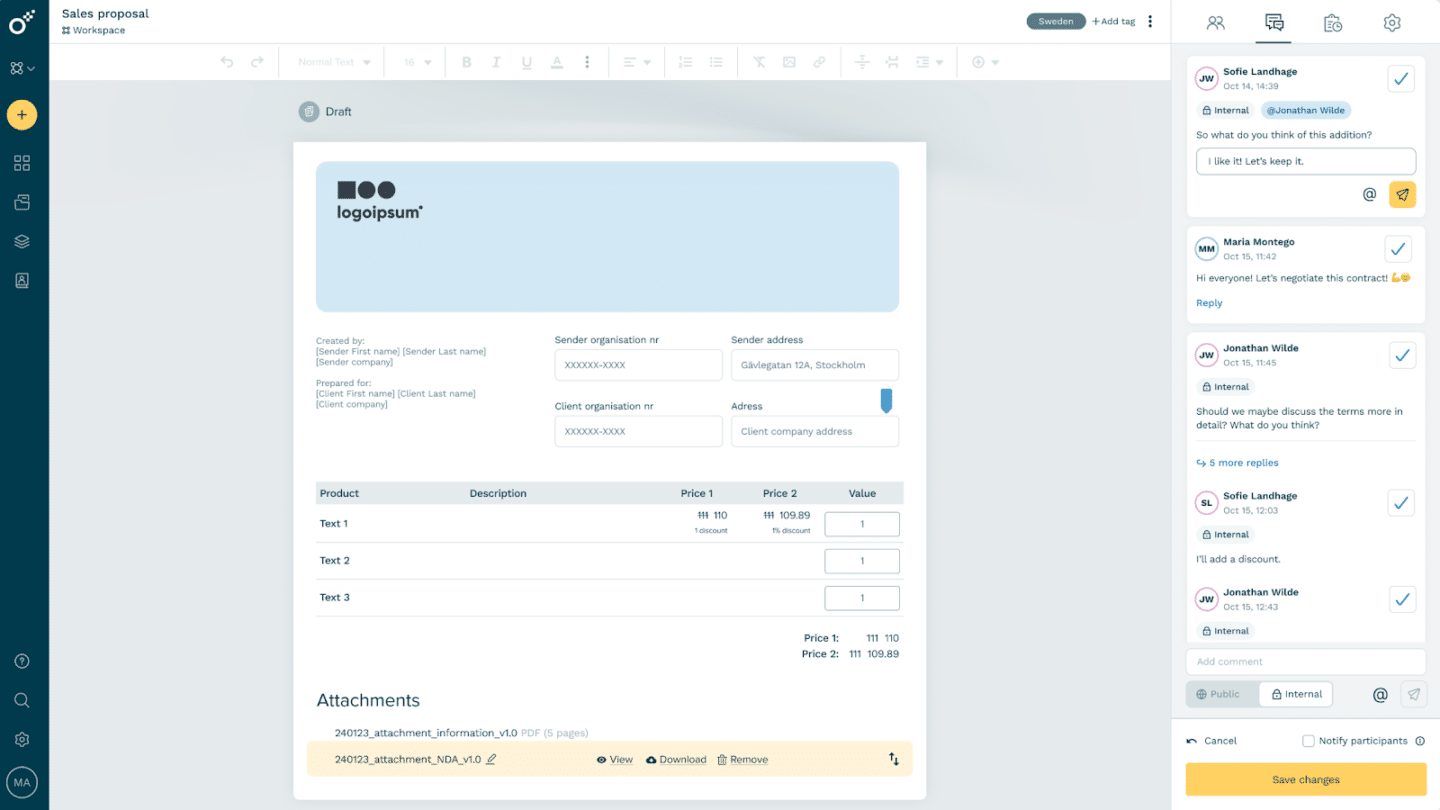
- Negotiation and redlining: Both parties negotiate terms, propose edits and mark up the document. This can become a chaotic exchange of tracked-changes files across email threads, with no one quite sure which version is the latest. Version control (or lack thereof) is the silent killer of deal momentum. Real-time collaboration inside a single live document allows for a much cleaner experience for everyone.
- Approval and review: Before anyone signs, the contract needs internal approvals from legal teams, and depending on the deal size and complexity, finance and sales leadership. Without workflow automation, this is where complex contracts go stale, they get stuck in inboxes, and approvers become bottlenecks.
- Execution: With solid e-signature options, getting sales contracts signed is fast, secure and fully digital—no PDFs, printing or manual back-and-forth. Look for tools with built-in version control that ensure you always send the correct document, plus smart workflows and recipient verification that reduce the risk of sending to the wrong contact.
- Post-signature obligations and handoff: Once the contract is signed, the data inside it needs to reach billing and operations with the agreed-upon price, payment terms, delivery terms, contract obligations and renewal dates. Manual data entry at this stage is a primary source of revenue leakage.
- Renewals and amendments: Managing contract renewals and mid-term amendments requires the ongoing visibility that manual processes just can’t give you. Auto-renewals pass unnoticed. Price escalations built into contract terms never get applied. Upsell conversations that should take place before renewal never happen.
The real cost of broken sales contract management
If you’re still managing sales contracts manually, you’re risking:
- Version chaos: When there’s no proper contract management software holding everything together, contracts end up scattered: email attachments, shared drives, a desktop folder labeled “contracts 2024 FINAL v3.” 71% of companies cannot locate 10% or more of their contracts. That’s a financial risk with real consequences, like missed renewals, unenforceable contractual obligations and compliance exposure.
- Widening the CRM-contract gap: Most sales reps live in their CRM. Most contracts are created outside of it. By the time a deal closes, the pricing in the CRM opportunity and the pricing in the signed contract may have diverged. Two-way sync between your contract and CRM data is the only way to make sure the data remains accurate and up-to-date across both.
- Revenue leakage: A 2024 Revenue Leak Report found that CROs lose an average of 16% of money to revenue leakage, which can be linked to inaccurate billing, bad data, and manual processes. The contract is often where that leakage starts: a discount applied after signing that never got updated in billing, a missed payment that nobody caught, a pricing model that changed, but the invoice template didn’t.
- Sales-finance misalignment: Sales closes the deal. Finance invoices it. When those two teams are working from different data, errors are inevitable. Finance can only invoice what it knows, and what it knows is whatever landed in the handoff email. The fix is connecting the systems, not writing better emails.
- Compliance and audit risk: Without audit trails and proper version control throughout the entire process, demonstrating what was agreed and when becomes difficult. For businesses in regulated industries or those managing enterprise accounts, it’s a legal protection issue that can determine outcomes in dispute-resolution scenarios.
“Contracts touch every dollar of revenue and cost, yet in most organizations they remain a blind spot: fragmented, slow, rigid, and unintelligible to the people who should rely on them.”
World Commerce & Contracting
What good sales contract management looks like in practice
The good news is you can overcome all those risks with sales contract management software like Oneflow.
CRM as the single source of truth
In a well-run sales contract process, product details, pricing structures, and customer data originate in the CRM and flow automatically into new contracts via a live sync, not via manual data entry. Any changes negotiated during redlining sync back. This is the foundation of an accurate quote-to-cash workflow.
Oneflow is built specifically for this, with its native integrations with Salesforce, HubSpot and Microsoft Dynamics that keep CRM as the single source of truth throughout the entire contract lifecycle. Sales reps work inside familiar systems. Finance teams receive structured, accurate data automatically. Nobody’s reconciling spreadsheets at the end of the quarter.
Dynamic contracts, not static PDFs
The biggest structural problem in most sales contract processes is reliance on PDFs. Static documents lock commercial terms in an unstructured format. They can’t be edited after generation without creating a new version, creating a hard wall between the signed agreement and your billing system. Everything that needs to cross that wall does so manually.
Dynamic contracts (live documents connected to CRM data that can be updated without breaking the audit trail) help teams keep contract data accurate and up to date throughout the lifecycle. Oneflow’s proposal software supports this with contracts that stay connected to the CRM records from the initial quote through to invoicing, and renewals.
Pre-approved templates and clause libraries
Contract automation with pre-approved templates do two things: they speed up the contract process and ensure contracts adhere to legal standards without requiring a lawyer to review every agreement. Legal teams review the templates and clause libraries once. Sales reps use them to generate compliant contracts independently any time they need.
This is especially useful for teams managing high contract volumes, multiple deal types, or a master service agreement structure where base terms are standard and only commercial variables change.
Automated approval process workflows
Every deal going through the same linear approval chain means more time wasted on something that could be automated. A standard renewal shouldn’t require the same approval stages as a six-figure enterprise deal with custom pricing models. Good workflow automation tools route contracts to the right stakeholders based on rules you set up—be it deal value, contract type or complexity—with automated reminders so nothing stalls in anyone’s queue.
Post-signature visibility
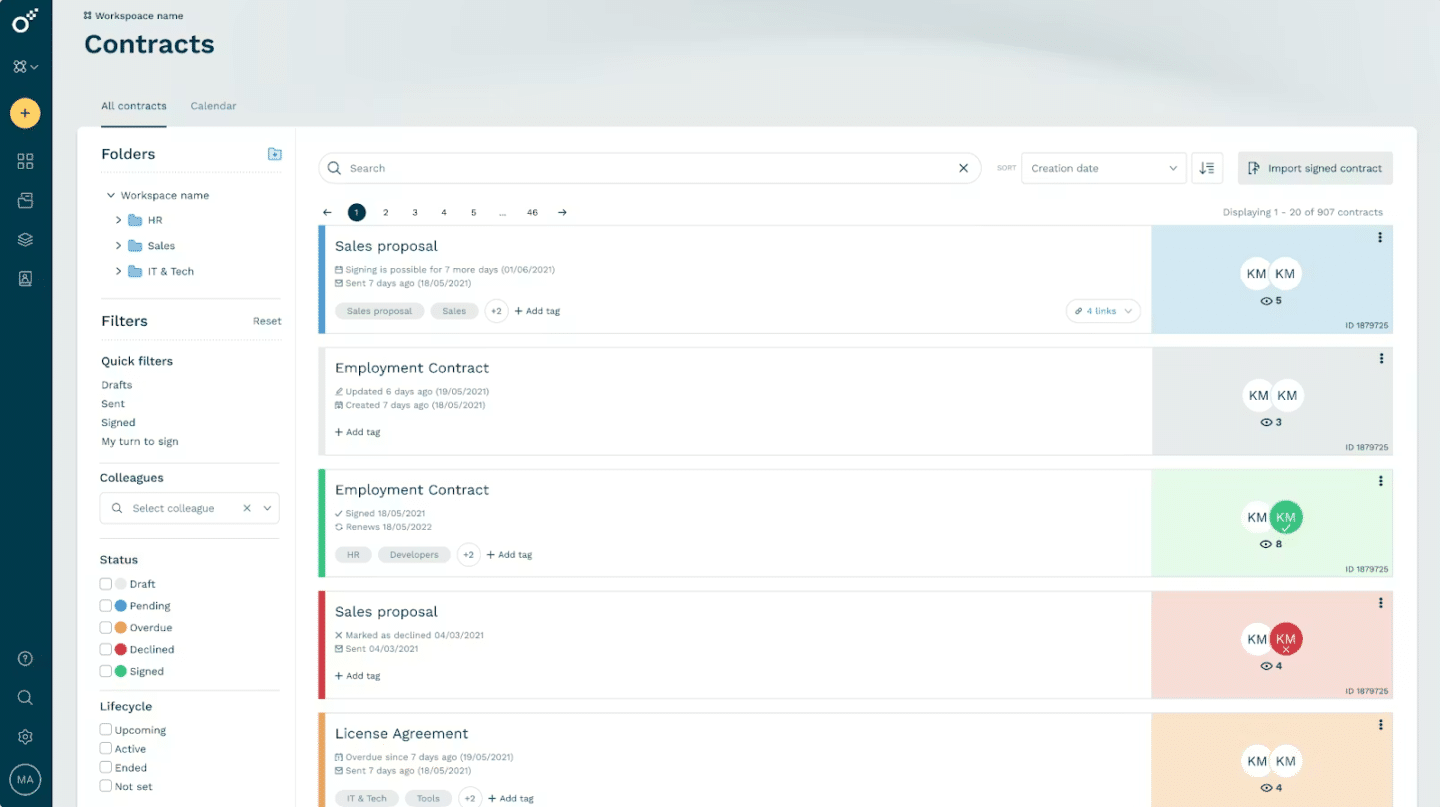
The contract that closes a deal needs to remain a usable data asset afterward. The information it includes should be searchable, trackable and reportable, not buried in a folder. Oneflow gives you the ability to track contracts throughout their lifecycle, surface upcoming renewal conversations, and give finance teams the structured data they need to invoice accurately. For teams managing enterprise-scale contract operations, this level of visibility is invaluable.
Ready to see what a connected contract process looks like for your team? Try Oneflow‘s proactive contract management.
Sales contract management software: tools worth knowing
The market for contract management software spans from basic e-signature tools to heavy, enterprise CLM platforms. The question is which one fits your actual sales contract process.
| Tool | Primary use case | CRM integration | Key differentiator | Ease of setup |
|---|---|---|---|---|
| Oneflow | Proposal and contract management across the full Q2C with secure digital signatures and post-sign visibility | Two-way sync with Salesforce, HubSpot, MS Dynamics | Dynamic contracts with live CRM data; edit-after-send; built-in analytics and AI search/drafting | Fast and intuitive |
| PandaDoc | Document automation for proposals, quotes, and e-signatures | Native integrations with major CRMs | Strong template ecosystem, pricing tables, and real-time engagement analytics | Moderate |
| DocuSign CLM | Enterprise e-signature and contract lifecycle management | Deep Salesforce integration + broad ecosystem | Advanced CLM workflows, clause libraries, and approval automation at scale | Moderate to complex |
| Ironclad | Legal-centric CLM for enterprise contracting | Integrates with Salesforce and enterprise systems via APIs/connectors | Highly configurable legal workflows with strong governance, auditability, and collaboration tools | Complex; longer implementation |
| Conga CLM | Salesforce-centric contract lifecycle and Q2C automation | Native Salesforce architecture | Strong Q2C alignment (CPQ + CLM) and support for complex pricing and deal structures | Complex; built for enterprise |
Stop filing contracts. Start connecting them.
The contract signing is more like the halfway point, not the finish line. Everything that happens after (invoicing, obligation tracking, managing contract renewals and amendments) depends on the quality of data that comes out of the contract.
When your sales contract management process is built on live, connected data, deal closures stop generating administrative debt. Business success in revenue operations depends on that connection from quote to cash.
Try Oneflow and see how quickly things change when your contracts and your business data start working together.
FAQs
How does poor sales contract management cause revenue leakage?
Revenue leakage from contracts usually comes from: pricing terms that diverged during negotiation but were never updated in billing, unauthorized discounts that stayed in place past their intended window, missed payments caused by overlooked payment schedules, and contract renewals that auto-renewed on old terms. Across a large contract portfolio, they add up to lost revenue that doesn’t show up clearly in any single report. The fix starts with treating contract data as live and connected, not archived and static.
What features should I look for in sales contract management software?
CRM integration is non-negotiable: bidirectional sync so data flows both ways without manual data entry. You should also look for dynamic contract capabilities, pre-approved templates with clause management, automated approval workflows, e-signatures that work on any device, version control and collaboration features, and post-signature tracking for renewal dates and contract obligations. AI features for contract review, drafting, searching and risk analysis are increasingly useful.
What are the 5 steps of contract management?
- Contract creation from CRM-connected templates
- Negotiation and redlining with version control
- Internal review and approval via automated workflows
- Execution via e-signature
- Post-signature management covering obligation tracking, payment schedules, contract renewals, and data handoffs
What is CLM used for in sales?
Contract lifecycle management in a sales context covers the full journey of a sales agreement, from the initial quote through drafting, negotiation, signing and ongoing management of contract terms and obligations. CLM tools help sales reps generate contracts faster from CRM data, keep legal teams informed without creating bottlenecks, execute digital signatures quickly, and ensure that post-signature data reaches finance accurately without relying on email forwarding. The goal is a single, connected process, not a collection of disconnected tools.
.png?id=40edbc9ee25345a211152388fdcf1fd2)

.png?id=073897979970647cd034d6db96c145de)