Your sales team just closed a major deal. Six months later, when it’s time for renewal, nobody can find the original contract. Does pricing stay fixed? Is there an annual increase? Was auto-renewal opt-out or opt-in? By the time someone tracks down the right version, your competitor has already swooped in with a better offer.
This scenario plays out time after time.
But here’s the good news: modern contract repository management has evolved far beyond simple document storage. Today’s solutions combine AI-powered automation, deep CRM integrations and intelligent workflows that don’t just store your contracts—they actively prevent revenue leakage and accelerate your entire quote-to-cash process.
In this article, you’ll discover how contract repository management transforms from a filing problem into a revenue engine, what features matter most and which solutions actually deliver on their promises.
Contract repository meaning
Contract repository management is the systematic approach to organizing, storing and retrieving all your contracts in a centralized digital system. Think of it as the difference between throwing receipts in a shoebox versus using accounting software.
As opposed to manual contract storage, a digital contract repository acts as a unified platform for storing and managing all contracts, providing a single source of truth for the agreements, secure and accessible from everywhere.
A modern contract repository management system includes several key components:
- Centralized digital storage for all contract types—from vendor agreements to customer contracts to employee documents. Everything lives in one searchable location instead of scattered across email threads, personal drives and filing cabinets.
- Metadata tagging and organization that categorizes contracts by type, status, party, value and custom fields relevant to your business. This structured data makes contracts searchable and analyzable at scale.
- Access controls and permissions ensure sensitive data stays secure while enabling the right people to access what they need. Your sales team sees customer contracts; procurement sees vendor agreements; finance sees everything relevant to revenue recognition.
- Version tracking and audit trails maintain data integrity by documenting who changed what and when. This becomes invaluable during audits, disputes or compliance reviews.
- Automated alerts and obligation monitoring prevent missed renewal dates, expired terms and unfulfilled contractual obligations. The system proactively notifies the contract owner before deadlines hit.
- Analytics and reporting capabilities transform contract data into actionable insights about contract performance, compliance status and business relationships.
Now, contract repository management exists on a spectrum; not all contract repositories do the same. On one end, you have basic document storage—Google Drive folders or SharePoint libraries where contracts live alongside meeting notes and vacation photos. These tools organize files but offer zero contract-specific functionality.
Traditional contract repositories sit in the middle. They provide centralized storage with some basic search, categorization and regulatory compliance standards, but they’re essentially static databases. You can find contracts easier and maintain version control, but you can’t do much with them.
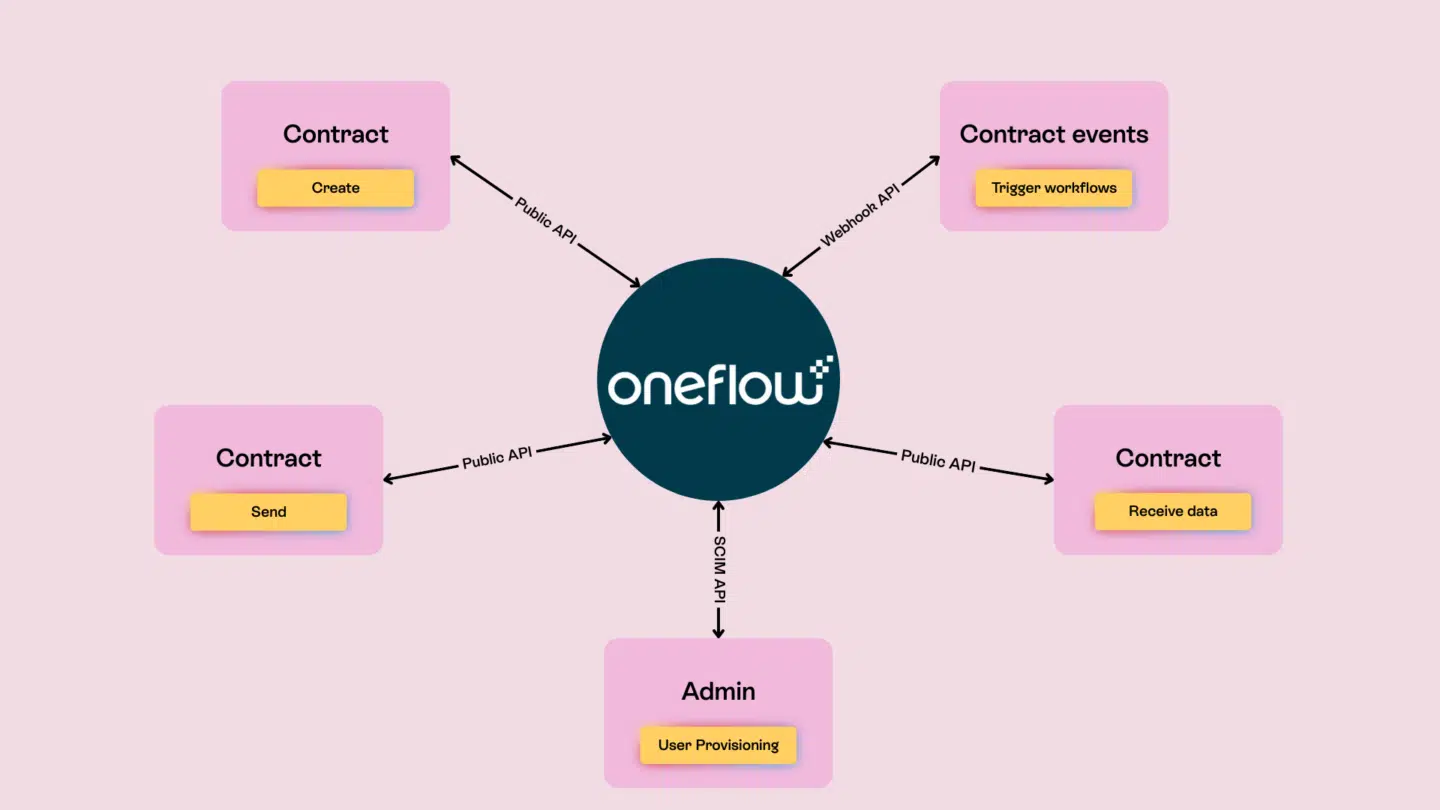
Modern contract repository management, like Oneflow, represents the sophisticated end of the spectrum. These systems are intelligent, automated and interconnected. They integrate with your CRM, trigger workflows based on contract events, allow signing, extract key metadata and use it for an advanced search functionality, provide real-time visibility into contract performance, allow pre-sign collaboration with version control and include post-sign archiving functionalities. This is what contract lifecycle management actually looks like in practice.
Why traditional contract data storage methods fail in 2026
According to a study by World Commerce & Contracting, poor contract management erodes about 8.6% of expected commercial value annually—including lost revenue, margin leakage and avoidable cost overruns—and can reach 15%+ in complex scenarios.
Here’s what causes this:
- Multiple conflicting versions create chaos. Sales has one version in their CRM. Legal has another in their document management system. Finance has a third version with different payment terms. When renewal time comes, nobody knows which version actually got signed. The same study from above shows that contracts-related data tends to be scattered across 24 different systems on average, which makes it nearly impossible to track commitments or optimize decisions on a timely basis.
- No automated tracking means renewal dates slip by unnoticed. Auto-renewals kick in for services you no longer need. Discounts expire without anyone realizing. Price increase clauses activate automatically.
- Compliance risks multiply when you can’t quickly prove what’s in your contracts. Regulatory audits become nightmares. Data processing agreements for GDPR? Good luck finding them all. Supplier diversity reporting? Hope you tagged everything from your existing contract obligations correctly in that spreadsheet.
- Limited visibility into contract performance means you’re flying blind. Which vendors consistently miss service level agreements? Which customers are approaching their contract limits? What’s your exposure if a key supplier fails? Traditional storage provides zero insight into these strategic questions.
- Security vulnerabilities emerge when contracts sit in shared drives with unclear permissions. A departing employee downloads your entire vendor contract database. An intern accidentally shares customer agreements externally. Sensitive pricing data leaks to competitors.
- Wasted time kills productivity. Legal teams spend hours searching for precedent clauses instead of reviewing new deals. Sales reps recreate proposals because they can’t find the template with approved terms. Procurement specialists manually track dozens of renewal dates in spreadsheets.
- Knowledge gaps develop as institutional knowledge walks out the door. When your contracts person leaves, their successor spends months figuring out where everything is and what it means. Context about negotiation history, special accommodations, and relationship nuances disappears.
- Scalability issues doom growth. Your company signs 50 contracts per quarter now. What happens when that number hits 500? Traditional storage methods collapse under volume. Manual tracking becomes impossible. Compliance gaps widen. Revenue leakage accelerates.
Modern contract management software solves these problems by combining repository functionality with contract automation, intelligent workflows and post-signature tracking. That’s the distinction between a simple document repository and true contract lifecycle management.
A contract repository focuses narrowly on storage and retrieval. Contract lifecycle management encompasses the entire contract lifecycle—from initial request through creation, negotiation, execution, obligation tracking, renewal and analysis. The repository is one component within a broader CLM system.
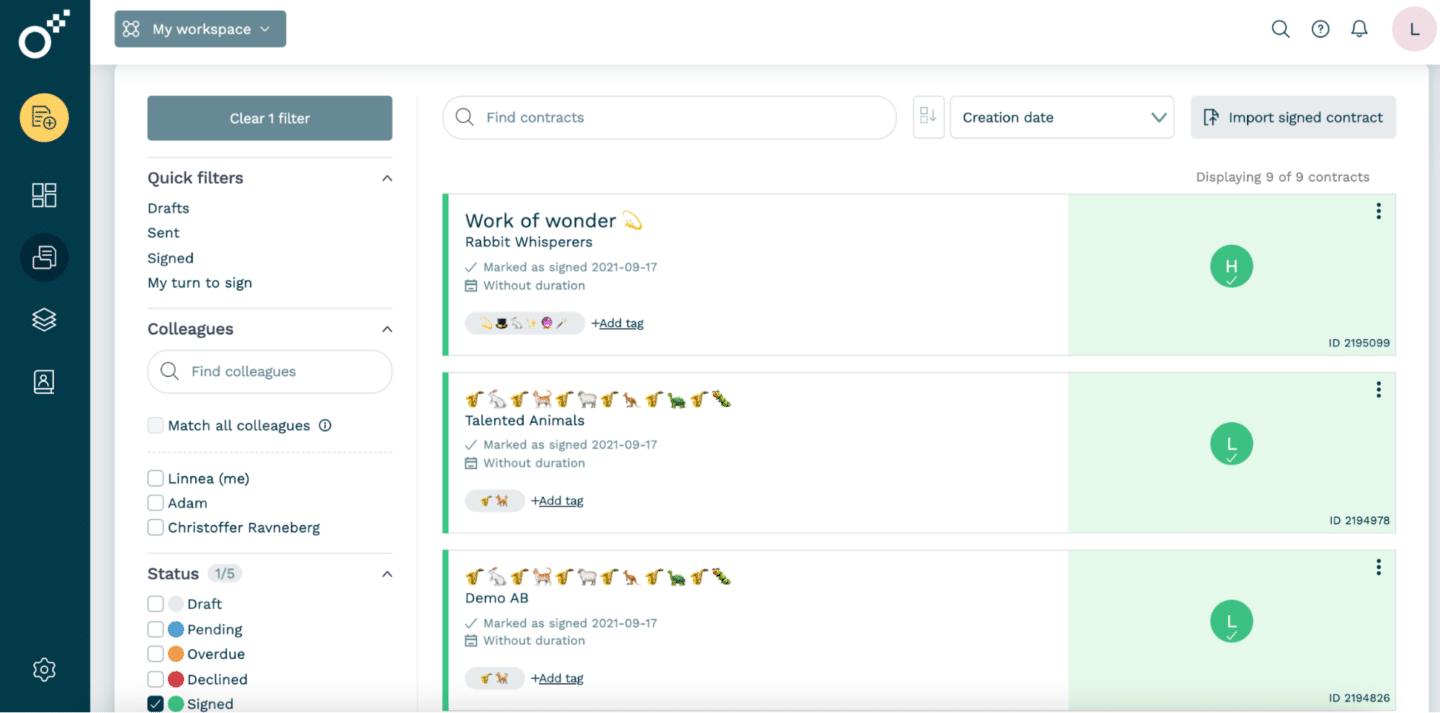
Oneflow exemplifies this distinction. While it provides a robust centralized contract repository, it’s actually a complete contract management platform with deep CRM integrations, electronic signatures and AI-powered features. This comprehensive approach addresses all the failure points in traditional storage methods.
Key features of modern contract repository software
Let’s examine the key features of intelligent contract management systems that allow you to make your contracts a revenue engine:
- Centralized contract repository (single source of truth): Imagine a unified hub where all your contracts live, regardless of type, status or department. Every sales agreement, vendor contract, employment document and NDA flows into one centralized contract repository system. This eliminates the scattered file syndrome, with strict version control, automatically saving every iteration and tracking who made what changes. Access management ensures sensitive data stays protected while enabling collaboration. Everyone works from the same data source, preventing the confusion and disputes that arise from multiple conflicting versions.
- Advanced search and automated data extraction: An advanced search functionality lets you locate any contract or clause in seconds using natural language queries or tags. You should be able to search by party name, contract value, date range, status or custom tags you’ve defined. The chosen platform should help with consistent naming conventions and structured data that makes your entire contract repository searchable and analyzable.
- Tagging, filtering and data extraction: Effective contract repository management requires intelligent organization. Custom metadata tagging aligned with your business needs allows you to sort contracts by department, product line, risk level, approval status or any criteria that matters to your organization. Look for AI capabilities that extract vital data automatically, populating fields for renewal dates, payment terms, key obligations and contract clauses. This eliminates manual data entry while ensuring consistent, accurate metadata across your entire contract repository.
- Automated alert and reminder system: Automation of contract management processes accelerates negotiation cycles and reduces inaccurate payments. Pick a platform that tracks key dates and obligations, sending automated reminders before renewal dates, milestone payments or compliance deadlines. Calendar integrations ensure these alerts appear where your team already works.
- Native CRM and business system integrations: Deep integrations with Salesforce, HubSpot, Microsoft Dynamics, ERP systems and other core business systems keep contract information and CRM data aligned, ensuring accuracy across your entire tech stack.
- Collaborative workflows (version control and audit trails): Modern contracting requires real-time collaboration between legal, sales, finance and external counterparties. Look for software that enables in-platform editing, commenting and negotiation without endless email chains or version confusion. It should include comprehensive audit trails documenting every action. This transparency proves invaluable during compliance audits, disputes or internal reviews.
- Security and access controls: SOC 2 Type II certification, GDPR compliance, enterprise-grade encryption, granular permissions control and role-based access are non-negotiable. Contracts shouldn’t be possible to download or share by anyone.
- Cloud-based accessibility: Modern teams work from anywhere, and your centralized contract repository should be accessible from any device, anywhere. Cloud infrastructure also ensures automatic backups, disaster recovery and seamless updates without IT involvement.
Contract repository management best practices
Technology only delivers value when combined with sound processes. These best practices help you maximize your contract repository management system’s potential:
- Standardize metadata schema across all contract types for consistency. Define required fields for every contract: parties, dates, values, obligations, and renewal terms. Apply these standards uniformly, whether you’re managing vendor agreements, customer contracts or employment documents.
- Implement role-based access to balance collaboration with security. Define clear roles and permissions that enable necessary access while protecting sensitive data.
- Automate wherever possible to reduce manual work and human error. Use AI-powered data extraction to populate metadata fields automatically. Enable workflow automation for approval routing and contract creation. Set up automated alerts for renewal dates and key obligations. Every manual task you automate reduces errors and frees your team for higher-value work.
- Conduct regular audits of contract data, compliance, contract terms, metadata accuracy and user permissions. These audits identify gaps before they become problems.
- Establish retention policies aligned with legal and regulatory requirements. Not all contracts need permanent storage. Define clear rules for how long each contract type should be retained and when it can be archived or deleted. This keeps your contract repository focused on active agreements while maintaining compliance.
- Integrate with key systems (CRM, ERP, HR) to eliminate data silos. Your contract repository should connect seamlessly with the platforms your team already uses. This ensures data consistency, reduces duplicate entry and provides contract intelligence where decisions get made.
- Monitor KPIs to measure success and identify optimization opportunities. Track metrics like contract cycle time, missed renewal rates and compliance adherence. These measurements reveal where your contract repository management is working and where it needs improvement.
- Start with active contracts for immediate value, then migrate agreements from legacy systems. Don’t let historical contract migration delay your implementation. Get your current contracts into the system first, then systematically digitize older agreements.
- Document workflows and processes for onboarding and consistency. Create clear documentation explaining how contracts move through your system, who approves what and when escalations occur. This documentation ensures consistency, speeds onboarding and preserves institutional knowledge as team members change.
- Maintain version control and audit trails. Every contract should have a version history, with clear version IDs (or naming), metadata about edits/approvals (who, when, what changed) and an audit trail. Only the latest, approved version should be used for execution, and prior versions should be archived for reference.
Best software tools for easier contract repository management
The contract repository management market offers numerous solutions, each with distinct strengths. Here’s an overview of five leading platforms that should help you make the right choice.
Oneflow
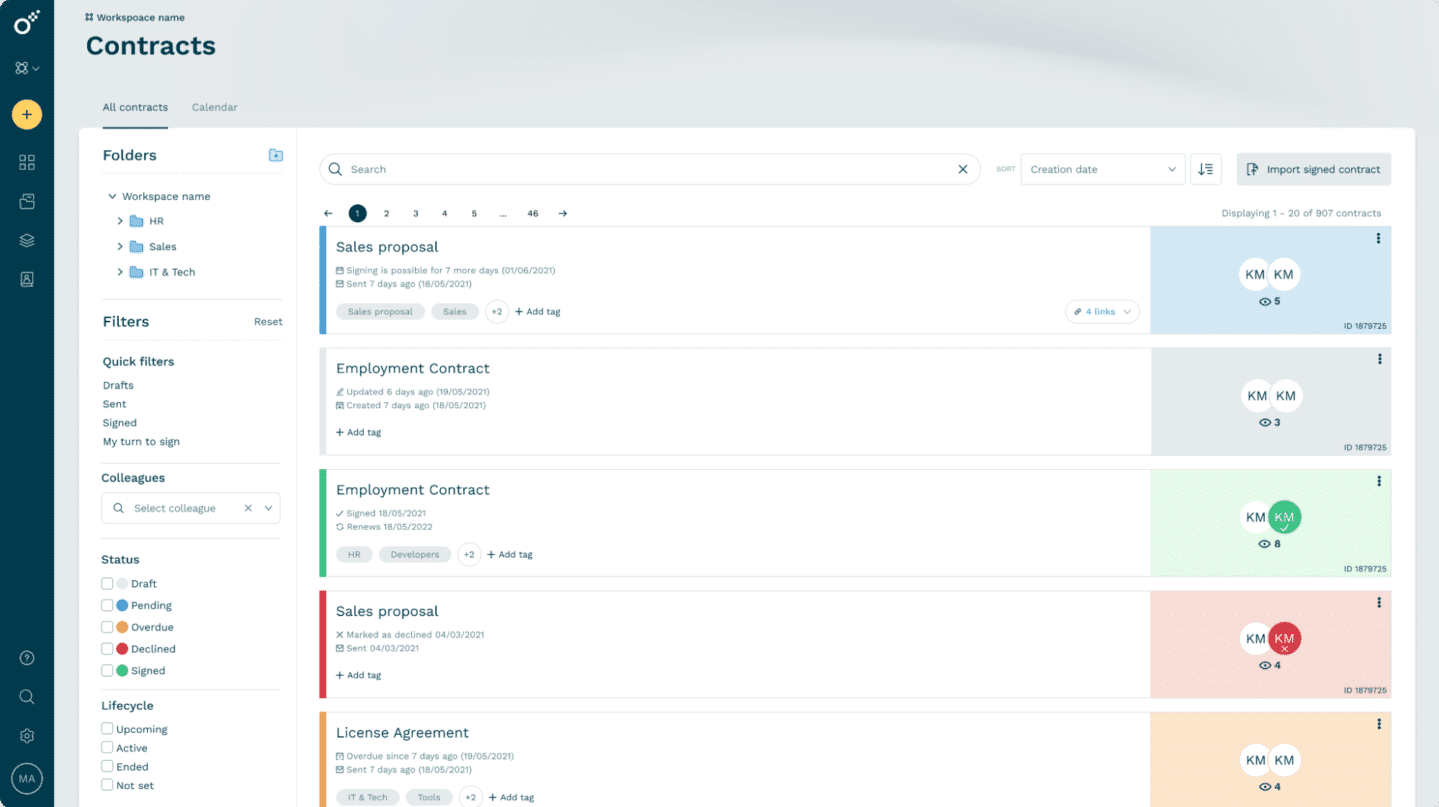
Oneflow stands out as a complete contract lifecycle management platform that goes far beyond simple repository functionality. While it provides practical and secure centralized contract storage, its real power lies in dynamic contract creation, bi-directional CRM sync and AI-powered features.
The platform optimizes the quote-to-cash process, enabling sales teams to generate proposals, create contracts, negotiate terms and collect signatures—all within a system that syncs directly with Salesforce, HubSpot or Microsoft Dynamics. This integration ensures contract data becomes the source of truth for invoicing flows, reducing revenue leakage and accelerating deal cycles.
When sales closes a deal in your CRM, Oneflow automatically generates the contract using approved templates and current product data. When finance needs to invoice, the system provides accurate, structured data automatically. This integration eliminates disconnected systems, reduces manual data entry, and prevents the errors that cause revenue leakage.
For businesses focused on quoting software or proposal software, these integrations become especially valuable. Oneflow acts as the connective tissue between your quote generation and contract execution, maintaining data integrity throughout the entire process.
Oneflow’s AI capabilities include contract writing help and automated review. Legal teams particularly appreciate the platform’s digital signatures capabilities with signing order configuration with notifications, comprehensive audit trails and extensive security.
The platform’s pricing scales with your business, making it accessible for mid-market companies while delivering enterprise-grade functionality. Implementation is quick – typically days rather than months – and the interface is intuitive enough that teams adopt it without extensive training.
Key differentiator: Complete Q2C workflow with true two-way CRM sync and modern AI tools, not just a contract storage system with basic integrations.
Try Oneflow to see how modern contract repository management should work.
Ironclad
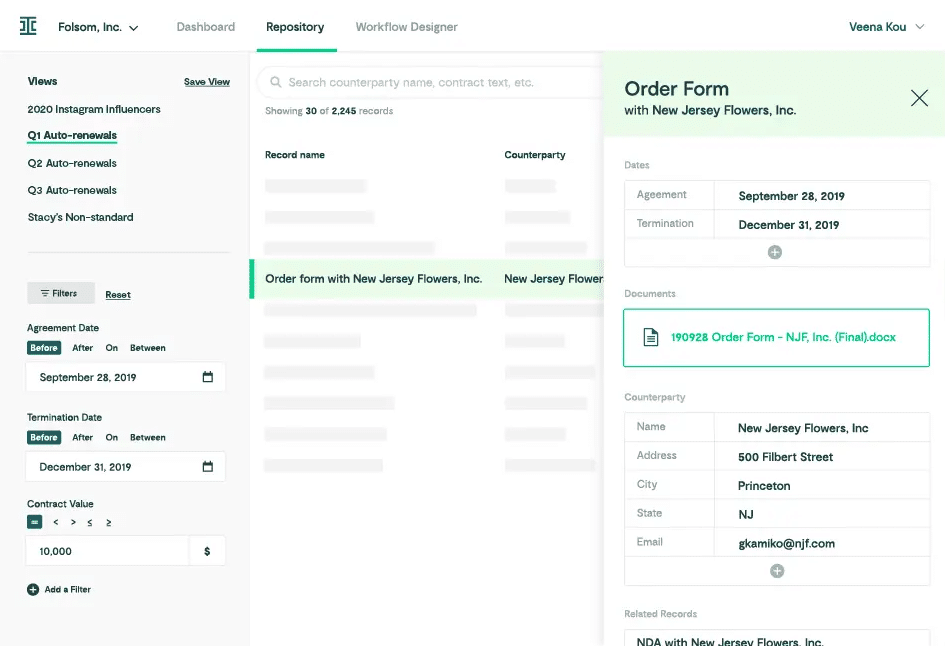
Ironclad is an AI-powered contract lifecycle management platform focused on legal and procurement workflows.
The platform offers extensive workflow automation, contract analytics and a dynamic repository that consolidates contract management across departments. Ironclad handles complex approval processes well and provides strong post-signature obligation tracking.
However, users report a steep learning curve and occasional technical issues with API integrations. The pricing model targets enterprise clients, making it cost-prohibitive for smaller organizations with constrained budgets.
Key differentiator: Deep workflow customization and enterprise-scale contract analytics.
Sirion
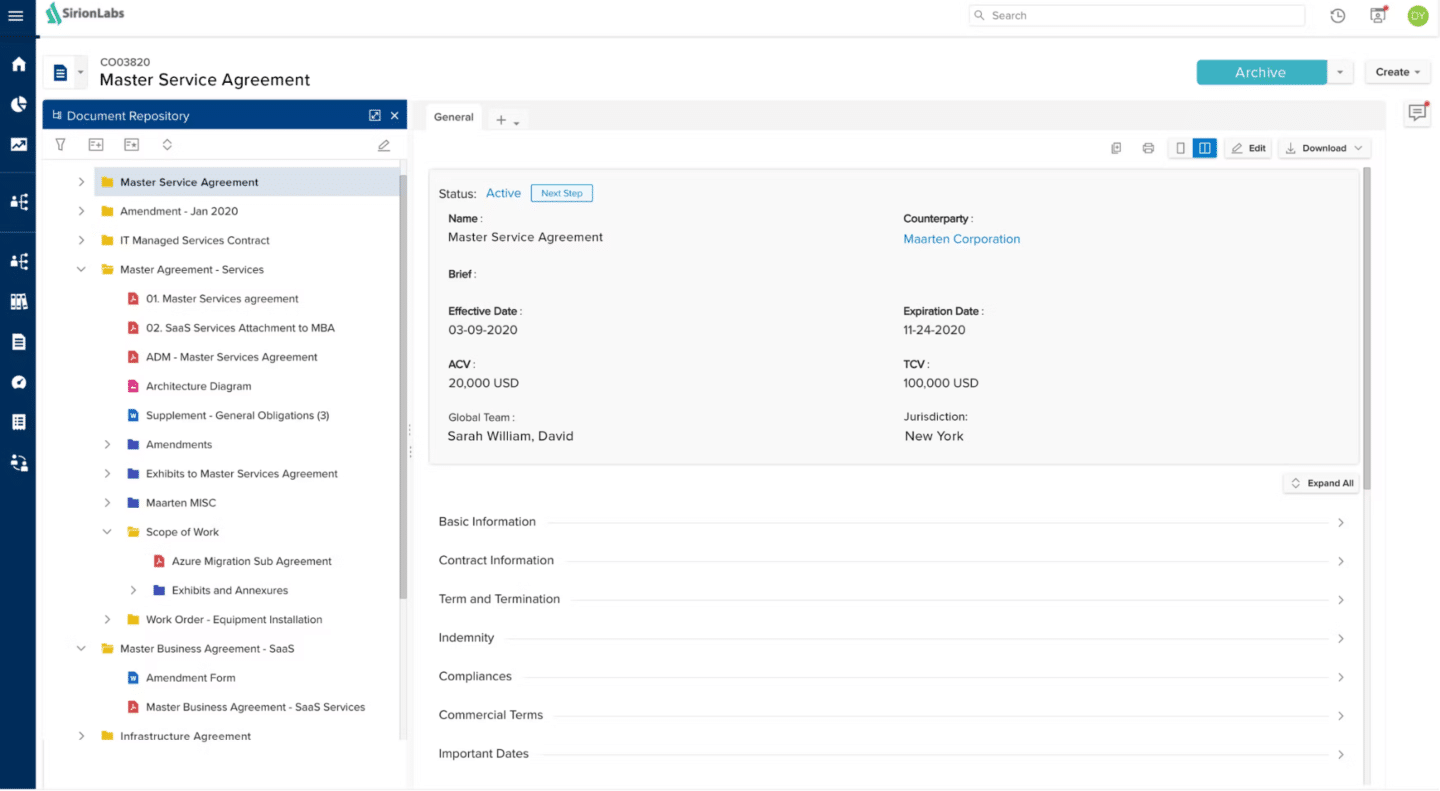
Sirion’s agentic AI approach includes purpose-built agents for contract search, drafting, issue detection and redlining. These agents handle complex tasks with practitioner-grade precision.
The system’s strengths lie in AI-powered extraction, conversational search and enterprise-grade integration with ERP and procurement systems. It’s particularly well-suited for large organizations with complex contract portfolios requiring sophisticated risk management.
However, Sirion’s enterprise focus means pricing and implementation complexity may not suit smaller businesses.
Key differentiator: AI-native platform with specialized agents for each stage of the contract lifecycle.
Docusign
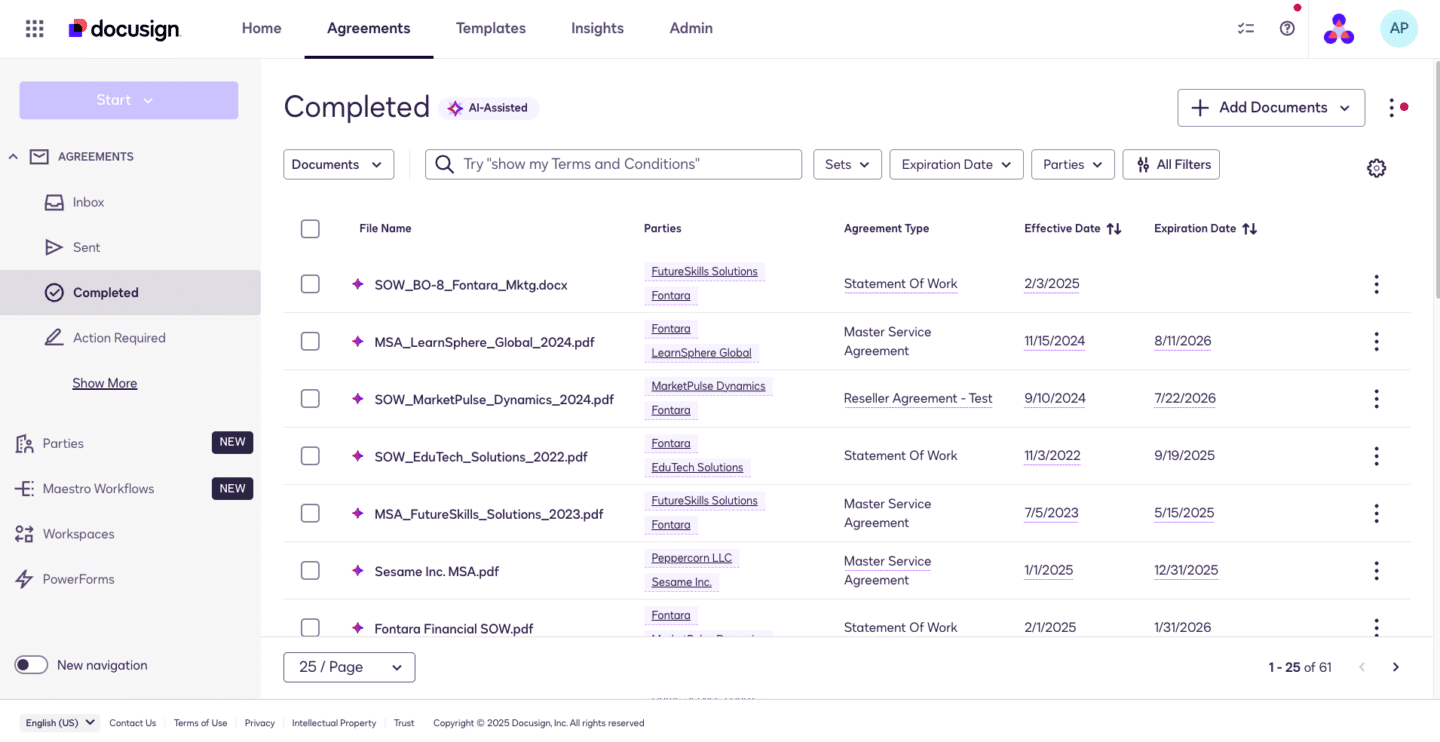
Docusign CLM combines the company’s dominant e-signature capabilities with contract lifecycle management features.
It provides workflow automation, contract generation and repository functionality integrated with Docusign’s signature tools.
However, users report that the interface can feel unintuitive, especially for complex contract management tasks. The platform focuses more on workflow automation than deep contract intelligence or CRM integration. Customer support responses can be slow for complex implementation issues.
Key differentiator: Seamless integration with Docusign’s e-signatures.
See also: The 20 best Docusign alternatives you need to know about
PandaDoc
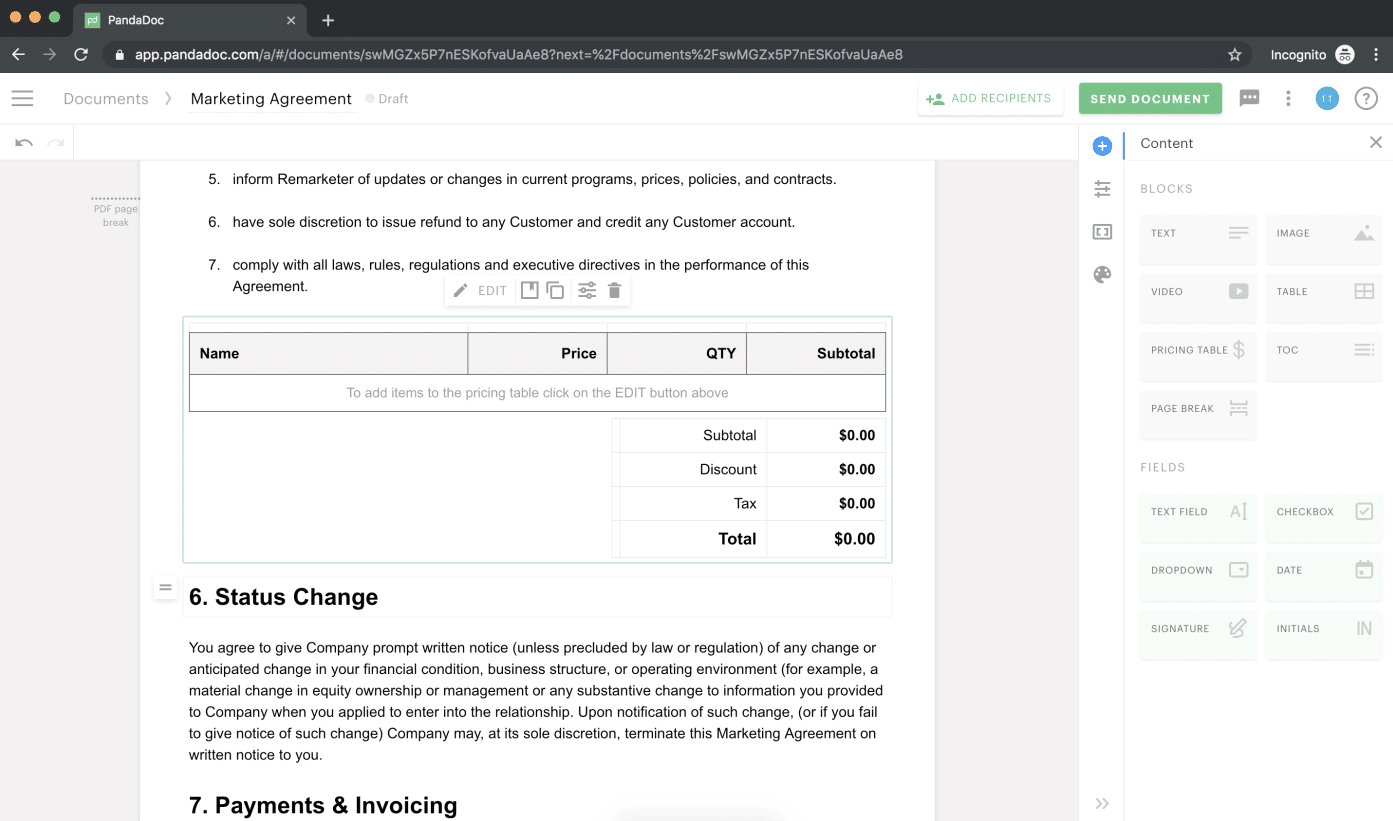
PandaDoc is document management software for contract development and management, offering template management, electronic signatures and document analytics. The platform appeals to small and mid-sized businesses seeking an accessible entry point to contract automation.
It provides solid document creation tools, built-in signatures and workflow automation. The interface is approachable for non-technical users, and implementation is relatively quick.
However, it lacks some advanced contract repository management features like AI-powered extraction, obligation tracking or sophisticated analytics.
Key differentiator: User-friendly interface with strong proposal creation capabilities at accessible price points.
See also: Top 20 PandaDoc alternatives and competitors
Regain control of your contracts
Contract repository management has evolved from a filing headache into a strategic opportunity. The organizations winning today don’t just store contracts—they extract intelligence from contractual obligations, automate workflows around them, and use them to prevent revenue leakage while accelerating growth.
Companies implementing modern contract repository management report faster contract cycles, dramatically reduced administrative work, improved compliance, and millions recaptured from contract value leakage.
Oneflow represents this new generation of contract management, going beyond repository functionality to enable dynamic contracting that syncs with your CRM, automates your quote-to-cash process, and turns contracts from static documents into strategic business assets.
The choice is clear: continue losing revenue to poor contract management, or implement a system that transforms contracts from a necessary evil into a competitive advantage.
Try Oneflow and discover how modern contract repository management should work.
FAQs
What happens to contracts after they expire in a repository system?
Most contract repository management systems allow you to set automated workflows for expired contracts. You can choose to archive them for record-keeping while removing them from active views, trigger renewal workflows before expiration, or automatically flag them for review. Modern platforms like Oneflow provide customizable retention policies aligned with your legal and regulatory requirements. Expired contracts remain searchable for reference but don’t clutter your active contract management workflows.
How much does contract repository management software typically cost?
Pricing varies significantly based on features, contract volume, and number of users. Oneflow offers flexible pricing that scales with your organization, providing enterprise functionality at mid-market price points, starting from $17/month.
What is the typical implementation timeline for contract repository management software?
Implementation timelines vary dramatically by platform complexity. Basic repository tools can be operational in days—upload contracts, set up folders and start using them. Mid-market CLM platforms typically take 2-8 weeks for full implementation, including data migration, workflow configuration and integration setup. Complex enterprise deployments can require 3-6 months or longer. Oneflow’s implementation typically completes in days to weeks rather than months, with most organizations realizing value immediately.
How secure is cloud-based contract repository management?
Modern cloud-based contract repository systems typically exceed the security of on-premise solutions. Leading platforms like Oneflow maintain SOC 2 Type II certification, GDPR compliance and enterprise-grade encryption for data in transit and at rest. Cloud providers invest heavily in security infrastructure, redundancy and disaster recovery that most organizations couldn’t replicate internally. Key security features to evaluate include role-based access controls, audit logging, multi-factor authentication and data residency options for regulated industries. Cloud-based systems also provide automatic security updates without IT involvement, ensuring your contract repository stays protected against emerging threats.
.png?id=40edbc9ee25345a211152388fdcf1fd2)

.png?id=073897979970647cd034d6db96c145de)