According to SHRM’s 2025 State of the Workplace Report, 57% of HR leaders say their compliance-related workloads increased year over year, largely due to expanding pay transparency laws, tighter I-9 enforcement, and AI-driven regulatory oversight. The volume of employee documents HR departments are expected to manage, track and retain has grown substantially. The tools most companies use haven’t kept up.
This article covers six HR document management software platforms worth your time, what to consider before you choose one, and why the decision matters more than most HR teams realize. Whether you’re managing offer letters for a high-volume hiring cycle, wrestling with paper files that should have been digitized years ago, or trying to keep employee records compliant across multiple jurisdictions, there is a tool that can help you.
What to look for in HR document management software
Here’s what separates useful HR document management solutions from expensive digital filing cabinets:
- Template automation and dynamic creation. Good HR contract management software should let you generate compliant employee documents in a few clicks, pulling employee data from your HR system, applying the right clauses for the role, and sending it without anyone touching a Word document.
- Approval workflows. Your HR document management system should automatically route documents, with a logged record of who approved what and when.
- E-signature. Ideally: legally valid under the US ESIGN Act and UETA, and native to the platform, not a third-party add-on. If your workforce spans Europe, eIDAS compliance matters too.
- Version control and post-signature editing. Candidates negotiate. Terms change. Sometimes an amendment is needed after signing. The platform needs to handle this without creating a chaos of document versions and email threads.
- Retention policy automation. I-9s, FLSA records, state-specific documentation—each category of employee records has its own legally mandated retention schedule that a proper HR document management system enforces automatically.
- HRIS/payroll system integrations. If your HR document management software doesn’t sync with BambooHR, Rippling, Workday, Gusto or whichever system holds your employee data, you’re creating double-entry administrative tasks.
- Role-based access controls. Medical records, I-9s, compensation documents and performance reviews are sensitive employee information categories that require different permission levels. Controlled access doubles as a data security measure and a compliance requirement.
- Audit trails. Every access event, change and view logged automatically. This is your primary defense in an employment dispute and your first response to a compliance audit.
Best HR contract management tools: an overview
The comparison below reflects platforms with extensive contract lifecycle management capabilities for HR use cases. Ratings are sourced from G2 and Capterra as of early 2026.
| Tool | Differentiator | User rating | Key features |
|---|---|---|---|
| Oneflow | Live, editable HR contracts with two-way HRM/CRM sync | 4.6 | AI drafting, dynamic contracts, e-signatures, approval flows, post-sign tracking |
| Sirion | Post-signature obligation and SLA monitoring at enterprise scale | 4.6 | Agentic AI, obligation tracking, redlining, ERP/CRM integrations |
| DocuSign CLM | Governed agreement workflows across the enterprise | 4.3 | Maestro automation, Navigator AI repository, Salesforce integration |
| PandaDoc | Polished proposal-style HR documents with engagement analytics | 4.5 | Drag-and-drop editor, analytics, payment collection, CRM integrations |
| Icertis | Contract intelligence for global enterprises managing millions of agreements | 4.2 | AI risk scoring, obligation management, SAP/Salesforce integration |
| Conga CLM | Salesforce-native contract lifecycle automation | 4.3 | Clause library, AI extraction, approval routing, ERP/CRM integration |
The top 6 HR document management software tools
Oneflow
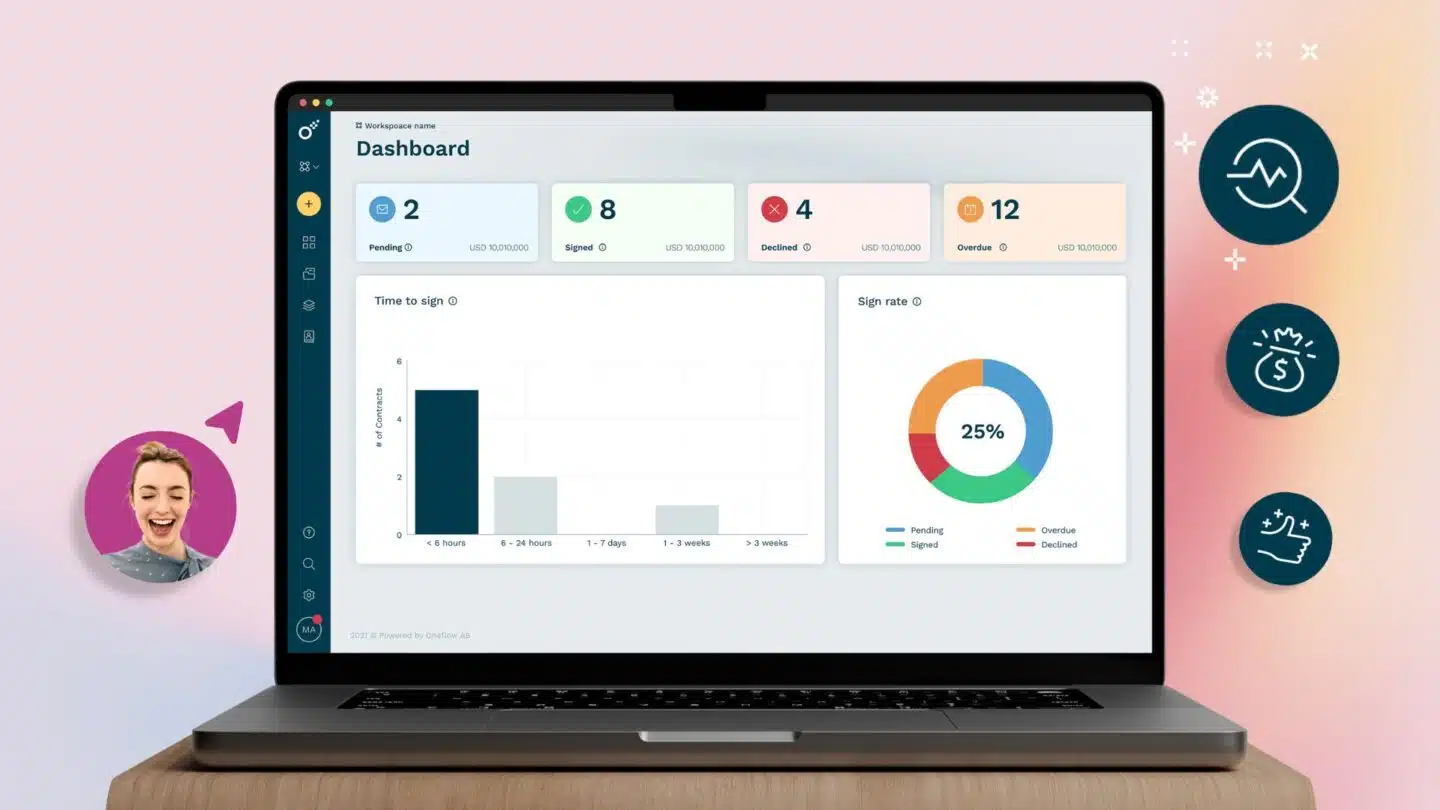
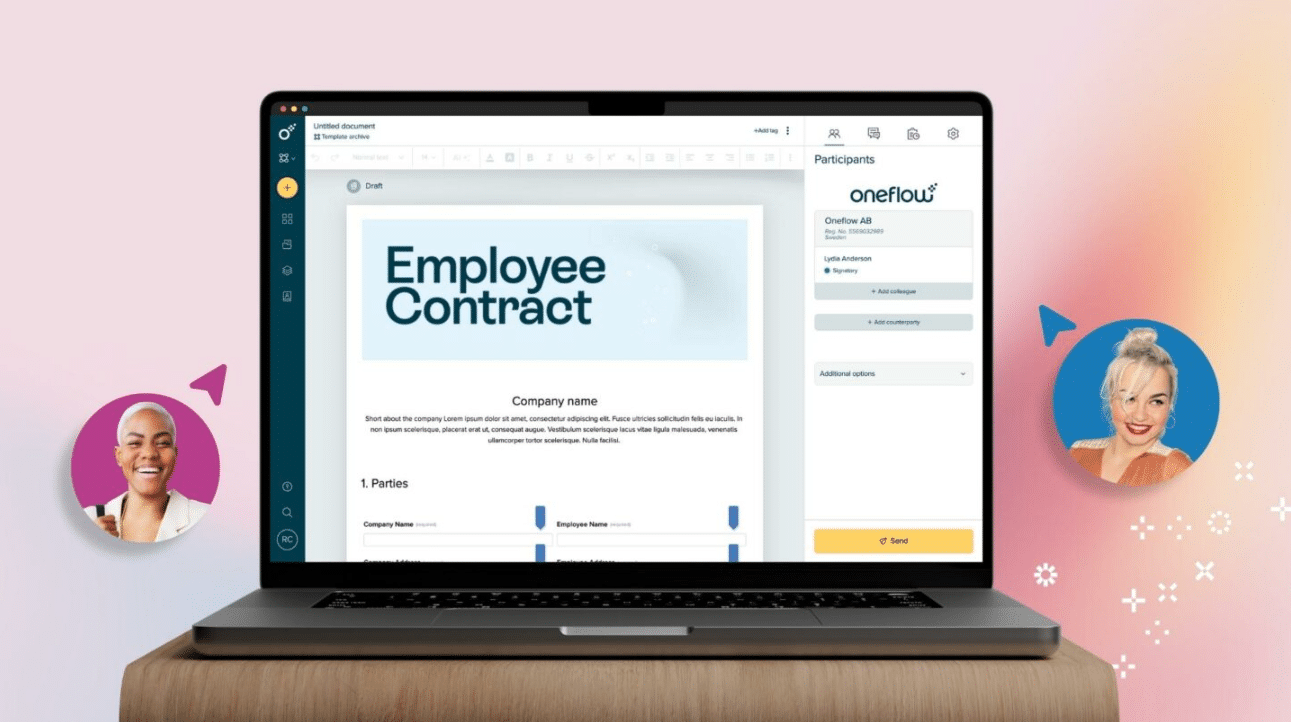
Employment agreements in Oneflow aren’t PDFs attached to emails. They’re browser-native, fully interactive documents that stay live throughout the negotiation process. A candidate receives the contract, can comment on specific clauses, propose changes to their start date, or flag something for clarification, and your HR team sees all of it in real time, directly in the document.
HR professionals managing high-volume employee onboarding love our HRM integrations. Connect it to platforms like HiBob or Teamtailor, and candidate information pulls automatically into the contract (name, role, salary, start date) without anyone touching a form field. When the agreement is signed, the confirmed terms sync back to your system of record.
Our HR team has noticed that the candidate and employee experience dramatically improves when candidates feel included in the process. Prospects who feel they had agency during the contracting stage tend to have a stronger sense of trust in their new employer.
Anders Hamnes, Oneflow CEO and Founder, notes: “By not having to deal with legacy processes that slow you down, companies can work smarter by focusing on higher-value activities, achieving more with less.” A customer survey found that users reclaimed an average of 16.7 hours per month (four hours per week) through automated contract workflows.
Oneflow’s AI handles drafting from templates, clause risk analysis, contract summarization, and portfolio-level compliance review. There’s also an AI Review feature that analyzes individual contracts before signing, which is useful when processing high volumes of employee documents, where you can’t have someone manually reviewing every line. The platform holds ISO 27001 (Information Security), ISO 9001, and ISO 14001 certifications, as well as SOC 2 compliance.
You can go deeper on the automation approach in our guides on what is contract automation, how to automate HR contracts, and how to create online contracts.
Key features
- AI drafting, clause analysis, compliance review and portfolio risk scanning
- Browser-native live contracts, editable throughout negotiation, not locked at send
- Advanced and standard digital signatures, including BankID—ESIGN, UETA and eIDAS compliant
- Real-time negotiation with inline comments and tracked suggestions
- Configurable multi-level approval workflows with full audit trails
- Post-sign lifecycle: renewal alerts, obligation tracking, searchable centralized storage
- Native integrations with HubSpot, Salesforce, Microsoft Dynamics 365, HiBob, Teamtailor and more
- Role-based access controls and workspace-level permissions for sensitive HR document categories
User review
Source: Capterra
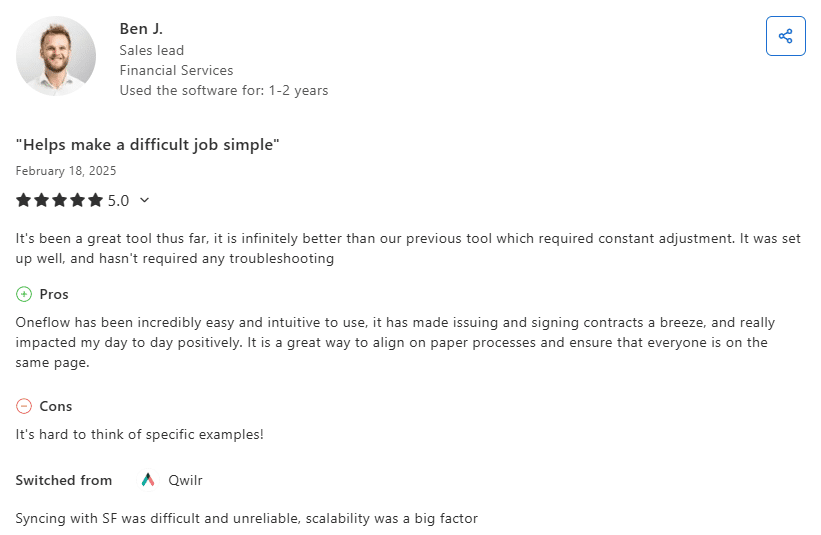
Before Oneflow, Hedin Bil, a large automotive group, was manually managing contracts for thousands of new hires annually. After implementing Oneflow with integrations across both HR and CRM systems, the team saved 10 hours per week in administrative work, hired over 3,000 employees through the platform, and achieved a positive ROI in under one month. You won’t see results like these when you’re still managing employee files in email.
Book a demo to see what we can do for you.
Sirion
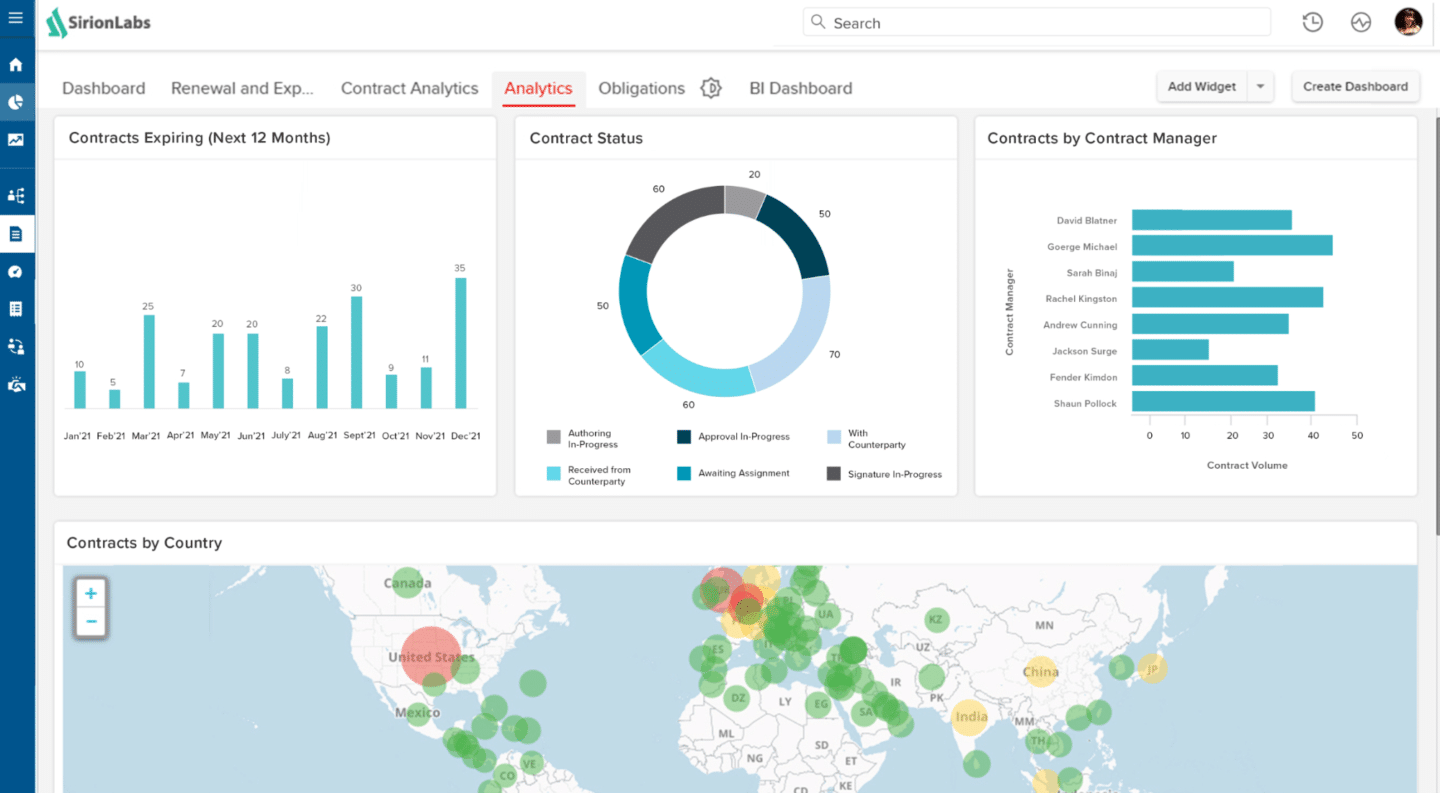
Sirion is less for HR teams generating offer letters and more for legal and procurement functions managing complex, high-value agreements where post-signature performance needs to be carefully monitored over time. Organizations with sophisticated contractor management needs, complex outsourcing relationships, or multi-entity employment structures will find solid capabilities here.
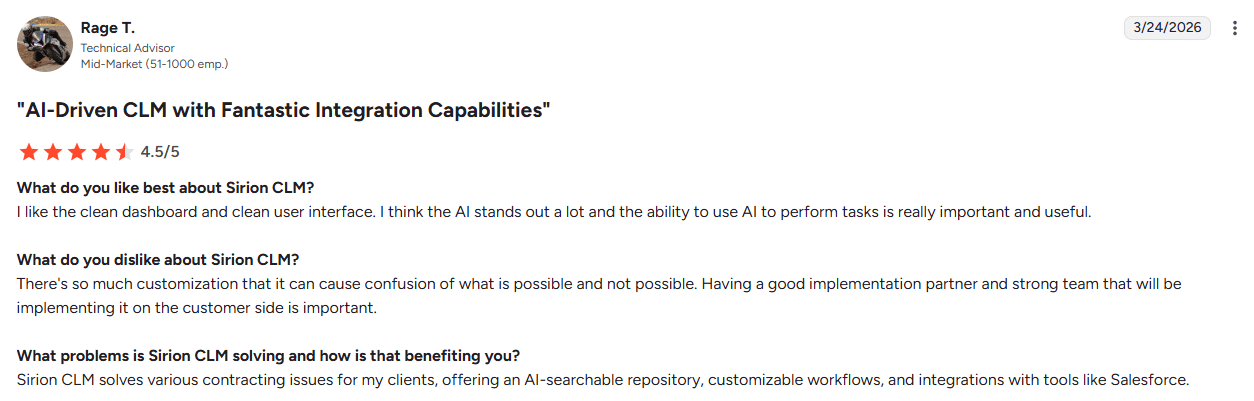
The platform’s “Agentic CLM” model uses AI agents across the full lifecycle. Its AskSirion conversational interface lets users retrieve critical information from contract portfolios by typing a plain-language question. Instant access to centralized data is especially helpful for enterprises managing thousands of employee documents and contractor agreements simultaneously.
Key features
- Agentic AI for drafting, redlining, obligation extraction and conversational contract search
- SLA and performance monitoring tied to contractual commitments
- Centralized, access-controlled repository with automated metadata extraction
- Configurable approval workflows and negotiation governance
- Deep ERP/CRM integration (Salesforce, SAP Ariba, Microsoft Dynamics)
- Multi-language support
User review
Docusign CLM
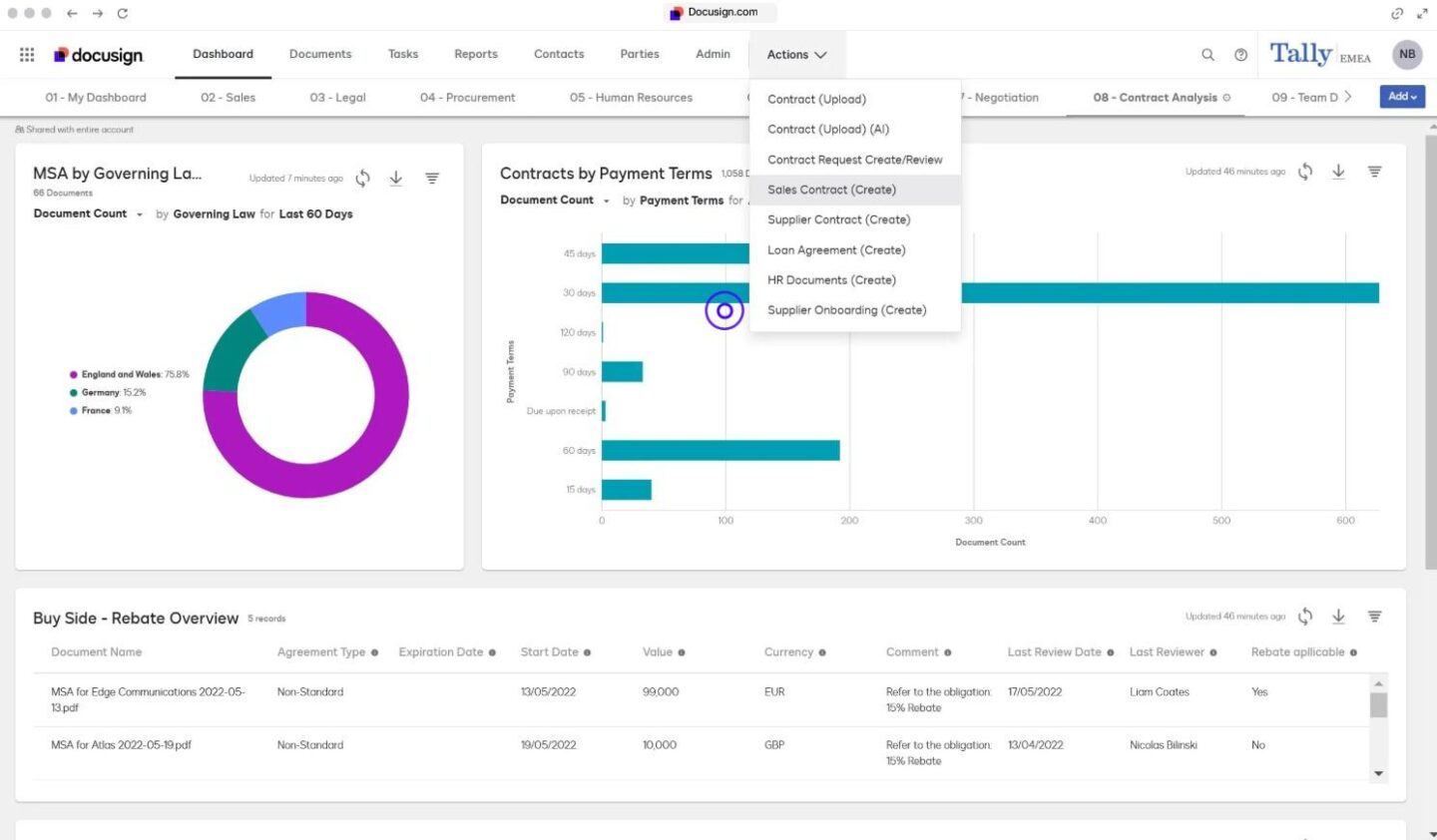
Docusign CLM extends the Docusign e-signature experience into a broader contract lifecycle layer. Its IAM (Intelligent Agreement Management) platform covers agreement creation, approval routing via Maestro, centralized document storage in its Navigator repository, and AI-powered extraction for quick access to key terms across large volumes of employee files.
The Salesforce integration is well-supported. Renewal alerts, obligation tracking and compliance management are available across tiers, though more advanced capabilities, like AI-assisted review, complex conditional routing or intake dashboards sit behind higher-tier licensing.
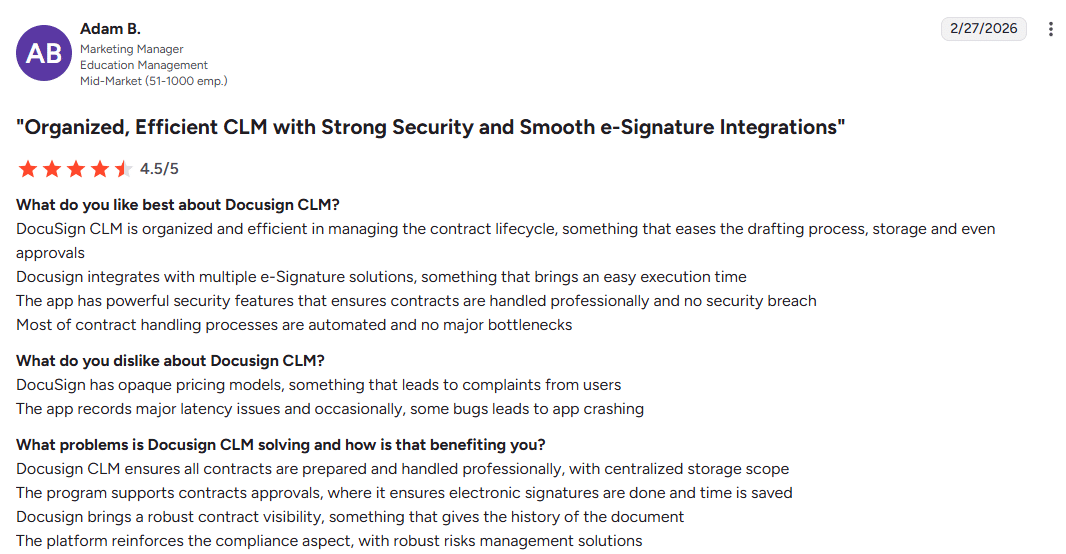
The user experience feedback is consistent: the platform works, but the interface lags behind newer tools. If your HR team is accustomed to modern SaaS design, you may have adoption friction.
See also: Best Docusign alternatives you need to know about
Key features
- Maestro no-code workflow automation for approval routing
- Navigator AI repository with agreement search and data extraction
- ESIGN, UETA, eIDAS-compliant digital signatures
- Salesforce and Microsoft Dynamics integration
- Template management, clause libraries and renewal tracking
- SOC 2 compliance and enterprise-grade security
User review
PandaDoc
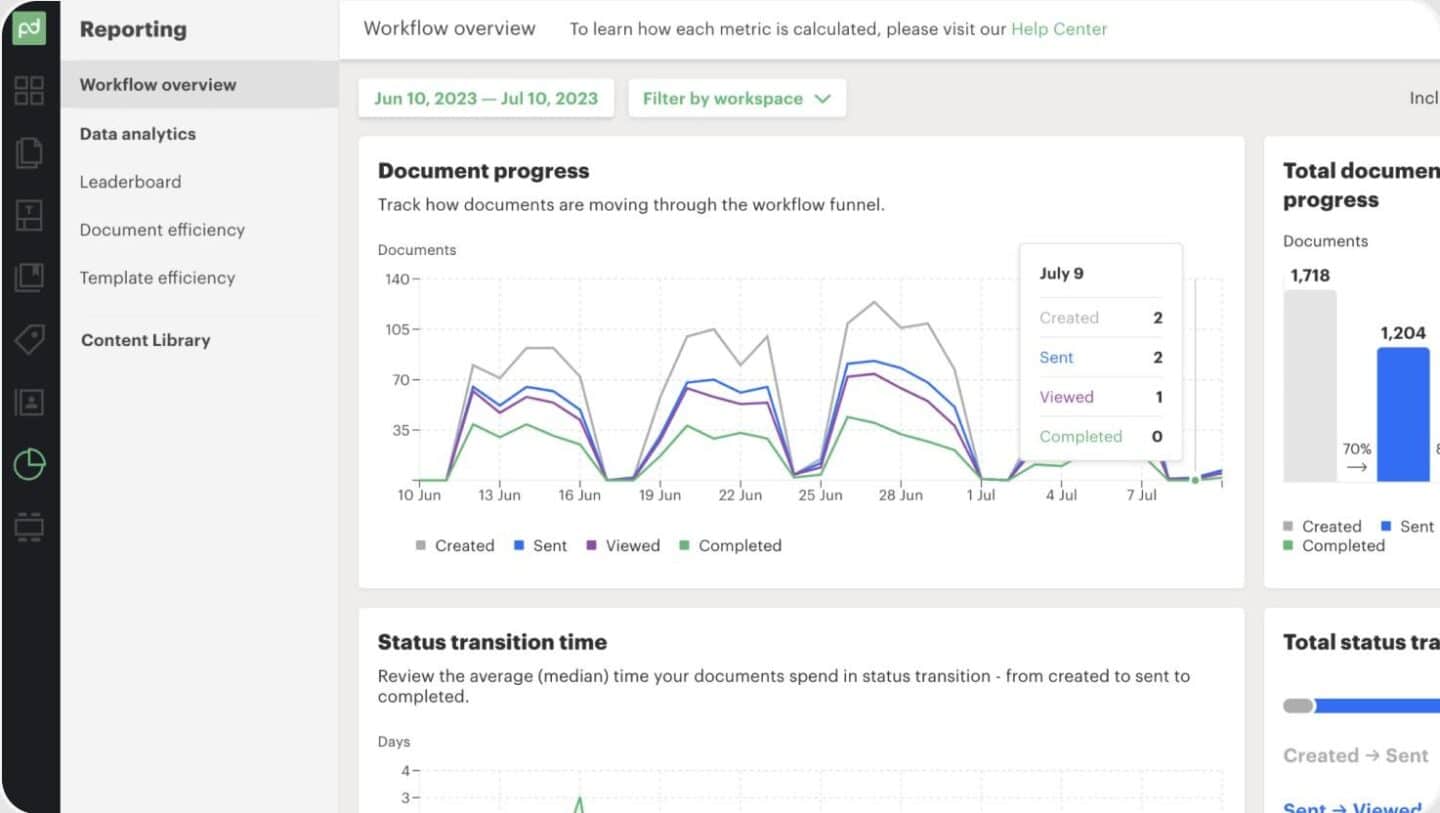
PandaDoc built its reputation in sales. The drag-and-drop editor produces polished, visually structured documents that make offer letters and compensation packages look organized. Built-in candidate and employee engagement analytics tell you exactly when someone opened the document and how long they spent on each section, which is useful for following up.
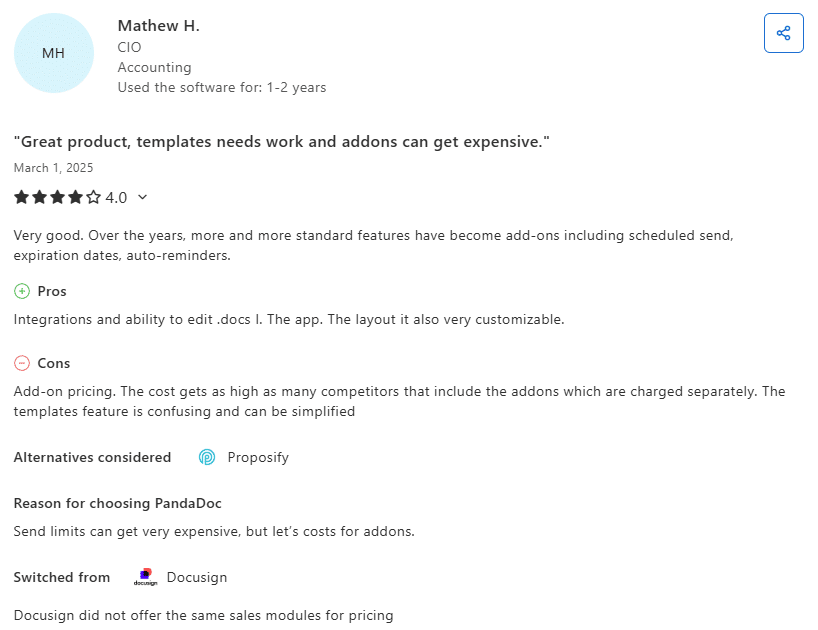
It handles standard e-signatures and includes basic approval workflows. Payment collection is available for contractor invoices. For a full comparison of its approach to document workflows, see our breakdown of PandaDoc alternatives worth knowing.
The limitation to be honest about: there’s only one native HR system integration, so if you’re using anything other than Greenhouse, you may find you still need to handle some copy-pasting or set up external connectors. Post-sign capabilities, like obligation tracking, audit trails for compliance management, and full-text search across employee files, are limited compared to dedicated contract lifecycle management platforms.
Key features
- Drag-and-drop document editor with content library and pre-built templates
- Engagement analytics showing open rates and time-on-page per section
- ESIGN, UETA and HIPAA-compliant e-signatures
- Approval workflows and payment collection for contractor agreements
- Greenhouse HR system integration
User review
Icertis
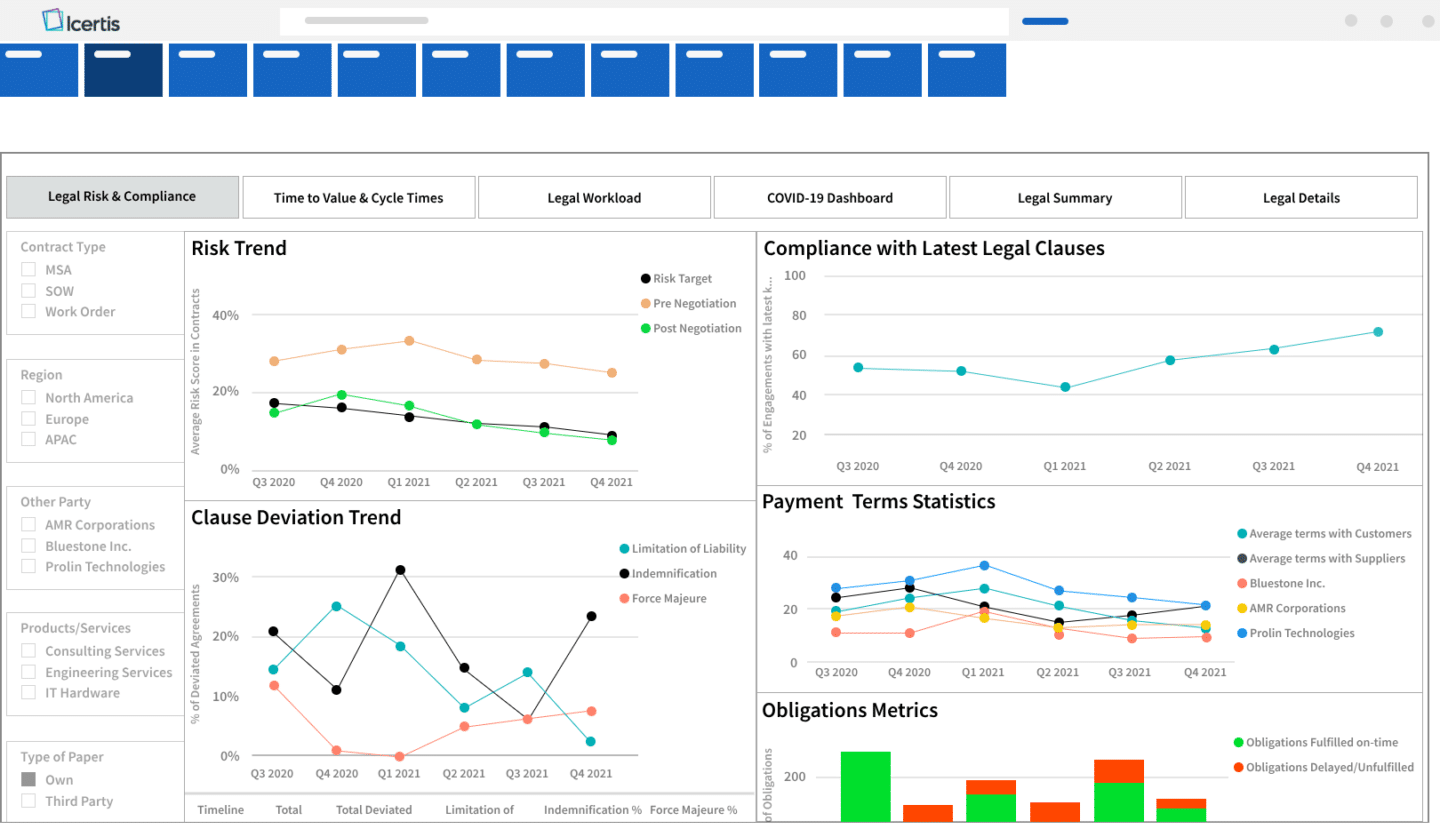
Icertis enterprise contract management is built for large-scale companies—it handles large contract volumes, multiple languages and countries. Its value proposition is converting contracts from static employee documents into structured, connected data that informs decisions across HR, legal, procurement and finance. The AI agent can draft agreements, flag deviations, extract obligations, and monitor compliance.
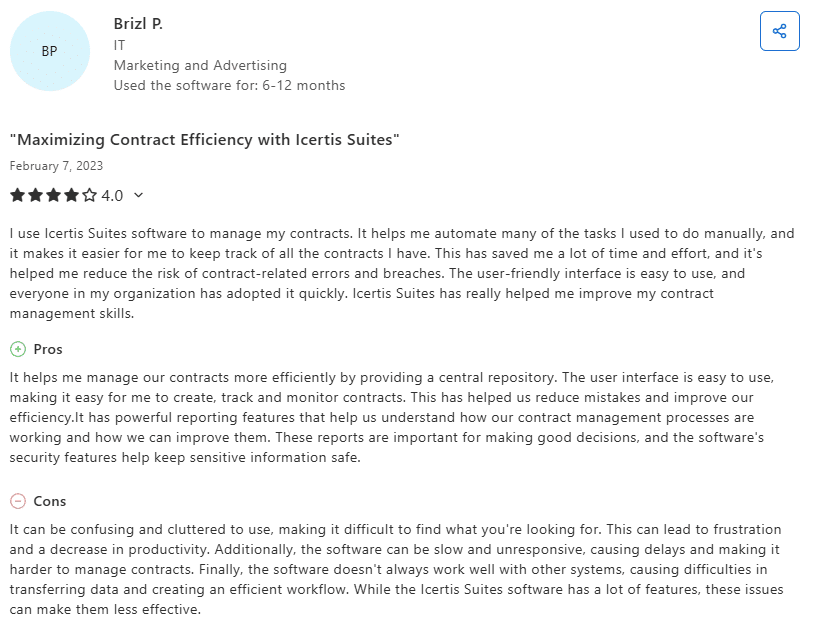
The trade-off: implementation is lengthy and resource-intensive, the interface has a steeper learning curve than most modern SaaS tools, and pricing is enterprise-tier with no public information available.
Key features
- AI-powered risk scoring, obligation extraction and clause deviation analysis
- Multi-jurisdiction, multi-language contract intelligence
- Deep integrations with Workday, Salesforce, Microsoft and SAP, but the list ends there
- Configurable templates, clause libraries and approval workflows
- 360-degree contract portfolio visibility with real-time dashboards
- Enterprise security and compliance frameworks
User review
Conga CLM
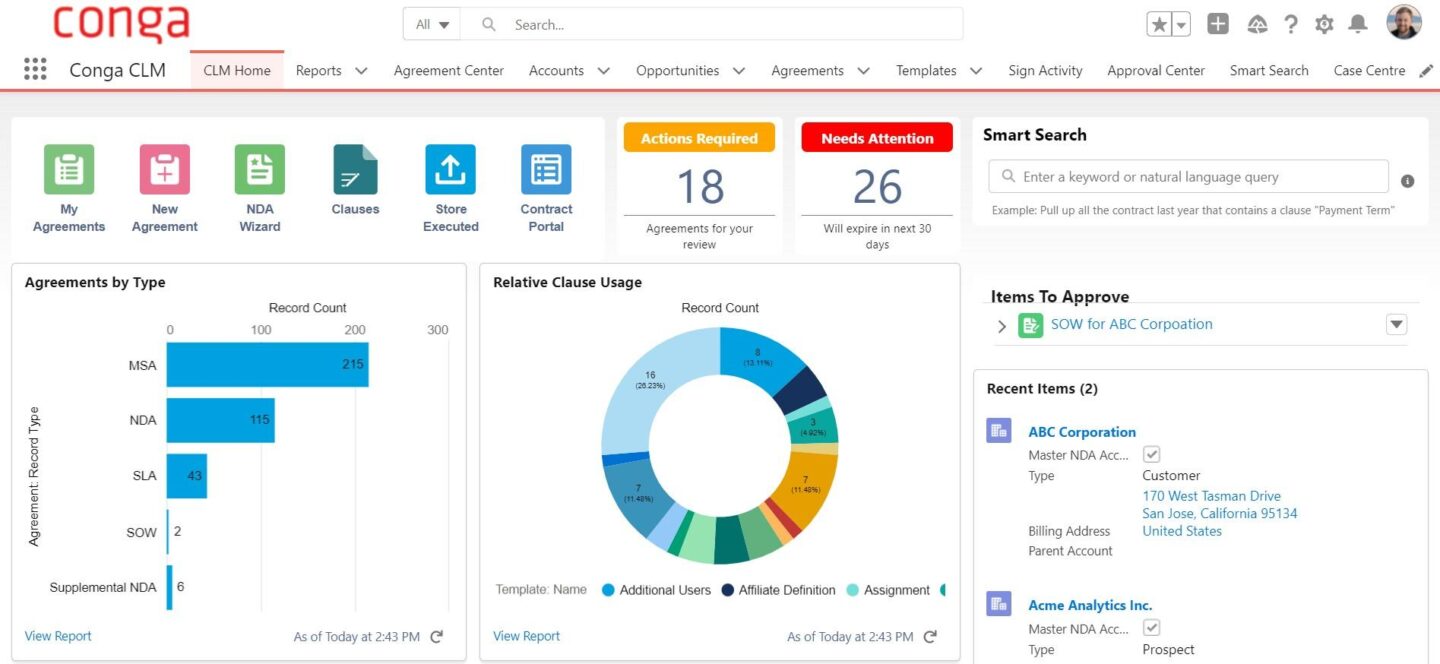
Conga CLM lets HR professionals or hiring managers produce their own documents from pre-approved templates, without routing every routine document through legal. AI extraction tools pull key terms from incoming third-party contracts and flag deviations from your standard clauses.
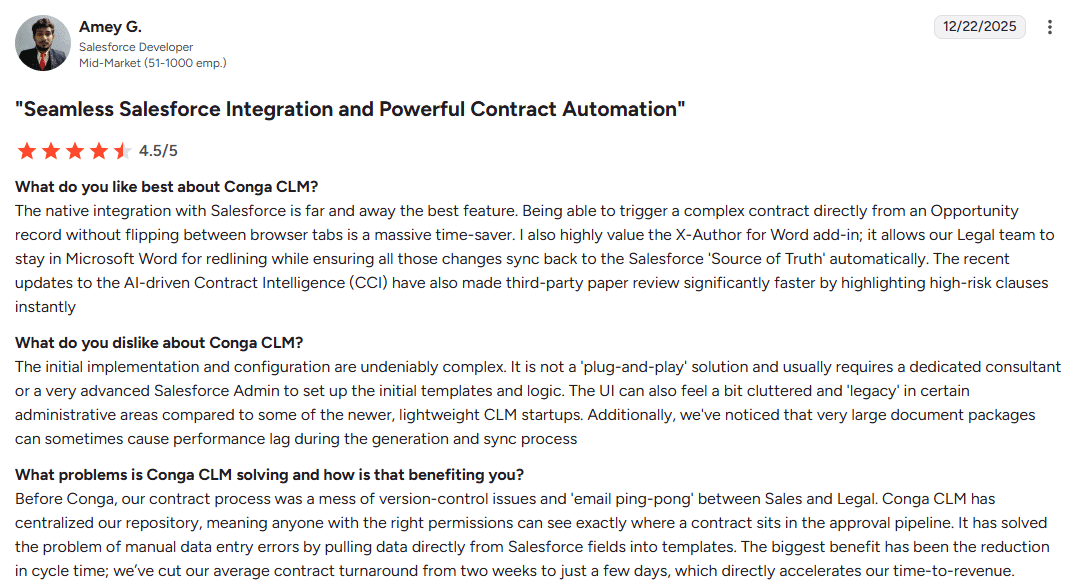
The criticism that appears most consistently in reviews is that initial setup and configuration take longer than expected, particularly without dedicated technical resources, and that licensing costs are at the enterprise tier. Users praise the integration flexibility and the depth of the approval workflow once the system is up and running.
Key features
- Template-driven contract creation with a pre-approved clause library
- AI-powered contract review, risk flagging and key term extraction
- Configurable approval workflows with real-time status tracking
- Version control, redlining, and real-time collaboration tools
- Centralized repository with searchable metadata and compliance tracking
- Integration with Salesforce, via APIs or custom connectors
- Obligation and renewal tracking post-signature
User review
Choose the right HR contract management software for your team
The most common mistake in evaluating HR document management software is treating it as a filing problem when it’s actually a workflow problem. The goal isn’t digitized paper files—you have employee documents that move, track, update and need to stay connected to the systems your HR team already lives in.
For organizations that want that full picture, including live contracts, AI-assisted review, HRIS integration, post-sign compliance tracking, and the flexibility to scale without a major implementation project, Oneflow is worth considering. It treats HR contract management as an end-to-end process, making efficiency gains fast and visible .
Try Oneflow free or explore our pricing and see how much faster your hiring process can be.
FAQs
What is HR document management software?
It’s a platform that helps HR teams create, store, organize, sign and track employee-related documents across the employee lifecycle—from offer letters and onboarding paperwork through performance reviews, amendments and offboarding documentation. Modern HR document management solutions go beyond centralized storage: they add workflow automation, compliant e-signatures, version control, access controls and audit trails that paper files and email attachments simply can’t provide.
What’s the difference between HR document management software and an HRIS?
An HRIS holds your employee data, e.g., payroll, benefits, org charts and time tracking. HR document management software handles the contractual and document layer: creating agreements, collecting signatures, tracking changes and maintaining audit trails. The best setups connect both systems, so employee information flows automatically between them without manual re-entry. Oneflow integrates with tools like HiBob and Teamtailor, and syncs with CRM systems like Salesforce.
Can HR document management software handle both employee document management and independent contractors?
Yes—the platforms on this list support both employment agreements and contractor arrangements. Independent contractor documents often carry different compliance requirements around classification, IP assignment and payment terms. Good HR document management solutions let you maintain separate templates and approval flows for each worker category, with appropriate access controls for sensitive data.
How is HR document management software different from a contract management platform?
Traditional HR document management is focused on storing and organizing employee files. Contract management platforms cover the full lifecycle: drafting, negotiation, signature, obligation tracking, renewals and compliance monitoring. For HR teams managing high volumes of employment agreements and contractor NDAs, a contract management platform with native HR integrations delivers substantially more value than a document store with a search bar.
.png?id=40edbc9ee25345a211152388fdcf1fd2)

.png?id=073897979970647cd034d6db96c145de)