AI contract review tools can speed up the first pass of reviews on routine agreements across sales, procurement, HR and legal workflows, but they can also produce confident-sounding hallucinations. The quality of the outcome usually comes down to the contract type, the quality of the playbook and the legal professional checking the output.
This guide covers seven contract review AI tools: what each platform does beyond AI, how its AI contract review works and the current pricing.
What is AI contract review software?
AI contract review software uses artificial intelligence to analyze legal documents, extract key data, compare contract language against approved standards and flag potential risks or missing clauses for human review.
How AI contract review works
AI contract review tools work based on natural language processing technology and large language models, which are developed through machine learning. Although the exact review process can look different in each tool, it usually has five steps:
- Process the document. Depending on the tool, you may simply upload a PDF or one of your Word documents, open the contract in Microsoft Word or pull it into the review tool from a connected system. But digital contracts always work best; scanned or image-only files may require optical character recognition, which can introduce errors.
- Extract information. Clause extraction and metadata extraction identify parties, dates, contract values, obligations and other important clauses.
- Apply the playbook. The system compares the legal contract with review criteria covering preferred language, preferred positions, fallback positions and risk thresholds.
- Surface findings. Based on the playbook, AI identifies risks, flags deviations and surfaces missing clauses. Where supported, the tool may also provide example alternative language or suggested redlines.
- Check the output. A lawyer or another qualified reviewer verifies the AI’s findings and reviews the recommendations.
Unlike open-source AI, dedicated AI contract review tools ground their analysis in company playbooks, maintain an audit trail and support enterprise-grade security controls. However, safeguards vary across tools, so you still need to confirm retention, model training, encryption and data residency before using AI for contract review.
AI helps with most of the repeatable work, such as reviewing NDAs, vendor agreements and high-volume business contracts. More complex documents, unusual governing law, commercial context and linked provisions demand a more thorough human legal review. Keep in mind that even sophisticated AI models can make mistakes and shouldn’t be used as a replacement for human professionals.
The best tools for AI contract review compared
What the right AI contract review tool for you is depends on your contract process. You may need a focused Word add-in for reviewing third-party documents, a broader CLM that connects review with approvals, e-signature and post-sign management, and/or a platform that keeps contract data synced across CRM, ERP and other core systems.
| Tool | Best fit | Key AI review features | User rating |
|---|---|---|---|
| Oneflow | Mid-sized and enterprise teams that want contracts connected to CRM and post-sign workflows | Playbook checks, risk and issue flags, missing-clause detection, portfolio insights | 4.6 |
| Ironclad | Enterprise legal and procurement teams with complex workflows | Jurist redlining, playbook review, risk analysis, drafting | 4.4 |
| Juro | Teams that want browser-based CLM with Word access | Review Agent, playbook redlines, AI Assistant | 4.8 |
| LinkSquares | Teams managing large contract repositories | AI playbooks, Word redlining, summaries, bulk extraction | 4.3 |
| Spellbook | Transactional lawyers who work mainly in Word | Review, Playbooks, Benchmarks, Associate multi-document agent | 4.7 |
| Luminance | Global teams handling review, due diligence and multilingual work | Traffic-light analysis, Auto Mark-Up, autonomous negotiation | 4.5 |
| Ivo | Enterprise in-house teams that want review and repository intelligence | Playbook and precedent-based redlines, benchmarks, legal research | 4.9 |
Oneflow
Oneflow is a contract lifecycle management platform for creating, negotiating, approving, signing, storing and managing contracts in one connected workflow. Its dynamic, web-based contracts support live collaboration and keep structured contract data available before and after signature. Native integrations with Salesforce, HubSpot, Microsoft Dynamics 365 and Pipedrive keep contract and CRM data aligned, while integrations such as Teamtailor and HiBob support HR workflows. This allows sales, RevOps, finance, HR, procurement, legal and operations to work from the same contract information. The platform also includes templates, approval workflows, lifecycle rules, reminders, a contract repository and legally binding e-signatures.
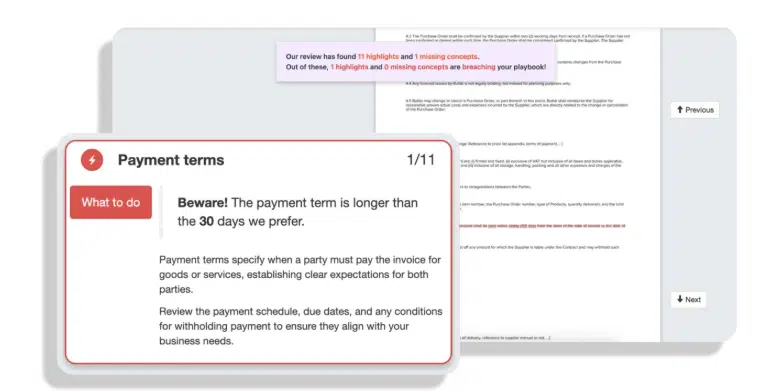
AI Review assesses individual contracts against configurable playbooks. It highlights issues and risks, and identifies missing clauses and deviations from your guidelines. AI Insights applies the same criteria across multiple documents and provides a portfolio-level risk and compliance snapshot that helps you prioritize what to fix first. AI Extract captures details such as participants, contract duration and the sign date from imported agreements as editable metadata. Write with AI helps draft, rewrite and translate contract content, and AI Summary helps create clear overviews of your contracts or specific parts of the contract you need to understand quickly.
The Business plan starts at $292 per month for five users, billed annually. It includes the core CLM, approvals, lifecycle management, e-signature, AI Extract, AI Summary and Write with AI. Enterprise uses custom pricing, includes 10 users and adds AI Review, AI Insights, SSO, SCIM, shared templates, audit logs and more advanced controls. A 14-day free trial is available, or you can book a demo to see how it works.
Ironclad
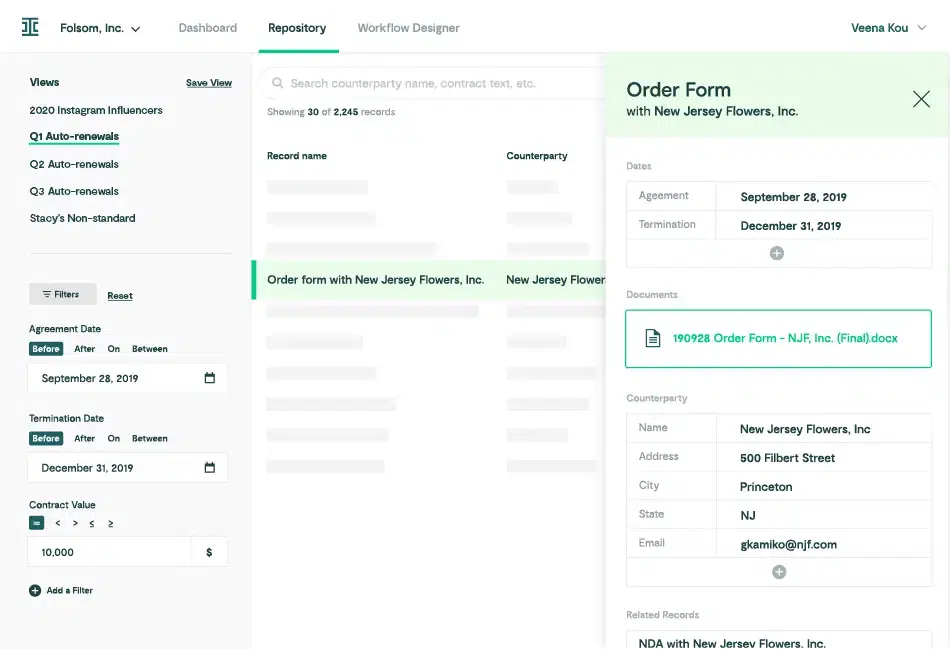
Ironclad is an enterprise CLM for creation, review, signing, storage, analysis and post-sign fulfillment. Its no-code Workflow Designer supports conditional routing, templates and approval logic for legal and procurement teams with complex review processes. It also offers a repository, analytics, e-signature and obligation management tools.
Ironclad offers a legal AI contract tool, Jurist. It helps draft contracts as well as review them—it can apply preferred language and fallbacks, produce first-pass redlines, analyze legal, financial and operational risk and work inside Microsoft Word. Additional features include AI Playbooks, AI Assist and bulk summarization.
Ironclad’s pricing is not publicly available, but third-party sources estimate it at $30,000-$150,000 per year before implementation fees. Jurist is sold together with Ironclad CLM; the end price of your deployment depends on the products (CLM, AI Assistant, e-signature solution), integrations, and deployment help you need. A seven-day trial of Jurist is available.
See also: Ironclad alternative tools.
Juro
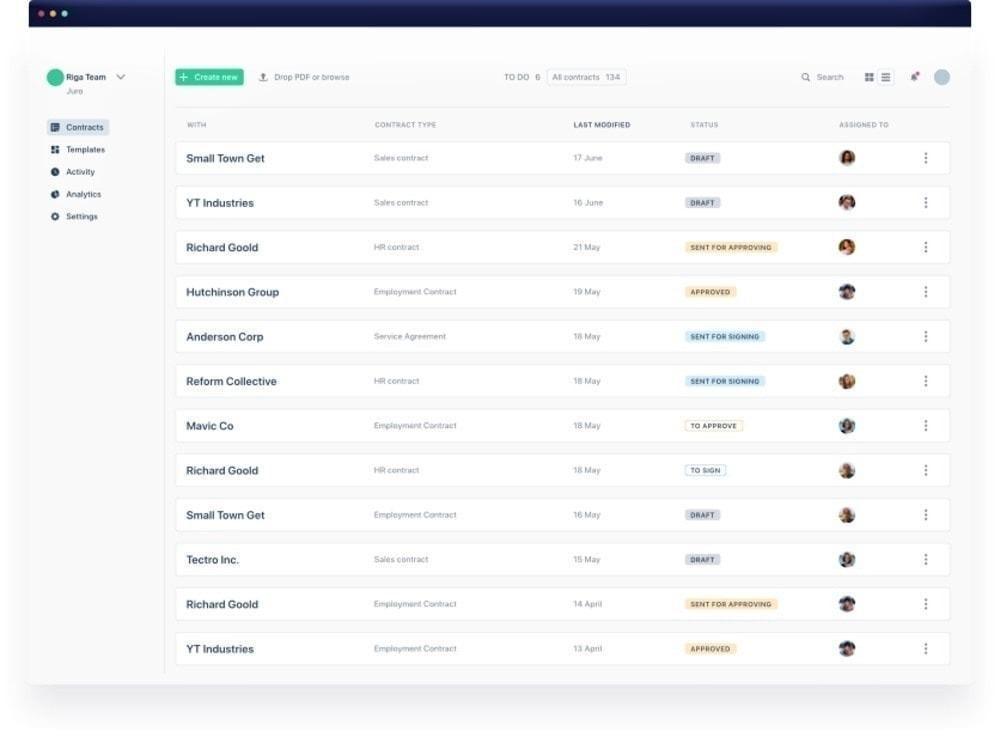
Juro is a browser-based contract automation platform with templates, approvals, negotiation, signing, storage and tracking. It supports conditional logic, comments, version control and integrations with Salesforce, HubSpot, Slack, Word and Google Drive. Legal can set guardrails allowing business users to handle routine new contracts through self-service.
The Review Agent checks and redlines incoming contracts against custom playbooks either in Juro or Microsoft Word. It flags deviations, inserts fallback language and gives reasoning for each change. AI Assistant drafts, edits, summarizes and checks language for compliance.
Juro has custom pricing based on contract volume and integration complexity. Every plan includes unlimited users, workflows and templates. Basic integrations are available across plans, while deeper connections such as Salesforce, HubSpot and Workday cost extra. Pricing estimates from external sources average between $15,000 and $60,000 a year, with cost savings that grow with headcount.
LinkSquares
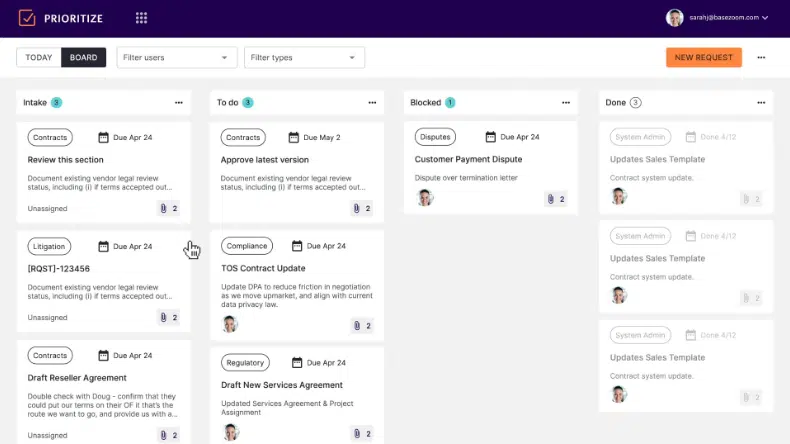
LinkSquares is an end-to-end CLM for drafting, review, approvals, execution, storage, reporting and renewals. It combines contract intelligence, an AI legal assistant, workflow automation, playbooks, clause libraries, analytics and integrations. It’s designed mainly for in-house legal and compliance teams that need visibility across large volumes of agreements.
LinkAI combines predictive and generative models to automate contract reviews and surface risks. AI-powered playbooks apply approved clauses, preferred positions and risk thresholds. The Word experience provides summaries, version comparison, clause generation and AI-assisted redlines. LinkAI also supports metadata extraction across multiple contracts, natural-language search and portfolio monitoring for renewals or non-compliant language. According to LinkSquares, customer data isn’t shared with, or retained by, its external LLM providers.
Pricing depends on contract volume, number of users, and your chosen modules and integrations. Third-party estimates suggest that deployments cost about $31,000 per year, with smaller packages likely starting at around $10,000 and larger enterprise implementations potentially exceeding $75,000.
Spellbook
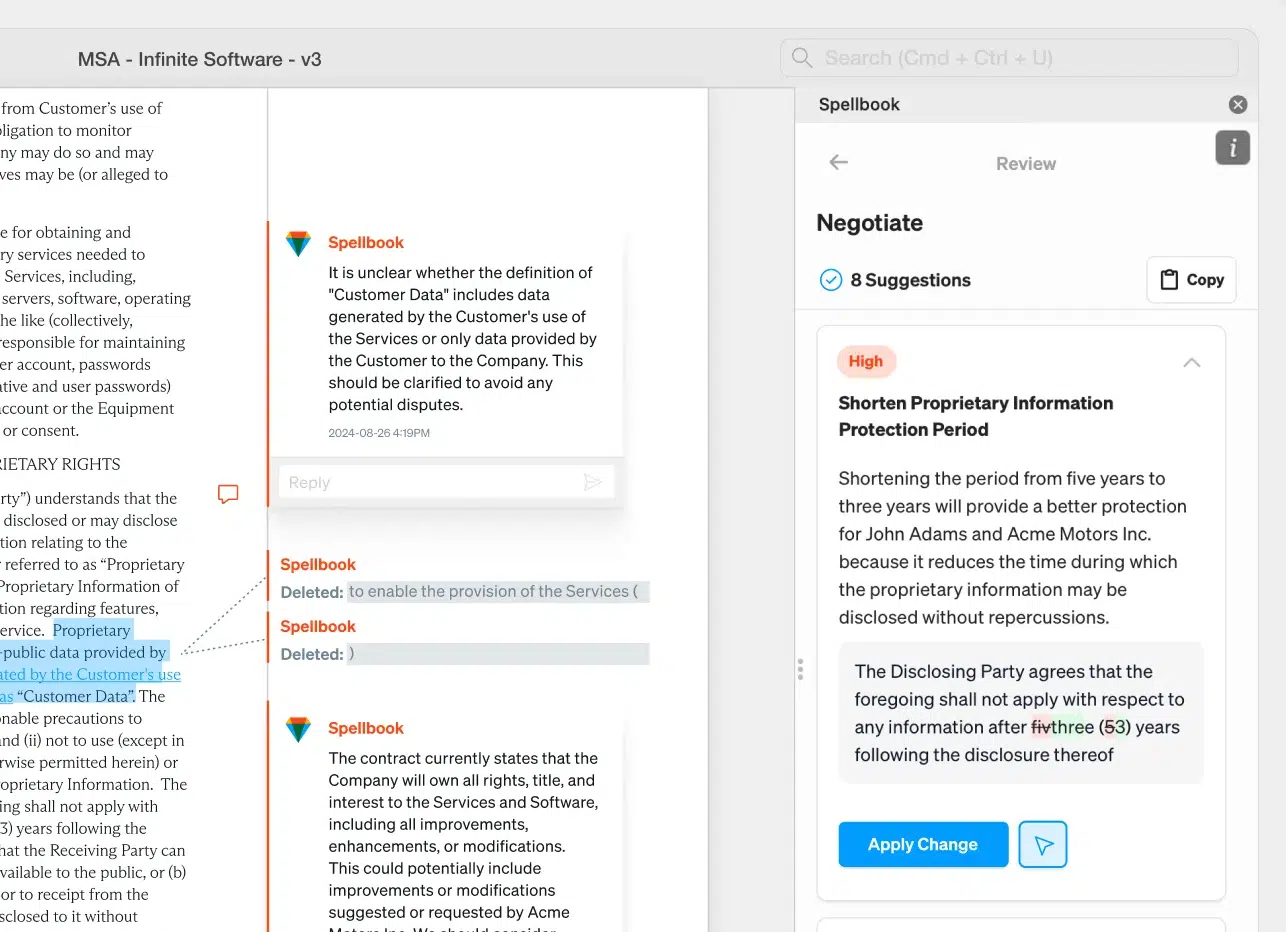
Spellbook is legal AI software for transactional law firms and in-house lawyers. It combines a Microsoft Word add-in with a multi-document agent called Associate. The Word product covers Review, Draft, Ask, Benchmarks and Playbooks. Associate can work across multiple contracts and other files under lawyer oversight. Spellbook also includes intake, searchable signed-contract history and early access to Autonomous Contract Management.
The review feature checks contracts against saved playbooks, catches non-standard terms and proposes redlines in Word. Benchmarks compares the contract language with similar agreements. Ask answers questions, providing you with direct contract citations. Associate supports multi-document drafting and review. Spellbook uses OpenAI and Anthropic models, operates under zero-data-retention agreements and is SOC 2 Type II compliant.
What Spellbook doesn’t do is contract lifecycle management: there is no contract repository, approval workflows, e-signatures or post-signature obligation tracking. Most Spellbook buyers pair it with a separate CLM. Pricing is custom.
Luminance
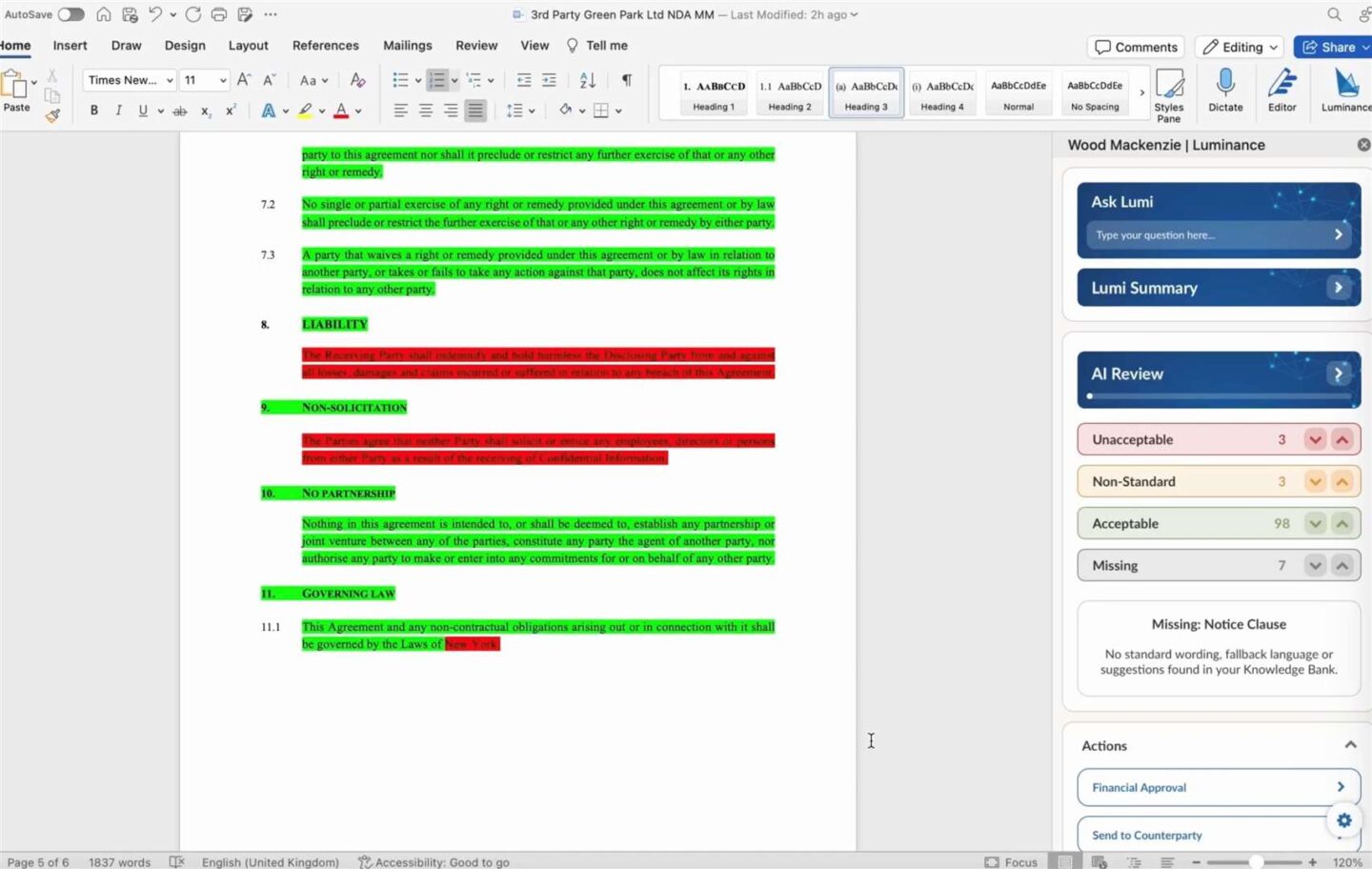
Luminance offers enterprise legal AI for drafting, negotiation, repository analysis, compliance, investigations and collaboration. It supports workflow automation and post-sign insights alongside contract review. Other available features include Microsoft Word review, repository intelligence and integrations. Law firms can use it for due diligence while corporate legal, procurement and compliance teams use it across the contract lifecycle.
The tool reviews contracts in Microsoft Word and marks clauses by risk level. Auto Mark-Up can revise wording that falls outside the company’s preferred positions, while Autonomous Negotiation supports supervised negotiation between AI agents for routine agreements. Its “Panel of Judges” architecture compares the conclusions of several models before presenting the result. Luminance can also review contracts in multiple languages, which may suit international teams, although a qualified reviewer still needs to confirm how the wording operates under the governing law.
Luminance doesn’t provide information on prices. Reports from buyers put a typical mid-size deployment in the five- to six-figure annual range.
Ivo
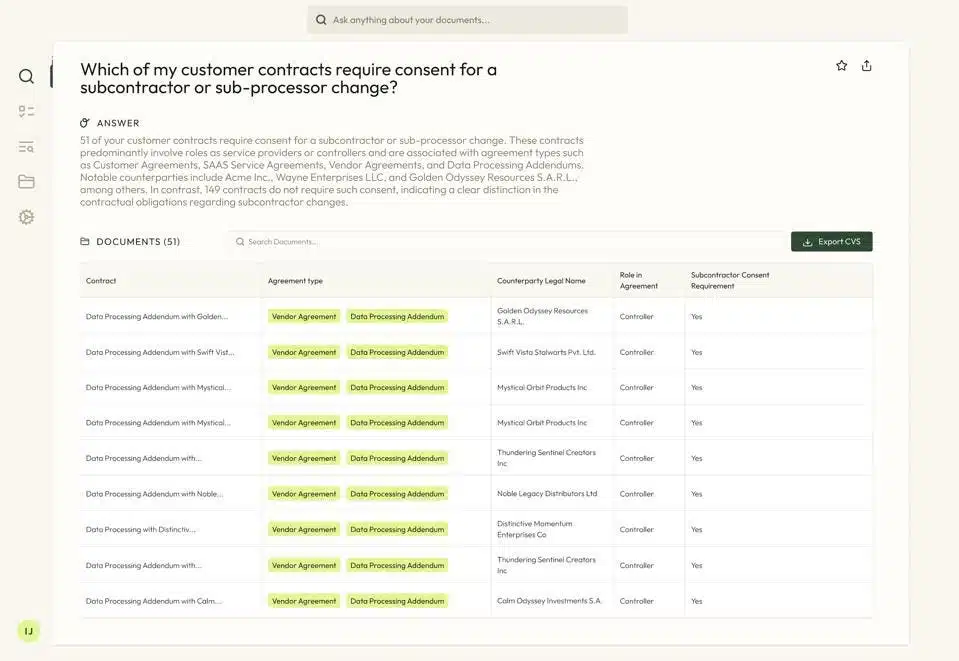
Ivo is a contract review and intelligence platform created for enterprise teams. It offers Ivo Review, an AI-native repository called Ivo Intelligence and Ivo Assistant for review, research and portfolio questions. The tool can map amendments and related agreements, analyze a contract library without manual review or tagging and integrate with common storage, CRM, CLM and e-signature systems.
Ivo Review redlines contracts in Microsoft Word and Google Docs using playbooks, negotiation history, deal context and jurisdiction-specific positions. It benchmarks clauses against comparable existing agreements, supports up to three playbooks in one review and produces issue lists, reports and email memos. Ivo Assistant can draft comments, compare documents and perform cited legal research.
Ivo doesn’t publish pricing. User-reported figures put the cost at around $500 per seat per month, or roughly $6,000 per user per year.
How to choose the right AI contract review tool
Start with your actual contracts, not a vendor demo. Test each tool by giving it the same NDA, vendor agreement and one difficult legal document to review, and score the quality of the output against a review completed by your legal team.
Analyze:
- Review quality: Test whether the tool identifies important clauses, missing protections, inconsistent definitions and incorrect cross-references. The suggested changes should also be clear enough for a reviewer to use.
- Playbook control: Check how granularly legal teams can define preferred wording, fallback positions and risk levels for different contract types, jurisdictions and deal values.
- Human handoff: Non-legal teams should be able to send higher-risk issues to legal without losing the contract history, comments or reason for escalation.
- Workflow coverage: Do the product’s capabilities end with contract review, or can the tool manage contracts further, through approvals, e-signature, storage, renewals and obligations?
- Portfolio work: Can it analyze multiple contracts at once and turn contract data into actionable data or useful reporting?
- Security: Make sure to check where sensitive information is stored, whether it’s used to train models, how long prompts are retained for, and which enterprise-grade security certifications apply.
- Commercial fit: Compare license structure, implementation difficulty and likely cost, integrations, AI usage limits and approximate cost savings.
What happens after the AI review?
AI contract review is only one stage of the process. A contract still needs human review, redlines and negotiation before it’s ready to sign. After signature, key data should be extracted and passed on to other business systems, and the contract needs to be stored and managed throughout the rest of its lifecycle.
Oneflow keeps the whole process in one place. AI Review flags potential risks and missing clauses, while legal and commercial teams decide what to accept or change. Teams can negotiate and redline the contract before signing it electronically, then use AI Extract to capture important data and the contract repository to manage the agreement after signature.
Book a Oneflow demo to see how the full process works with your own contracts.
FAQs
How is AI contract review different from using ChatGPT or Claude on a contract?
A general-purpose AI assistant can flag unusual clauses, but it doesn’t automatically know your company’s preferred terms, approved fallback positions or the concessions accepted in previous negotiations. It also operates as a standalone chat rather than as part of a structured contract workflow. On the other hand, purpose-built contract review and CLM tools can work within Microsoft Word or a contract platform and connect the review process with approvals, negotiations and electronic signatures.
How accurate are AI contract review tools?
Accuracy depends on the tool, the quality of the playbook and the contract itself. Standard agreements such as NDAs and supplier contracts are usually easier to review than documents with unusual wording, extensive amendments or heavily negotiated terms. The results can speed up the first review, but a qualified person should still check the findings before acting on them.
Is AI contract review software secure enough for sensitive contracts?
Most established vendors have SOC 2 Type II certification at a minimum, along with GDPR compliance and encryption for sensitive information in transit and at rest, which constitutes enterprise-grade security. What varies more is whether a vendor uses your contract data to train its underlying model, so confirm that directly, along with data residency.
How much does AI contract review software cost?
Pricing varies widely. Oneflow’s Business plan starts at $292 per month for five users, billed annually (equivalent to $700 per user annually), while most other tools covered here offer custom pricing. Third-party estimates range from around $6,000 per user annually to more than $150,000 for enterprise deployments. Always ask whether implementation, integrations and AI review features are included in a plan or charged separately.
.png?id=40edbc9ee25345a211152388fdcf1fd2)

.png?id=073897979970647cd034d6db96c145de)