Ironclad, a well-known contract lifecycle management platform for enterprise legal, procurement and contracting teams, provides structured workflows, templates, approvals, repository management, native Ironclad Signature plus e-signature integrations, AI-assisted review and post-signature tracking. It serves as a centralized, governed contracting hub for organizations that want to manage contract workflows in one controlled system.
For some, that’s exactly what they’re looking for. Others encounter friction when contract data needs to move through CRM, finance, procurement, HR and operations systems. Because it’s not enough for a contract lifecycle management platform to store contracts or route approvals. The real value comes when it makes contract data usable across the business without manual handoffs, duplicate entry or disconnected versions.
This comparison looks at Ironclad alternatives through that lens: where each platform fits, how it handles contract data, what users commonly praise or question, and what kind of company it is best built for.
Why do teams look for an Ironclad alternative?
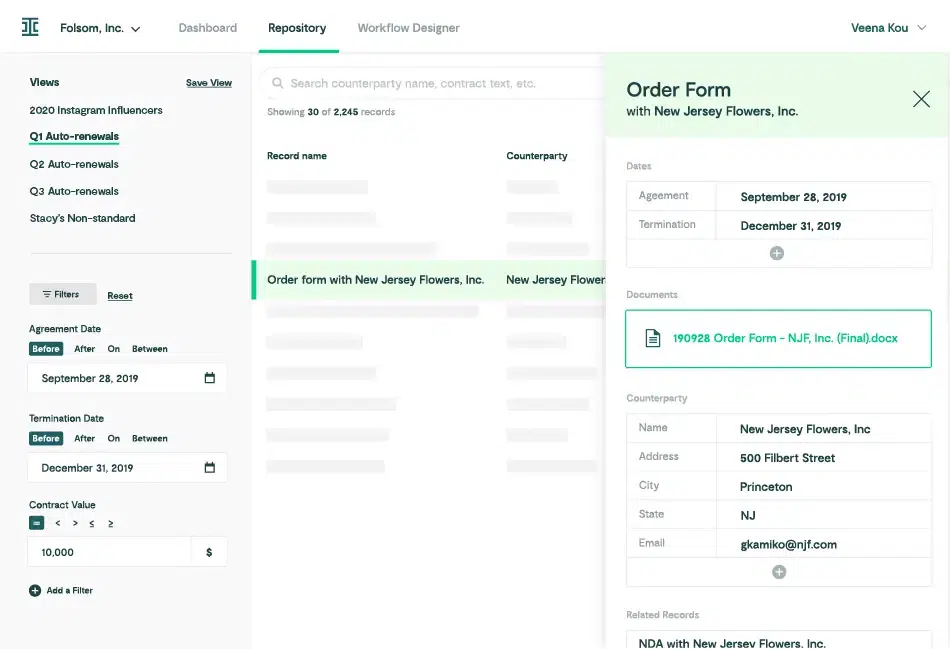
Ironclad generally has strong review scores and a mature product. It covers the full contract journey: create, review, sign, store, analyze and fulfill. Its Workflow Designer, contract repository, Salesforce connection, e-signature, analytics and AI layer give legal and procurement teams a high level of control over contract processes.
So why do buyers still compare Ironclad with other CLM software?
- Search relies on manual tags and metadata. Reviews on G2 and Software Advice mention difficulty finding older contracts when metadata or tags are inconsistent. A good contract repository takes the guesswork out of search, as well as out of looking for renewal dates and managing obligations.
- Document editing can feel heavy. Users report friction with Word formatting, PDF-to-Word workflows, locked PDFs and browser-based editing on larger contracts.
- Setup requires clear ownership. Ironclad’s flexibility is one of its strengths: Workflow Designer can support templates, request fields, conditional clauses, approvers, signers and routing rules. But reviews also describe the setup as open-ended, with a noticeable learning curve for teams that don’t already have legal operations ownership or admin capacity.
- Feedback on Ironclad’s AI is mixed. Ironclad has invested heavily in AI, including Ironclad Assistant, Ironclad Agents and Jurist, which support drafting, summarizing, risk analysis and redlining against company playbooks. Some reviewers praise the legal AI experience, while other practitioner discussions and review feedback also point to inconsistent results with Smart Import, metadata extraction or AI redlining.
- Integration depth varies by system. Ironclad offers native integrations, iPaaS options and a public API, with connections to CRM tools such as Salesforce and HubSpot, e-signature tools such as Docusign and Adobe Acrobat Sign, document management tools such as Google Drive, Box and Microsoft OneDrive, and collaboration tools such as Slack and Microsoft Teams. Its Salesforce integration works well, with support for initiating workflows from CRM records and mapping contract data back to opportunities. However, for anything that is not Salesforce, reviewers describe manual configuration with thin documentation.
The best Ironclad alternatives at a glance
We compared the best Ironclad alternatives on CRM integration depth, repository quality, AI capabilities, contract data connectivity, workflow automation, ease of adoption and value.
| Platform | Best for | AI capabilities | Ease of adoption | Capterra rating | Pricing structure |
|---|---|---|---|---|---|
| Ironclad | Governed enterprise CLM hub | Ironclad Assistant, Agents, Jurist, Smart Import, AI review, redlining and reviewing contracts | Medium | 4.4 | Does not publish pricing; Capterra lists starting from $500/month |
| Oneflow | Connected contract data across CRM, finance and HR | AI Review, AI Extract, AI Summary, Write with AI | High — minimal training required | 4.6 | Free 14-day trial; paid from $292 for 5 users |
| Juro | Browser-based contracting for in-house legal teams | AI assistant for drafting and review | High | 4.8 | Custom |
| PandaDoc | Proposals and quotes for SMB sales teams | AI drafting, data extraction, document assistant, summaries and contract Q&A | High | 4.5 | $19-49/seat/mo |
| Docusign CLM | Lifecycle management on a signature backbone | Iris AI, AI-assisted review, data extraction, summarization, Q&A/search, Agreement Manager and Workflow Builder | Medium | 4.5 | Custom; eSignature plans public |
| Conga CLM | Revenue lifecycle contracting for Salesforce/Conga CPQ-heavy enterprises | AI extraction and review | Low–medium | 4.3 | Custom |
| Agiloft | Customizable no-code workflows | Astra AI contract review/analysis, Screens playbooks, Ask AI, Prompt Lab, white-box AI | Medium | 4.8 | Custom |
| SpotDraft | Legal intake and routine contract ops | VerifAI AI contract review and redlining | High | 4.8 | Custom |
| ContractWorks | A simple, affordable, secure repository | AI-assisted tagging | High | 4.7 | From $600/mo, unlimited users |
| Icertis | Global enterprise businesses with heavy governance | Vera Copilot, Vera Agents, Vera Analytics/Insights for risk, obligation and portfolio intelligence | Low | 4.4 | Custom |
| Sirion | AI-native enterprise CLM and obligation tracking | Agentic agents, conversational contracting | Low–medium | N/A | Custom |
Top Ironclad alternatives reviewed
Each profile covers the main features and pros of each platform, as well as its comparison to Ironclad.
Oneflow
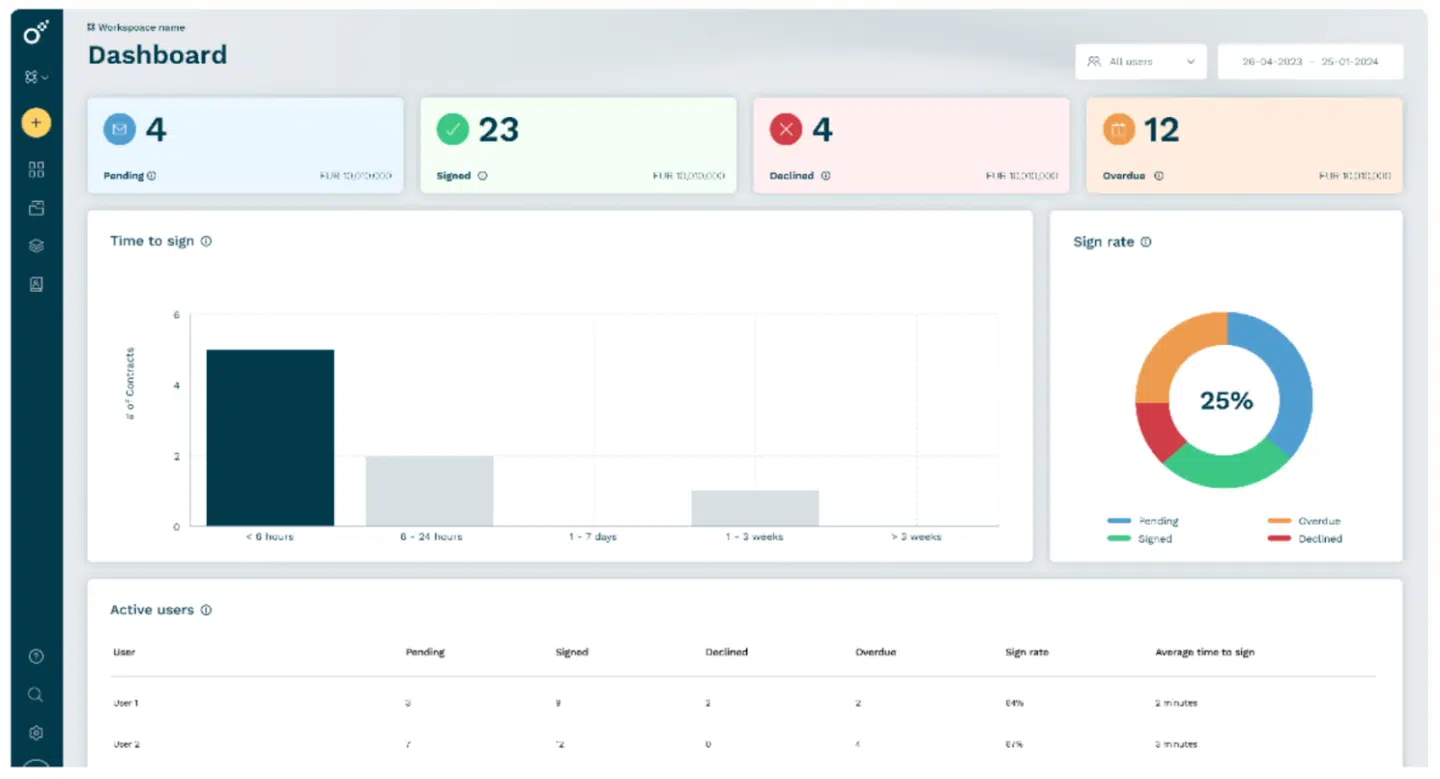
Best for: mid-size and large organizations where contract data needs to flow automatically into CRM, billing and HR systems.
Oneflow starts from a different premise than many CLM vendors: contracts should not sit in silos, isolated from the systems that create and use them. They should carry data through the business before and after the signature.
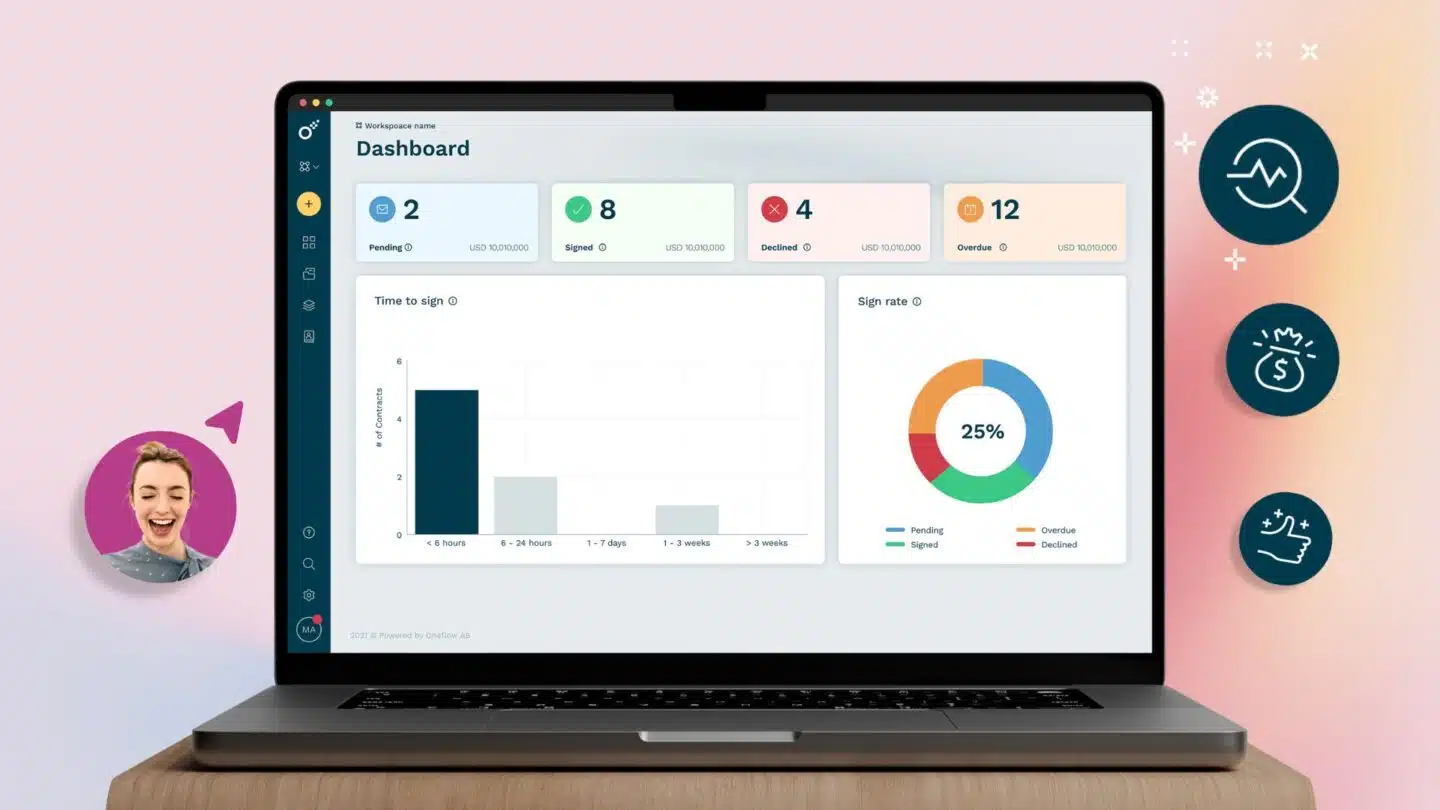
The platform uses live, dynamic contracts instead of static files. Sales teams can generate contracts from CRM data, collaborate with counterparties in real time, negotiate inside the contract and keep commercial data synced with the CRM. Finance gets cleaner data for invoicing and revenue recognition. Procurement can manage supplier agreements and obligations. HR can work with employee contracts, amendments and renewals in a connected flow.
That matters because contract management is rarely only a legal process. A signed agreement becomes a billing instruction, a supplier commitment, a renewal risk, a revenue event or an HR record. When the contract is structured and connected, teams don’t have to manually re-enter the same information over and over again.
Key features
- Live, dynamic contracts that remain editable after sending
- Native bi-directional CRM integrations with Salesforce, HubSpot, Microsoft Dynamics and Pipedrive, as well as other business systems
- AI Review, AI Extract, AI Summary, Write with AI
- Workspaces with contract templates, permissions and multi-level approval workflows
- Real-time collaboration, customizable approval processes, e-signing and audit trail capabilities
- Renewal reminders, obligation tracking, repository search and portfolio analytics
- Workflows across quote-to-cash and hire-to-retire
- Contract repository with content search, metadata and tags
How it compares to Ironclad: Ironclad centralizes contracting in a governed CLM hub, meaning contract requests, approvals, templates, review, signing and repository management are managed primarily inside Ironclad as the controlled system of record. Oneflow takes a more connected approach by allowing contract data to flow into the business systems teams already use, such as CRM, finance, procurement and HR tools, so contract data can move with the business instead of sitting in a separate place. Ironclad is a strong fit when legal or procurement wants tight control over workflows, templates, approvals and review. Oneflow is stronger when the main problem is disconnected contract data across sales, finance, procurement, HR and operations, causing inefficiencies, manual hand-offs and revenue leakage.
Book a Oneflow demo and see how your contracts could move from creation to signature to renewal without losing data at any point of the entire lifecycle.
Pricing: 14-day trial; Business from $292/month billed annually, with 5 users included; Enterprise custom.
Juro
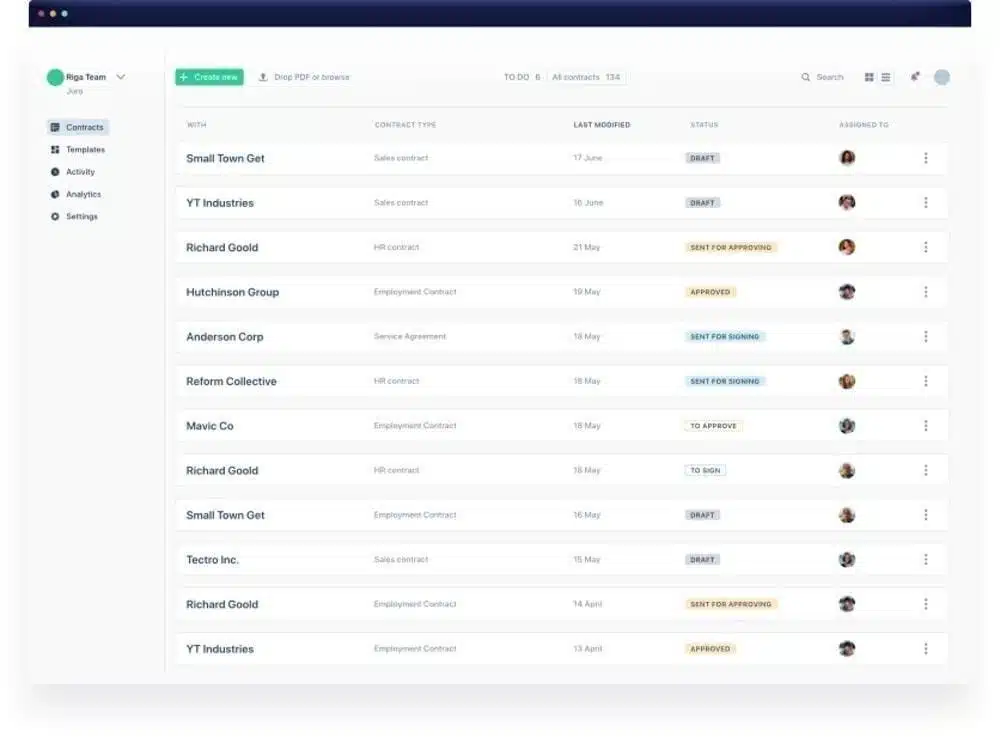
Best for: fast-growing companies with lean in-house legal teams that want self-serve contracting without a long enterprise rollout.
Juro is a browser-native contract platform for drafting, approval, negotiation, signing and storage. It’s fairly easy to use, has a clean editor, configurable templates and legal self-serve workflows that help business teams finalize standard agreements without sending every request through legal.
The AI assistant supports drafting, summaries and playbook-based review. Reviewers often praise the user experience and support. However, Juro may not be enough for complex enterprise workflows or deeply customized approvals.
Key features
- Browser-based contract editor
- Conditional logic and approval workflows
- AI Assistant, AI review/redlining, AI Extract and Operator
- Self-serve contract templates for sales, HR and legal
- Salesforce, HubSpot, Slack and Greenhouse integrations
How it compares to Ironclad: Juro is easier to adopt and lighter to administer. Ironclad offers greater workflow depth for enterprise clients and greater legal operations control, but the initial setup is more time-consuming. Juro is better for teams that want speed, self-service and usability over heavy configurability.
Pricing: custom.
PandaDoc
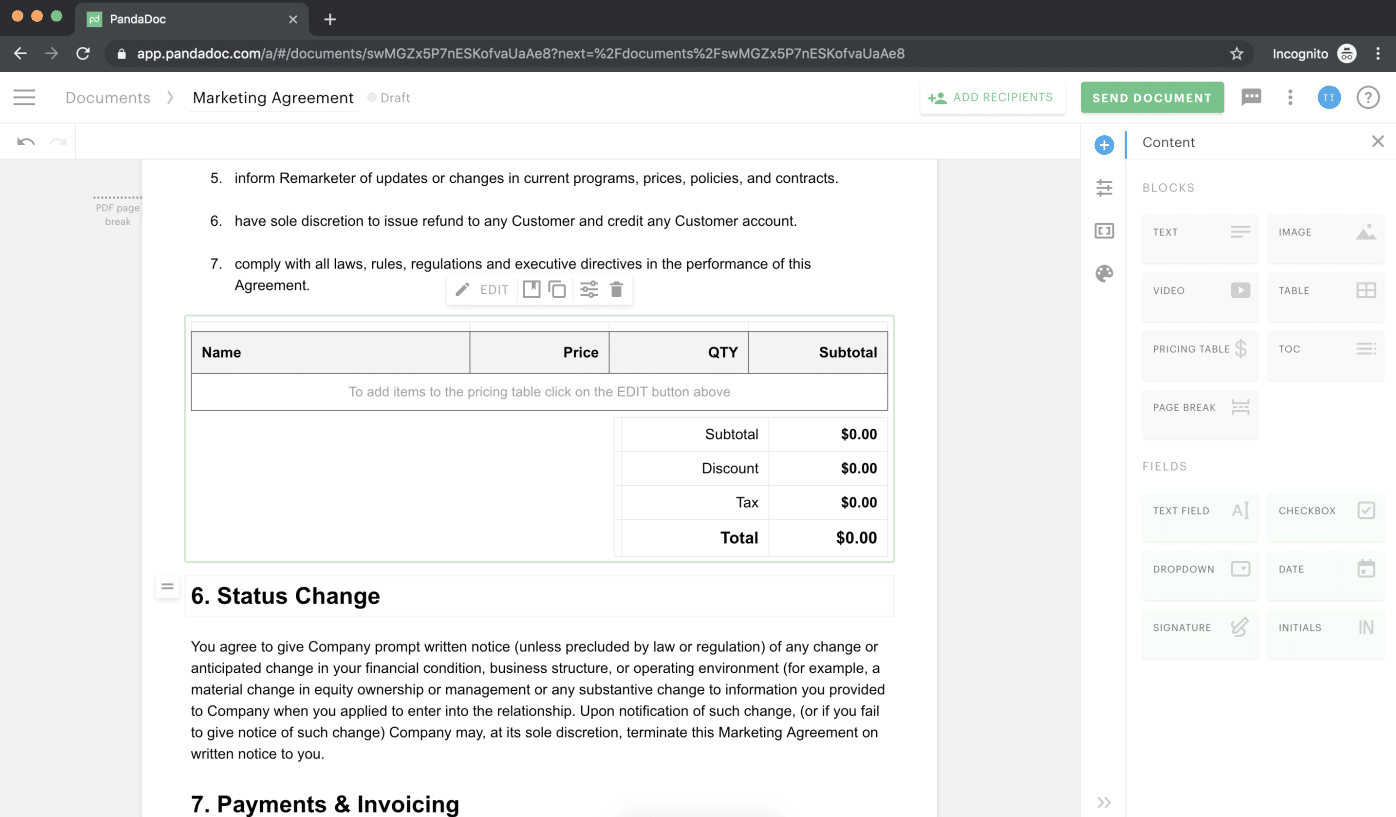
Best for: small and mid-sized commercial teams that need proposals, quotes and standard agreements created quickly.
PandaDoc began as a document automation and proposal platform; it’s strong for sales documents, pricing tables, templates, e-signature and payment collection. It can be used by teams that mainly need polished proposals and repeatable agreements.
Its CLM capabilities are lighter than the enterprise tools in this list. Post-signature obligation management, portfolio reporting and complex workflow governance are not the main reasons to choose PandaDoc. It’s more useful when document creation and sales enablement are your main goals.
See also: PandaDoc alternatives.
Key features
- Template and content library
- Drag-and-drop document builder
- CPQ-style pricing tables
- Payment collection
- E-signature with audit trails
- AI-assisted document generation tools, AI data extraction, document summaries, contract Q&A/search and document assistant workflows
How it compares to Ironclad: PandaDoc is faster to adopt and easier to use for commercial teams. Ironclad works better for legal workflows, approvals, repository control and post-signature management. PandaDoc works best when the immediate need is sales document speed rather than entire contract lifecycle governance.
Pricing: Free eSign plan available; Starter $19/user/month and Business $49/user/month billed annually; Enterprise/custom for advanced needs.
Docusign CLM
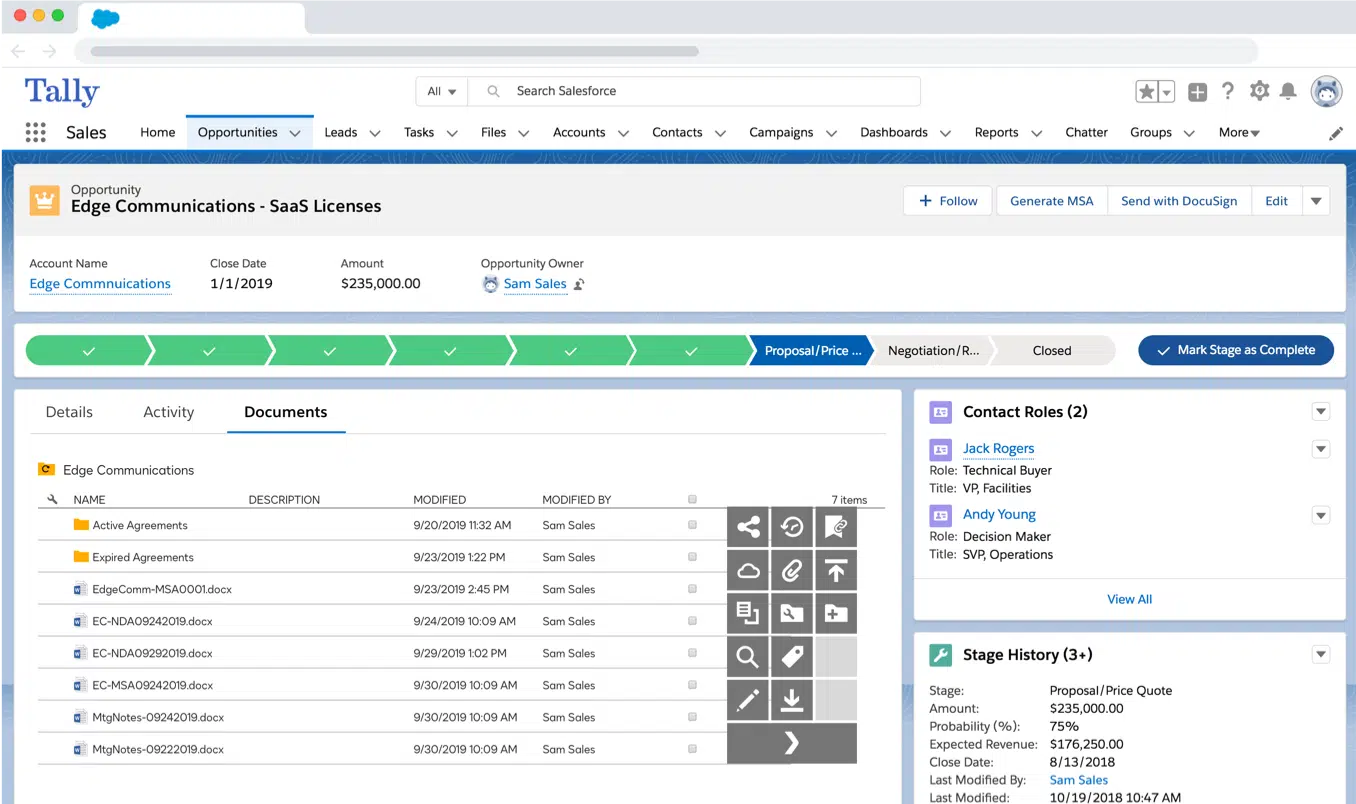
Best for: enterprises that want the contract lifecycle management connected to a widely adopted e-signature foundation.
Docusign CLM is part of Docusign’s broader agreement platform. It adds document generation, workflow automation capabilities, repository management and AI analysis to the familiar signing experience.
Many teams already know Docusign for e-signature, which can make adoption easier at the signing stage. The challenge is that CLM and e-signature are separate products, and the lifecycle layer involves configuration effort, module decisions and steeper pricing.
See also: Docusign alternatives.
Key features
- Document generation and clause library
- Conditional routing and approval workflows
- Contract repository
- Iris AI, AI-assisted review, data extraction, summarization, Q&A/search, Agreement Manager and Workflow Builder
- Connection to Docusign eSignature and Salesforce
How it compares to Ironclad: Both platforms are built for enterprise agreement workflows, and both can require implementation effort. Docusign’s key features are signatures and managing documents. Ironclad is a legal workflow and a governed CLM. Buyers should check whether the platform supports the whole contract process they need.
Pricing: IAM Starter from $40/user/month, IAM Standard $45/user/month, IAM Professional $75/user/month, billed annually; enterprise CLM/custom packages quote-based.
Conga CLM
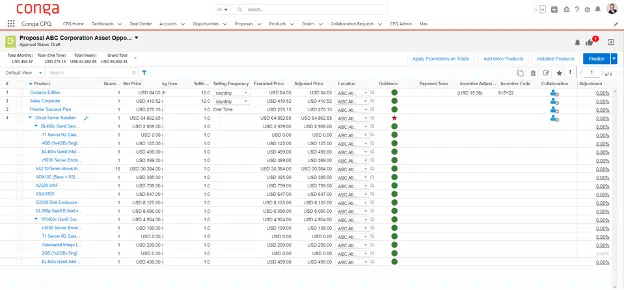
Best for: large enterprises whose commercial operations are deeply tied to Salesforce.
Conga CLM is best for companies that want contract generation, negotiation, approvals and obligations connected to Salesforce-based revenue workflows. That depth of integration can be valuable for complex sales operations. Still, buyers should understand how much implementation, configuration and consulting effort is required before that value appears.
Key features
- Salesforce and Conga Platform deployment options
- Object-level data mapping
- Clause libraries and approval matrices
- AI contract analysis and risk scoring
- Bundling with Conga CPQ for revenue workflows
How it compares to Ironclad: Conga goes deeper into Salesforce-led commercial operations. Ironclad offers broader legal workflow governance. Conga may be the stronger fit when Salesforce and CPQ are the central need; Ironclad may suit teams that want a dedicated CLM hub across legal and procurement.
Pricing: Conga doesn’t provide the information, but Capterra lists Basic at $35/user/month.
Agiloft
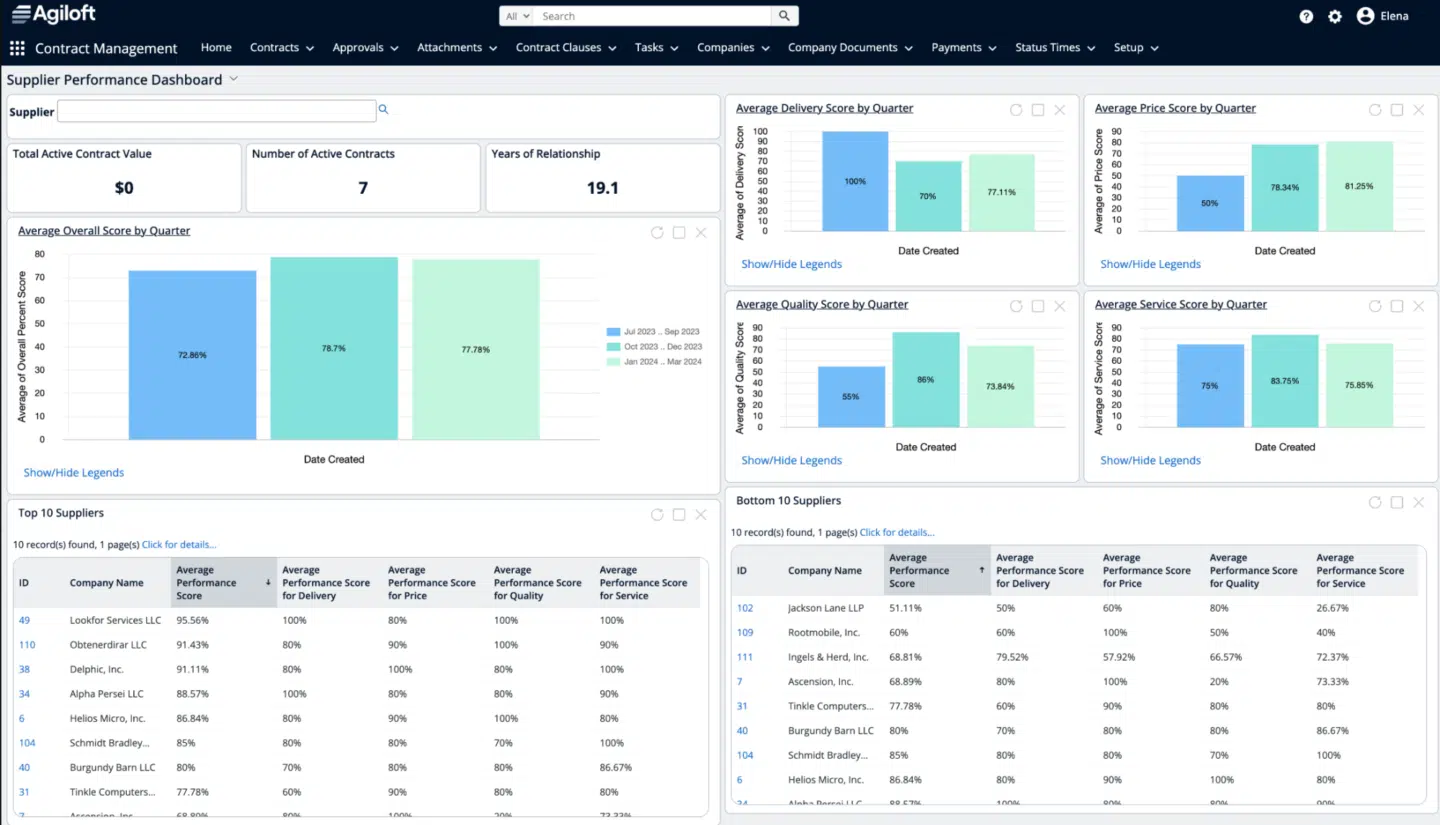
Best for: organizations with complex contracting processes that need high configurability.
Agiloft is a no-code CLM platform that provides extensive flexibility. Teams can configure workflows, fields, rules, permissions, contract processes and repository structure. That makes it useful for companies with complex approval paths, multiple business units or contract processes that don’t fit a standard template.
The downside is similar for most highly configurable systems: it needs planning. Agiloft can do a lot, but companies need a clear view of how the system should work and enough time to configure it properly.
Key features
- No-code workflow, field and rule configuration
- Flexible repository and permissions
- Astra AI contract review and analysis, Screens playbook-based review/redlining, Ask AI contract interrogation, Prompt Lab for custom AI workflows, batch analysis and obligation/risk extraction.
- Custom AI agent building through Prompt Lab
- Strong support for complex approval models
How it compares to Ironclad: Both platforms reward teams that have admin capacity and mature process ownership. Agiloft offers more configurability, while Ironclad prioritizes a more legal-workflow-centered CLM experience. Neither enterprise system should be treated as a quick plug-and-play choice.
Pricing: custom.
SpotDraft
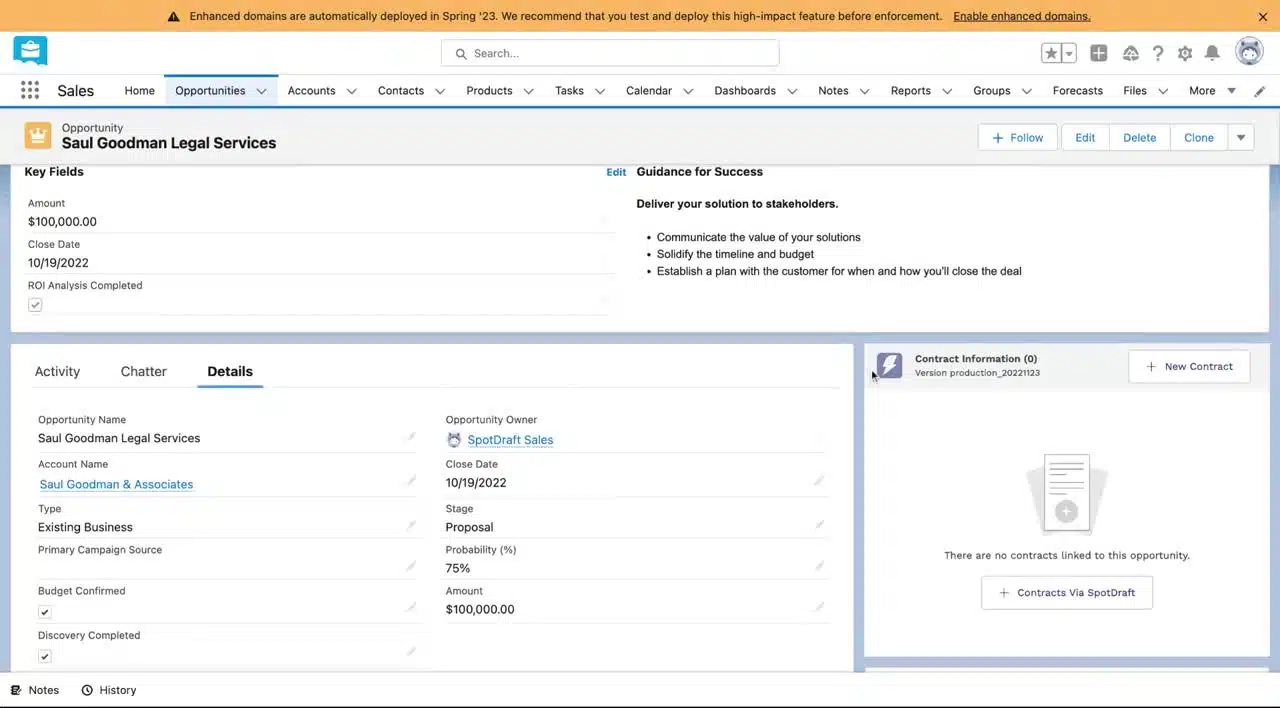
Best for: legal and business teams that want to speed up routine agreements, intake and approvals.
SpotDraft is an AI-powered CLM platform for legal teams that covers workflows, negotiation, collaboration, e-signatures, repository, reporting and contract analytics. Its AI includes DraftMate AI for turning documents into templates, Smart Data Capture for extracting types of contract metadata, and VerifAI for contract review and redlining directly in Microsoft Word. It’s often considered by legal teams looking to reduce manual work on NDAs, vendor agreements and standard sales contracts.
Key features
- Contract workflows, intake forms and custom approval routing
- Dynamic templates and questionnaire-based contract creation
- Salesforce and HubSpot contract creation
- Negotiation, collaboration, e-signatures and Microsoft Word editing
- Repository search, metadata management and contract analytics
- AI tools, including DraftMate AI, Smart Data Capture and VerifAI review/redlining
- Security and compliance positioning, including ISO 27001, SOC 2 and GDPR
How it compares to Ironclad: SpotDraft allows faster intake, template automation, approvals, AI review and contract analytics. Ironclad is broader and heavier as an enterprise CLM hub. SpotDraft may be the better fit when the priority is legal workflow efficiency and quicker implementation; Ironclad is stronger when a company wants a more mature, highly governed CLM environment across complex enterprise contracting.
Pricing: custom.
ContractWorks
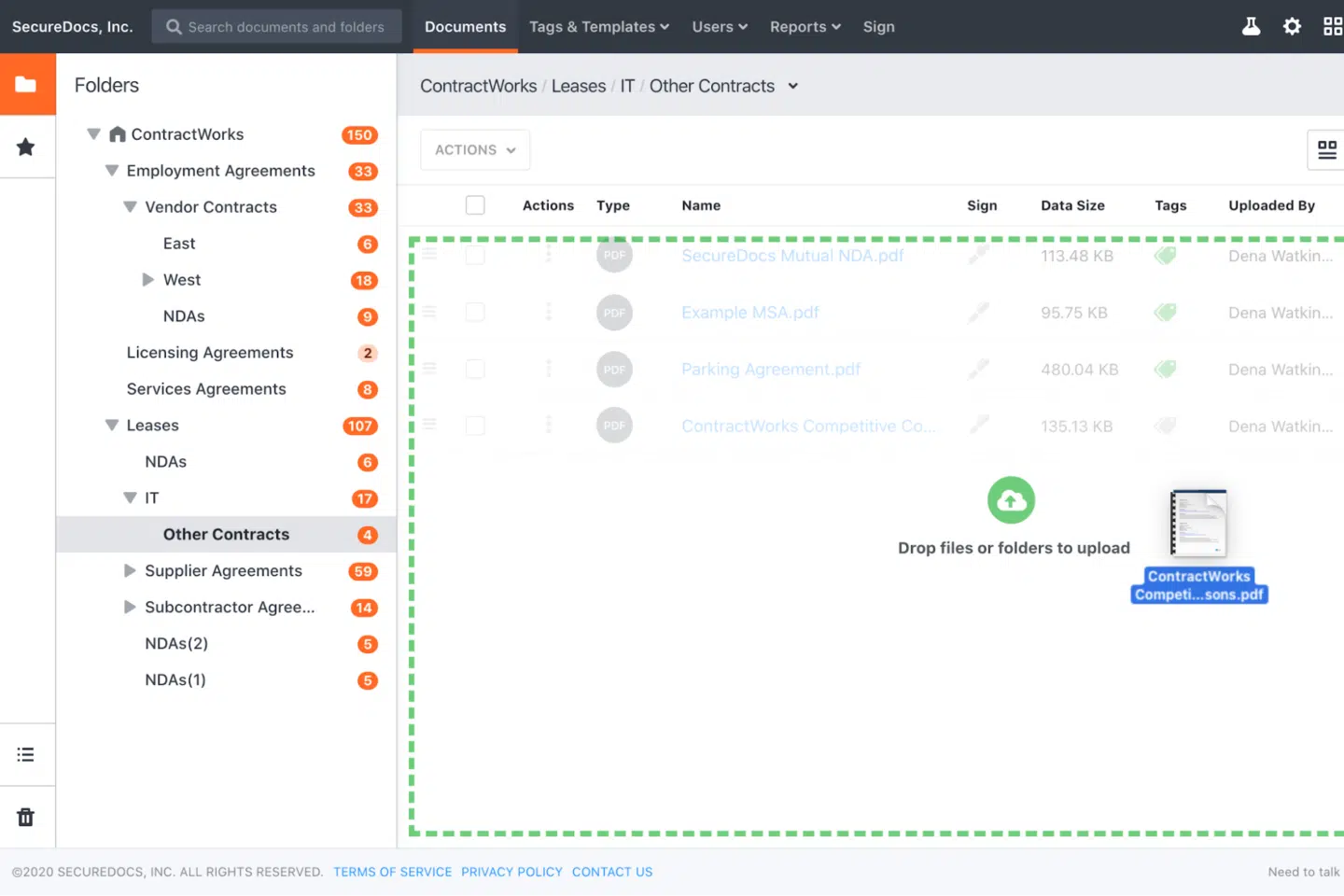
Best for: teams that need to organize signed contracts, track renewals, and improve repository control without a large CLM rollout.
ContractWorks, now part of Onit, is not a full contract lifecycle platform. It’s built for secure storage, search, AI-assisted tagging, milestone alerts and basic signing with limited pre-signature capabilities.
ContractWorks focuses on secure contract repository management, smart document tagging, OCR-supported contract outlines, automatic key-field tagging, alerts, built-in e-signature and fast setup. Its AI is built in-house and helps reduce implementation time, improve navigation through long agreements and surface key terms faster.
If your main problem is signed contracts scattered across shared drives and missed renewal dates, ContractWorks can solve that without the cost and complexity of a large enterprise CLM deployment.
Key features
- Centralized repository
- OCR and smart tagging
- Alerts for renewals, milestones and key dates
- Built-in e-signature
- Unlimited users
How it compares to Ironclad: ContractWorks is much simpler and more repository-focused than Ironclad. It’s a better fit when the main problem is organizing signed contracts, tagging key metadata, tracking deadlines and improving search without a large CLM rollout.
Pricing: from $600/month billed annually, unlimited users.
Icertis
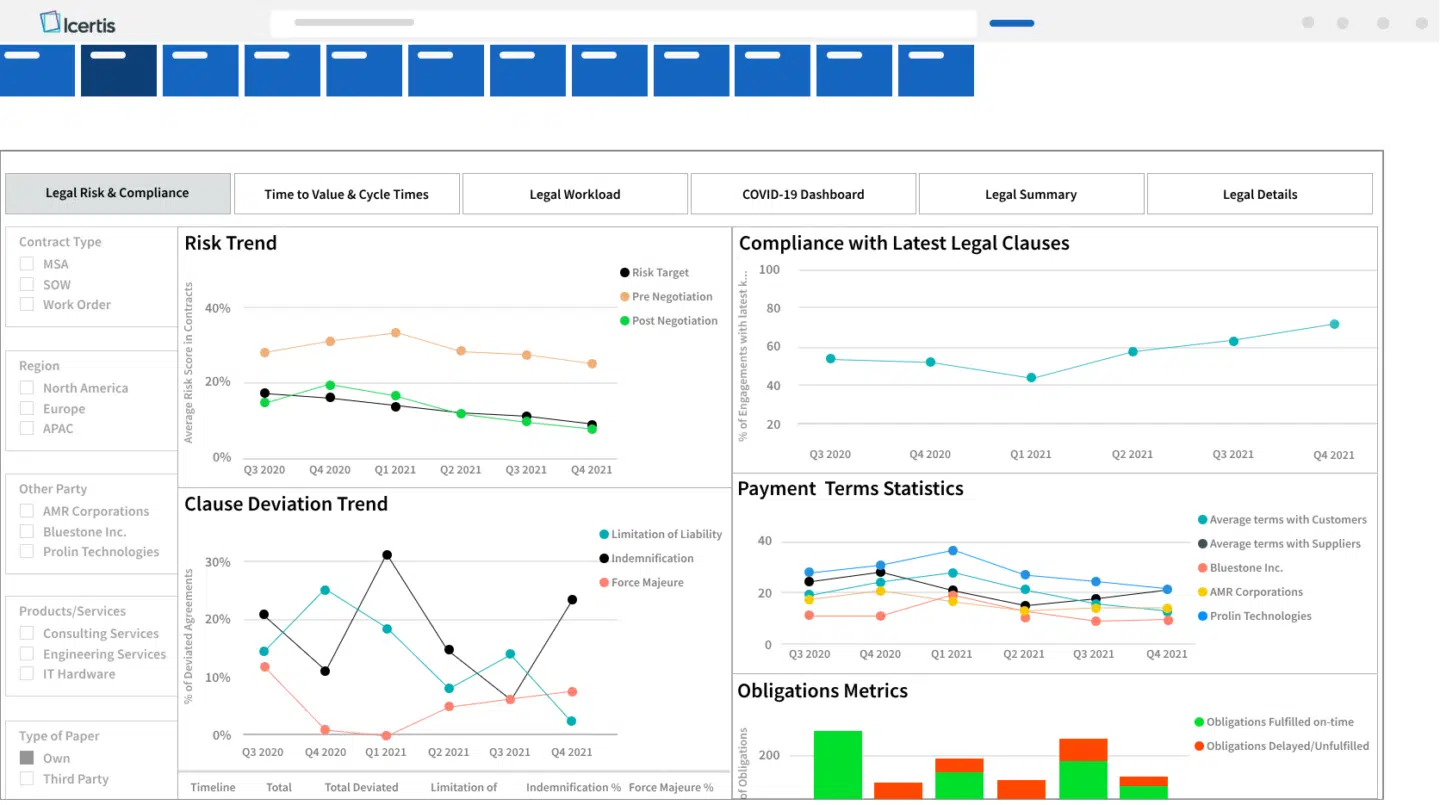
Best for: global enterprises managing high contract volumes, multiple business units, complex obligations and strict governance and regulatory requirements.
Icertis works best for enterprise-scale contract management. Companies dealing with global operations, regulatory complexity, multiple entities, large supplier or customer bases and detailed obligation management will find it useful.
The scalable governance also means it may be too heavy for companies that need a faster, more business-user-friendly contract workflow.
Key features
- Enterprise obligation management
- Industry and compliance support
- Vera Copilot, Vera Agents, Vera Analytics/Insights for risk, obligation and portfolio intelligence
- Multi-entity, multi-language and multi-regulation support
- Integrations across SAP, Microsoft and Salesforce
How it compares to Ironclad: Icertis is stronger for large-scale enterprise governance and complex global cooperations. Ironclad may feel more approachable for legal and procurement teams that need a governed CLM hub without the same level of global enterprise complexity.
Pricing: custom.
Sirion
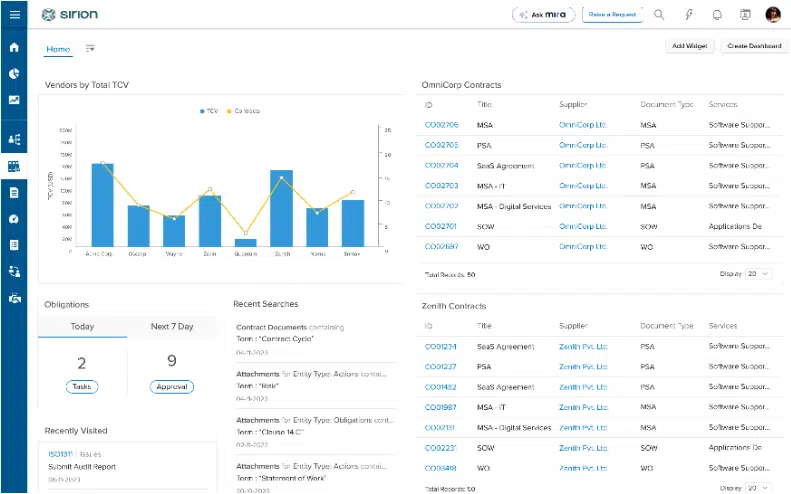
Best for: enterprises that want AI-led contracting and strong post-signature obligation management.
Sirion is an AI-native enterprise CLM platform with conversational contracting features and agentic workflows. AskSirion lets users ask plain-language questions, draft contracts, build playbooks, review clauses, redline agreements, extract metadata, track obligations, and monitor performance. Sirion’s agentOS supports purpose-built agents, including Search, Draft, Issue Detection, Redline, Playbook, Extraction, Obligations and Invoice agents.
Key features
- AskSirion conversational interface
- AI repository and contract centralization
- Search Agent with explainable, source-linked answers
- Draft Agent for negotiation-ready drafts
- Issue Detection and Redline Agents
- Playbook Agent
- Extraction Agent for structured contract data
- Obligations Agent for commitments and deadlines
- Invoice Agent for contract-term/payment reconciliation
- Performance, governance and risk management
How it compares to Ironclad: Sirion has more agentic features and is more post-signature/performance-oriented than Ironclad, with conversational AI across repository, contract drafting, redlining, obligations and invoice checks. Ironclad is better suited as a governed legal workflow hub with strong workflow design, Salesforce-connected contracting, and legal AI via Jurist.
Pricing: custom.
How to choose the right Ironclad alternative
The right platform choice depends less on feature count and more on how contracts should work inside your company. When evaluating the different options, ask yourself:
- Does contract data move both ways between the CLM and your CRM? Many tools “integrate” by attaching a signed PDF to a record or pushing limited fields in one direction. That’s not the same as connected contract data. Ask what syncs and when, and what happens when data changes.
- Which system stays the source of truth? If sales works in Salesforce, HubSpot, Microsoft Dynamics or Pipedrive, the contract workflow should not force reps to rebuild data in a separate tool. Decide whether the CRM, the CLM or another system owns pricing, product, counterparty and renewal data.
- Can teams edit contracts without version chaos? If every negotiation means downloading a file, editing in Word, re-uploading, resending and reconciling versions, the process will slow down as volume grows. Test the actual workflow with a real agreement.
- What happens after the signature? Signing is not the end of the contract lifecycle. That’s when obligations, renewals, billing, supplier commitments and compliance responsibilities become active. Ask vendors to show post-signature workflows on realistic data.
- Who will own the platform after launch? Enterprise CLM systems can be powerful, but they need ownership. If legal operations, RevOps, procurement or IT cannot maintain workflows and data quality, the platform may become just another system people work around.
- What will the cost look like at twice your current volume? Ironclad doesn’t publish pricing, and third-party purchase data suggests core platform quotes can range from tens of thousands of dollars for smaller deployments to $200,000+ annually for large enterprise setups, before implementation, advanced AI, analytics, integrations and training. Whatever platform you choose, model the renewal cost before signing the first contract.
Pick a contract platform that keeps data moving, not just documents organized
Ironclad is a strong choice for companies that want a centralized CLM hub with governed workflows, repository control, approvals, e-signature, analytics and legal AI through Jurist. It fits best when legal, procurement or contract operations need structure, and the company has the budget, time and ownership to configure the platform properly.
The limitation is that many companies need contracts to serve as connected business data, rather than static files managed in a separate place. Sales needs contract terms in the CRM. Finance needs accurate data for invoicing and revenue recognition. Procurement needs supplier obligations. HR needs employee agreement history. Operations need current, usable renewals, commitments and risk signals.
That’s where Oneflow stands apart from most Ironclad alternatives—by keeping contracts live, structured and connected across the entire quote-to-cash and hire-to-retire workflows. Teams can create, negotiate, sign, track and analyze contracts while keeping the systems they already use at the center.
If your goal is more legal control, Ironclad deserves a reconsideration. If the goal is contract data that flows across the business, Oneflow is more relevant.
Want to see how that would work in your organization? Book a Oneflow demo to see how it can reduce your manual contract work.
FAQs
What is the best Ironclad alternative for sales and revenue teams?
Oneflow is the strongest fit for sales and revenue teams that need contract data connected to CRM workflows. Native integrations with Salesforce, HubSpot, Microsoft Dynamics and Pipedrive help teams create, negotiate and sign contracts while keeping commercial data connected to the systems finance and RevOps rely on.
Why do people switch from Ironclad for contract lifecycle management?
Common reasons include setup complexity, a learning curve for new users, search issues when metadata is inconsistent, friction in editing documents with Word or PDFs, and mixed results of some AI-supported workflows. Some companies also want contract data to live more closely to CRM, finance, procurement and HR processes rather than inside a separate CLM hub.
Is Ironclad contract management software expensive?
Ironclad doesn’t publish standard pricing. Vendr data suggests core platform quotes of around $40,000–$80,000 for smaller deployments, $50,000–$120,000 for some mid-market buyers and $200,000+ annually for larger enterprise deployments. Implementation, integrations, advanced AI, analytics and training can increase the first-year cost significantly.
How long does it take to implement an Ironclad alternative?
It depends on the platform category. Lighter tools such as Oneflow, Juro, SpotDraft and ContractWorks can usually move faster than enterprise-heavy platforms (weeks). Systems such as Ironclad, Conga CLM, Icertis and Sirion typically require more planning, configuration, integrations, testing and training (months).
.png?id=40edbc9ee25345a211152388fdcf1fd2)

.png?id=073897979970647cd034d6db96c145de)